

- HOME
- Taxes & compliance
- What are the benefits of UAE eInvoicing for finance teams?
What are the benefits of UAE eInvoicing for finance teams?
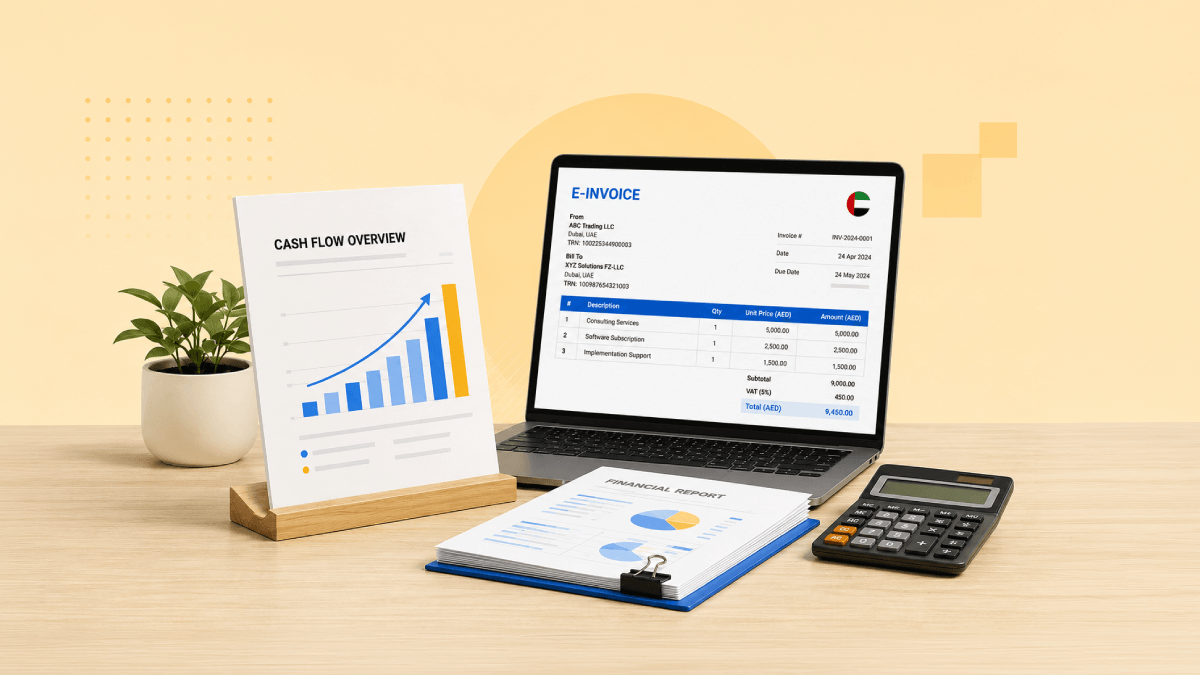
UAE eInvoicing is mandatory. Businesses with revenue of AED 50 million or more go live on 1 January 2027, and smaller businesses follow on 1 July 2027. So the practical question for a finance team is not whether to comply. It is whether eInvoicing brings any value beyond compliance, and how to tell.
The short answer is yes, but most of the value depends on what you do with it. eInvoicing replaces PDF and paper invoices with structured data sent between Accredited Service Providers (ASPs). That data is easier to process, check and store. But it does not change your approval process, your collections process or your month-end close by itself. The benefits appear when you adjust those processes to use the new data.
This guide sets out the benefits the Ministry of Finance (MoF) describes, which ones arrive automatically, which need work, what eInvoicing will not fix, and how to measure the results.
What benefits does the Ministry of Finance expect from eInvoicing?
Section 4 of the UAE Electronic Invoicing Guidelines, version 1.1 (Guidelines v1.1) lists the benefits of the system. Most are policy goals for the country: better tax compliance, more transparency and better audits, a better taxpayer experience, less manual work in tax reporting, lower costs, economic growth, and near real-time data for government decisions.
The same section also lists benefits for businesses:
• "Reduced processing time as compared to paper invoice cycles."
• "Fewer commercial disputes since standardized formats significantly reduce data entry errors."
• "Faster payment cycles and cash flow brought in by electronic approval workflows."
• "Savings in archival and retrieval due to digital retention."
• "Improved audit response times arising from easier searchability."
Read these as possibilities. Each one depends on your processes. Faster payment cycles, for example, come from electronic approval workflows, not from the invoice format alone.
Which eInvoicing benefits come automatically, and which need work?
It helps to sort benefits into three groups.
Group | What it means | Examples |
Automatic | Comes with eInvoicing itself, with no process change | Structured data on every in-scope invoice; a confirmation when the buyer's ASP receives your invoice; tax data reported to the Federal Tax Authority (FTA) through your ASP |
Needs process changes | Appears only if you change how the team works | More invoices posted without manual entry; lower cost per invoice; faster approvals; fewer disputes; easier reconciliation; faster close |
Longer term | Needs most customers and suppliers on eInvoicing, clean master data and some investment in reporting | Better cash flow forecasts; spend and revenue analysis; smarter exception handling |
The automatic benefits are safe to plan on. Put the second group in your plan only with a starting number and a target. Keep the third group for later.
How can eInvoicing help accounts payable?
Accounts payable (AP) sees the first change, because structured invoices start arriving whether or not AP has changed anything.
Under step 6 of section 5.1 of Guidelines v1.1, the buyer's ASP delivers the invoice to the buyer in an agreed format. This is usually the XML file plus a readable copy. Because the data arrives in fixed fields, there is no need to type in or scan in-scope invoices.
Matching, approval and exception handling do not change by themselves. They still need purchase orders, goods receipts, correct supplier records and clear tolerance rules. For the AP workflow, see AP eInvoicing in the UAE.
Two measures show whether AP is gaining:
• First-time match rate: the share of invoices posted without anyone correcting them.
• Touchless rate: the share of invoices that go from receipt to payment approval without manual work. This depends more on purchase order discipline and tolerance rules than on the invoice format.
How can eInvoicing help accounts receivable and cash flow?
For accounts receivable (AR), the main gain is certainty that the invoice arrived.
When the buyer's ASP receives and validates your invoice, it sends a confirmation back through your ASP. That confirmation removes "we never received your invoice" as a reason for late payment. It gives your collections team a dated record of delivery.
It does not change payment terms or how willing a customer is to pay. UAE eInvoicing rules do not set payment terms. Those come from your contract. Days sales outstanding (DSO) still depends on credit terms, disputes, collections work and the customer's ability to pay.
eInvoicing can help with disputes. Standard formats mean fewer data entry errors, and confirmed delivery removes some disagreements. Disputes about price, quantity or quality continue as before. For the AR workflow, see AR eInvoicing in the UAE.
How does eInvoicing help with reconciliation, month-end close and audits?
A structured invoice is easier to reconcile than a PDF. Line items, tax categories and identifiers always sit in the same fields. That helps your general ledger, VAT return and audit records match sooner.
Records must still be kept for the required period. Under section 5.4 of Guidelines v1.1, a taxable business keeps eInvoices for five years after the end of the tax period, or seven years for real estate. The records can be stored in the cloud, as long as the FTA can retrieve them in a complete and readable form. See UAE eInvoice retention periods and audit records.
One simple measure: pick any invoice number and time how long it takes to produce the full record, including the invoice, its confirmations and any credit notes. If that time drops after go-live, you have a real benefit to report.
Does eInvoicing improve controls and reduce invoice fraud?
It improves some controls and leaves others unchanged.
What it changes: invoices travel between accredited providers instead of by email, and each ASP checks every invoice against the UAE specification. The FTA also receives tax data from both the supplier's ASP and the buyer's ASP. That makes some kinds of manipulation harder.
What it does not change: eInvoicing does not approve a supplier, confirm that goods arrived, stop collusion inside a business, or catch a fake purchase order. Segregation of duties, supplier checks, three-way matching and approval limits remain your responsibility.
Can structured invoice data improve finance reporting?
Yes, over time. Early reports will look much like the ones you have today. Once enough invoices flow through the system and your master data is clean, the data can show spending patterns, dispute trends, payment behaviour by customer and cycle times by supplier.
There is also a cross-border angle. The UAE format, PINT AE, is the UAE version of the Peppol International (PINT) model. This can make it easier to work with trading partners in other Peppol countries. But each country sets its own specification, so a UAE invoice is not automatically accepted everywhere. The benefit depends on how much you trade with Peppol-connected businesses abroad.
What will eInvoicing not fix?
Be clear about the limits. eInvoicing does not fix:
• Late payers. Customers who pay late today will still pay late.
• Bad master data. A wrong TRN, an old bank detail or a badly set-up chart of accounts stays wrong.
• Weak approvals. eInvoicing gives your approval process cleaner inputs. It does not add approval controls.
• Missing goods receipts. Three-way matching still needs a record of what arrived.
• Integration cost. Connecting your systems to an ASP is a real project with real cost.
• Customers who are not live yet. Until a buyer joins eInvoicing, you issue the eInvoice to the fixed address 0235:9900000098 and also send a regular Tax Invoice by PDF or paper, under section 10.2.2 of Guidelines v1.1. The wider benefits grow as more of your customers and suppliers go live.
How should you measure the benefits of eInvoicing?
Give each benefit a starting number, a target, an owner and a data source. Without these, you cannot show the value six months after go-live.
Record the starting numbers before go-live, ideally averaged over a full quarter. Give each target to a named team, such as AP, AR, the controller or tax. Take the data from a system, not a spreadsheet someone updates by hand.
These nine measures are a good starting set:
Measure | What it counts | Unit | Data source | Owner |
First-time match rate | Received invoices posted without manual correction | % of AP volume | AP system | AP manager |
Exception rate | Invoices sent to the exception queue | % of AP volume | AP system | AP manager |
Touchless rate | Invoices from receipt to payment approval with no manual step | % of AP volume | AP and workflow system | AP manager |
Cost per invoice | Total AP cost divided by the number of invoices | AED per invoice | Cost centre and AP volume | Finance |
Invoice cycle time | Days from receipt to approval, or to payment | Days | AP system | AP manager |
Disputes | Number of disputed invoices and median time to resolve | Count and days | AR ledger | AR manager |
Days sales outstanding (DSO) | Standard DSO | Days | AR ledger | Treasury |
Month-end exceptions | Reconciliation breaks at month-end | Count | Close checklist | Controller |
Record retrieval time | Time to produce the full record for one invoice | Minutes | Document storage system | Tax or controller |
Review these every quarter in the first year, then once a year. Set targets as ranges rather than single numbers.
In what order do eInvoicing benefits usually appear?
Benefits tend to arrive in stages. How fast you move depends on your invoice volume, the state of your master data, your systems and when your customers and suppliers go live.
Stage | What the team is doing | What success looks like |
1. Go-live and settling in | Running the new process, fixing onboarding issues and clearing exceptions | No penalties, and a complete record for every in-scope invoice |
2. Process changes | Updating AP matching, AR collections, reconciliation and close to use the structured data | Better match rates, touchless rates, cycle times and fewer month-end exceptions |
3. Longer-term value | Using invoice data for analysis, forecasting and smarter exception handling | Better forecasts, tighter working capital and less audit effort |
Trying for stage 3 before stage 1 is stable rarely works. The data has to be clean and consistent first. For how structured data can support analytics and AI later, see from compliance data to AI-ready finance.
Zoho Software Trading LLC is a Ministry of Finance-accredited eInvoicing service provider for the UAE, with accreditation number 121988, as shown on the MoF register of accredited service providers. Most of the benefits in this guide come from changing how AP, AR and the close work, which is easier when the system connected to your ASP is the same one your team uses every day.
Explore UAE eInvoicing with Zoho Books
Frequently asked questions
Will eInvoicing reduce days sales outstanding (DSO)?
Not directly. DSO depends on credit terms, collections and how customers pay. eInvoicing removes "we never received it" as an excuse and gives you a dated delivery record. That helps only if your collections team uses it.
How should you measure cost per invoice?
Take the total AP cost, including salaries, systems and a share of overheads, and divide it by the number of invoices processed in the same period. Measure over a full quarter before go-live and calculate it the same way afterwards.
Does eInvoicing stop payment disputes?
No, but it reduces some. Disputes about a missing invoice, an unreadable invoice or missing details become less common. Disputes about price, quantity, quality or credit terms continue as before.
How should a smaller business approach the benefits?
Businesses with revenue below AED 50 million go live on 1 July 2027. Start with the automatic benefits: structured data, delivery confirmations and a complete record. Then target the manual tasks that take most of your team's time. Leave analytics and forecasting for later, once you have enough data.
Related guides
• How does UAE eInvoicing change AP, AR and month-end close?
• AP eInvoicing in the UAE: receiving, matching and processing invoices
• AR eInvoicing in the UAE: issuing, tracking and correcting invoices
• UAE eInvoice retention: periods, storage and audit records