

- HOME
- Taxes & compliance
- UAE eInvoicing self-billing: rules, workflow and what to confirm first
UAE eInvoicing self-billing: rules, workflow and what to confirm first
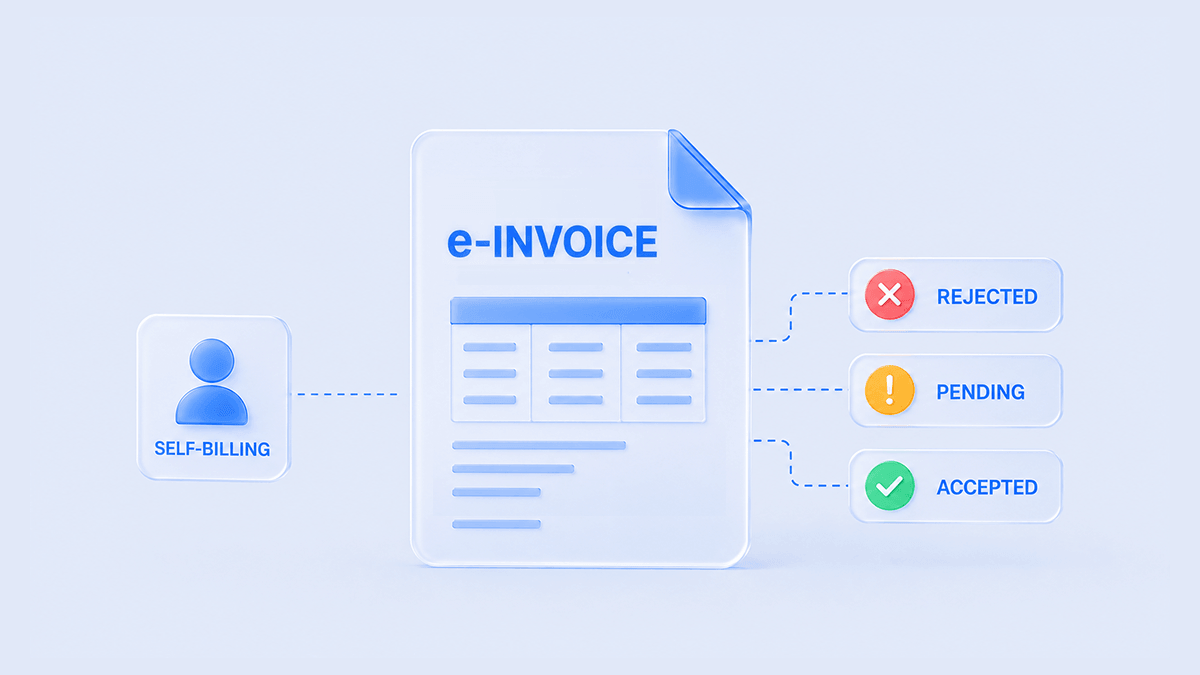
A waste-management company weighs each supplier's delivery at the gate and prices it against an agreed rate card. It pays out based on its weighbridge reading, not an invoice the supplier sent in. A freight aggregator settles with independent drivers the same way: its system calculates what's owed and produces the paperwork. In both cases, the supplier never writes their own invoice.
Under UAE eInvoicing, this arrangement has a name: self-billing. Normally, the supplier issues the Electronic Invoice and sends it through an Accredited Service Provider (ASP) for validation and reporting to the Federal Tax Authority (FTA). Self-billing lets the buyer do that instead, under an agreement between the two. It comes with its own, narrower set of conditions than a standard Electronic Invoice.
This guide covers those conditions: who can rely on self-billing, what has to be confirmed before treating an arrangement as safe to run, and who carries the compliance risk if it goes wrong. For the full step-by-step invoice flow, see How UAE eInvoicing works: the 5-corner model, end to end. For how corrections and credit notes work more generally, see UAE eInvoicing credit notes and corrections; this guide only covers the one correction document specific to self-billing, the self-billed Tax Credit Note.
Who is eligible to self-bill under UAE eInvoicing, and what does it change?
The Ministry of Finance's (MoF) Guidelines v1.1 is direct about the Value Added Tax (VAT) conditions: “The self-billing of electronic Tax Invoices will require the buyer to be on the Electronic Invoicing System. Self-billing arrangements only apply for VAT purposes under the conditions within the VAT Decree-Law and are not available for suppliers who are not registered for VAT. Hence, there is no option for self-billing of Commercial Invoices.”
Two things follow. First, self-billing only ever produces a self-billed electronic Tax Invoice or a self-billed electronic Tax Credit Note. It never produces a Commercial Invoice or its credit note. That is because self-billing applies for VAT purposes, while a Commercial Invoice covers sales that don't require a Tax Invoice at all—an exempt or out-of-scope supply, or a sale by someone who isn't VAT-registered.
Second, each side has its own precondition. The supplier must be VAT-registered. The buyer must already be onboarded to the Electronic Invoicing System, not merely willing to issue on the supplier's behalf.
The Guidelines add one further condition: self-billing happens "subject to an agreement between the supplier and the buyer." Once a supplier is in scope for mandatory Electronic Invoicing under the roll-out plan, that condition applies to every business transaction it makes, self-billed ones included.
How is a self-billed invoice identified under UAE eInvoicing?
A self-billed invoice isn't a standard Electronic Invoice with a flag added to it. It's issued under a separate specification, PINT AE Self-Billing (the UAE's Peppol-based self-billing format), and carries its owndocument type codes. Neither that specification nor Guidelines v1.1 names a dedicated self-billing indicator field. The document type code and the specification it's issued under are what identify it as self-billed, not a marker on an otherwise-ordinary invoice.
The two self-billing document type codes, confirmed directly against Peppol's specification pages:
Self-billed document | Document type code |
Self-billed electronic Tax Invoice | 389 |
Self-billed electronic Tax Credit Note | 261 |
How a self-billed invoice moves
The buyer prepares the invoice from the agreed supply details.
The buyer's ASP validates it and sends it to the supplier through the supplier's ASP.
Both ASPs report the tax data to the FTA, and each party checks its confirmations.
The supplier reconciles the invoice against its own records, and any difference goes through the agreed correction process.
The supplier is still the seller named on the invoice, even though the buyer sent it.
Configuring self-billing into an enterprise resource planning (ERP) or accounting system means configuring against this separate specification directly, not treating it as an option on the standard Billing one.
What does a self-billing agreement need to establish before you rely on it?
Guidelines v1.1 requires an agreement between supplier and buyer, but it doesn't spell out what that agreement has to contain. The following isn't a legal template. It's a list of what's confirmed as necessary before relying on one:
● Both parties' VAT registration status. Self-billing isn't available at all where the supplier isn't VAT-registered.
● The buyer's Electronic Invoicing System onboarding status, checked against the current roll-out phase, not assumed from an earlier conversation.
● A signed agreement authorizing the buyer to issue Electronic Invoices on the supplier's behalf, since Guidelines v1.1 conditions the whole arrangement on one existing.
● A plan for what happens if either party's onboarding timing shifts, covered in the mistakes to avoid below.
What should you check before you rely on a self-billing arrangement?
Four checks are worth running before you treat an arrangement as safe:
● Confirm the buyer is onboarded, not just willing. Guidelines v1.1 requires the buyer to already be on the Electronic Invoicing System. If it isn't, the arrangement needs modifying or pausing until it is, rather than continuing as though nothing has changed.
● Assuming an existing arrangement carries forward automatically once a supplier reaches its mandatory phase. It doesn't: a self-billing arrangement that predates a supplier's mandatory phase isn't grandfathered in.
● Applying self-billing to a Commercial Invoice or another exempt, out-of-scope supply. Guidelines v1.1 rules this out directly: self-billing only ever applies where VAT registration already applies.
● Confirm both parties know who carries the eInvoicing obligation. Under a self-billed arrangement it sits with the buyer, which reverses what most people assume.
Who's responsible if a self-billed invoice goes wrong?
Guidelines v1.1's responsibilities table (Section 5.2) draws a specific distinction. In a standard arrangement, the supplier alone is responsible for exchanging and reporting Electronic Invoices, and for calculating their values. Under a self-billing arrangement specifically, that responsibility moves to the buyer for both activities. The table's footnote states it plainly: the compliance obligation “remains with the supplier (or buyer in the case of self-billed invoices).” Self-billing doesn't just delegate a task; it relocates the compliance obligation.
Be precise about what moves. The footnote allocates the eInvoicing obligation, not every tax duty the supplier has. The supplier still accounts for its supplies, files its returns, and keeps its records. What shifts to the buyer is the obligation to issue, exchange and report the electronic document, and to calculate its values.
The penalty for an eInvoice not issued or sent on time is AED 100 per invoice, capped at AED 5,000 per month. Read alongside the responsibility allocation, that points the eInvoicing exposure at the buyer in a self-billed arrangement. It doesn't make the supplier's other obligations disappear, and a supplier relying on self-billing has a direct interest in the buyer's eInvoicing readiness rather than treating it as someone else's problem.
Self-billing is a permitted way to run invoicing under UAE eInvoicing, not a way around the mandate. It has its own eligibility conditions, its own document type, and a responsibility allocation that surprises people used to the supplier issuing the invoice. Agree in writing who checks the invoice, how errors get corrected, and who watches the exchange and reporting confirmations.
Zoho Software Trading LLC is an Accredited Service Provider for UAE eInvoicing.
Explore UAE eInvoicing with Zoho Books.
Frequently asked questions
What is self-billing under UAE eInvoicing?
An arrangement, subject to an agreement between supplier and buyer, where the buyer issues the Electronic Invoice on the supplier's behalf instead of the supplier issuing it directly. It only applies for VAT purposes and requires the buyer to already be on the Electronic Invoicing System.
Can any buyer self-bill on a supplier's behalf?
No. The supplier must be VAT-registered, and the buyer must already be onboarded to the Electronic Invoicing System. Self-billing also never applies to a Commercial Invoice, because a Commercial Invoice covers sales that don't require a Tax Invoice—exempt or out-of-scope supplies, and sales by someone who isn't VAT-registered.
What document type codes identify a self-billed invoice?
389 for the self-billed Tax Invoice, 261 for its self-billed Tax Credit Note, both under the separate PINT AE Self-Billing specification, not a flag on a standard invoice.
Who is responsible for compliance if a self-billed invoice goes wrong?
The buyer, for the eInvoicing obligations. Guidelines v1.1's responsibilities table assigns the buyer both the exchange and reporting of the document and the calculation of its values when an invoice is self-billed, and its footnote places the compliance obligation with the buyer in that case. The supplier still has its VAT accounting and record-keeping duties, which self-billing does not move.
What happens if the buyer hasn't onboarded to eInvoicing yet?
The buyer has to be onboarded before it can issue a self-billed eInvoice. If the supplier's mandatory date arrives first, review the arrangement and agree a compliant process with your ASP rather than continuing as though nothing has changed.
Related guides
● How UAE eInvoicing works: the 5-corner model, end to end
● UAE eInvoicing credit notes: rules for correcting an Electronic Invoice
● UAE eInvoicing glossary: PINT AE, Peppol, ASP, TIN, MLS and more