

- HOME
- Taxes & compliance
- UAE eInvoicing for VAT groups and intercompany billing
UAE eInvoicing for VAT groups and intercompany billing
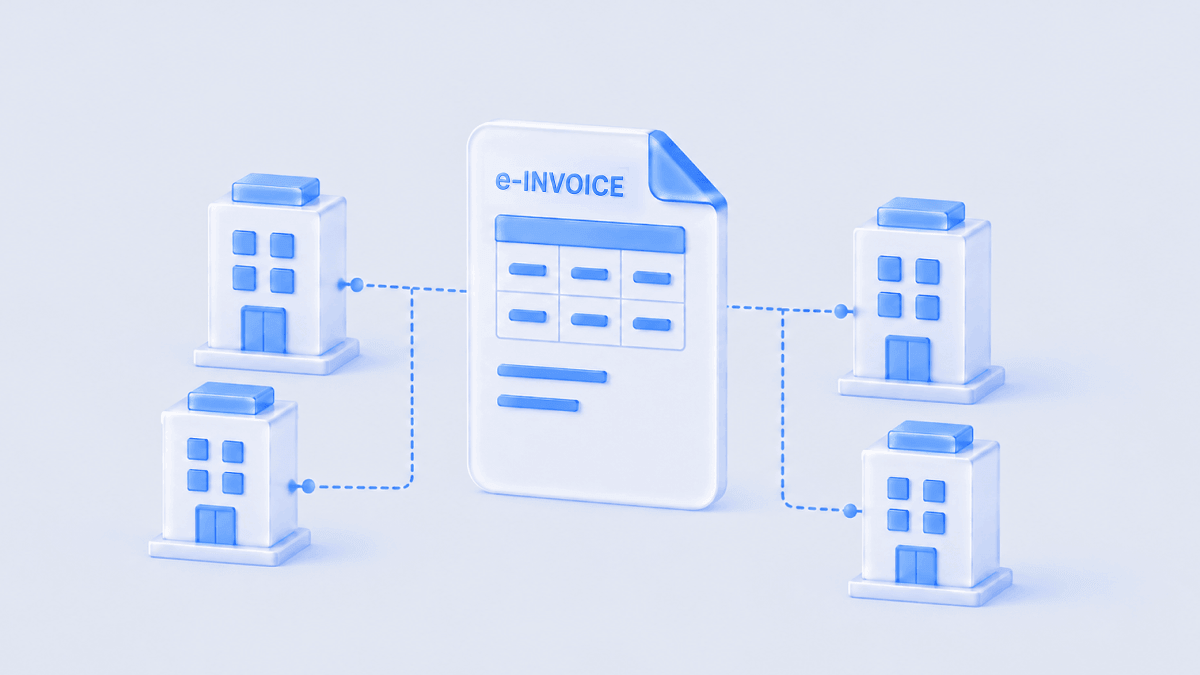
If your companies file VAT as a group, you may have heard that invoices between them get a two-year break from UAE eInvoicing. That is true, but the break is narrower than many groups assume. It covers invoices between members of the same VAT group, and nothing else.
UAE eInvoicing replaces PDF and paper invoices between businesses with structured data files. They are exchanged through Accredited Service Providers (ASPs) and reported to the Federal Tax Authority (FTA). For a group, three questions decide what applies:
• Are the companies members of the same VAT group, registered with the FTA?
• Is the transaction between two members, or with someone outside the group?
• Which phase applies to each company's sales to outside customers?
This guide answers each one, and explains how related companies that are not in a VAT group invoice each other.
Quick answer: Invoices between members of the same VAT group have a grace period from 1 January 2027 to 1 January 2029. Every other invoice, including those between related companies outside the group, follows the normal deadlines. Each group member needs its own Tax Identification Number (TIN) and is onboarded separately.
What is a VAT group in the UAE?
A VAT group, called a Tax Group in the law, is two or more businesses registered with the FTA as a single taxable person. The group files one VAT return through a representative member. Supplies between members are disregarded for VAT, so no VAT is charged on them.
Article 14 of the VAT Decree-Law sets three conditions for forming one:
• Each business has a place of establishment or fixed establishment in the UAE.
• The businesses are related parties.
• One or more of them controls the others.
Common ownership alone does not create a VAT group. The businesses must apply, and the FTA can refuse where the conditions are not met or where the group would be used to avoid tax. The FTA can also register related businesses as a Tax Group on its own initiative, based on their economic, financial and regulatory ties. So the group's boundary is not only your choice. Check your EmaraTax records to confirm which companies are actually members.
What does the 24-month VAT group grace period cover?
Section 6.3.2 of the Ministry of Finance (MoF) Electronic Invoicing Guidelines v1.1 gives a temporary grace period for Business Transactions between members of the same VAT group. It runs from 1 January 2027 to 1 January 2029. After that, full eInvoicing requirements apply to those transactions.
What | When |
Sales to outside customers, members with gross income of AED 50 million or more (Phase 1) | Mandatory from 1 January 2027 |
Sales to outside customers, members with gross income below AED 50 million (Phase 2) | Mandatory from 1 July 2027 |
Invoices between members of the same VAT group | Grace period, 1 January 2027 to 1 January 2029 |
Invoices between members of the same VAT group | Mandatory from 1 January 2029 |
The grace period does not cover:
• Sales to customers outside the group.
• Purchases from suppliers outside the group.
• Invoices between related companies that are not members of the same VAT group.
Phases are set by gross income. If members of your group fall on both sides of AED 50 million, the simplest plan is to prepare every member for the Phase 1 dates. The grace period does not move any member's deadline for outside sales.
Does each VAT group member need its own TIN and ASP?
Yes. Onboarding for eInvoicing works per member, not per group. Section 9 of the Guidelines states: "Each Tax Group member will have their own TIN, which is used to generate their individual Peppol participant identifier. Each of the group members may onboard with a different ASP."
Your TIN is the first 10 digits of your own Tax Registration Number (TRN). It is not taken from the group representative's TRN. Your Participant Identifier, your address on the Peppol network that carries eInvoices, is 0235 followed by that TIN. Your ASP creates it after you start onboarding through EmaraTax, the FTA's portal. Our guide to EmaraTax onboarding shows each step.
What happens when a company joins or leaves a VAT group?
Appendix 3 of the Guidelines asks businesses to promptly tell their ASP about "changes in circumstances like joining or leaving a Tax Group." Update your EmaraTax details and your ASP at the same time as the VAT change.
Joining or leaving also changes how the company's intercompany invoices are treated:
• A company that joins a VAT group gets the grace period for its invoices to other members, until 1 January 2029.
• A company that leaves is no longer a member, so its invoices to former members are ordinary business invoices. They follow the normal rules from the date it leaves.
If you plan to add or remove a member, set up its intercompany invoices for the new treatment from the date the change takes effect.
How do related companies outside a VAT group invoice each other?
Many groups have companies that share an owner but are not in the same VAT group. They invoice each other in the same way as unrelated businesses. Each follows its own eInvoicing phase from the start, with no grace period.
The VAT treatment follows the supply itself: standard-rated, zero-rated, exempt or outside the scope of VAT. There is no special intercompany rate.
One rule targets pricing between related parties. Article 36 of the VAT Decree-Law, "Value of Supply for Related Parties", replaces the invoiced price with market value when both of these are true:
• the price charged is below market value; and
• the buyer cannot recover the VAT in full.
If either condition is not met, the invoiced price stands.
How do the rules compare for group members, related companies and third parties?
| Members of the same VAT group | Related companies, not in the same VAT group | Unrelated businesses |
VAT on the supply | Disregarded, no VAT charged | Normal rules. Article 36 can replace a low price with market value | Normal rules |
eInvoicing | Required, with the grace period until 1 January 2029 | Required from each company's own phase | Required from each company's own phase |
TIN and ASP | Each member has its own TIN and may choose its own ASP | Each company has its own TIN and ASP | Each company has its own TIN and ASP |
How should a group prepare its intercompany eInvoicing?
Map every company in the group. Mark which are VAT group members and which are related but registered separately.
For each company, confirm its TIN, its phase and its ASP. Decide whether all members will use one ASP or different ones.
For related companies outside the VAT group, review intercompany prices against the two Article 36 conditions.
Make sure every company can issue and receive eInvoices to and from outside parties by its own deadline.
Set up and test invoicing between VAT group members well before 1 January 2029. Leaving it to the last months of the grace period repeats the go-live pressure.
Reconcile intercompany balances against the eInvoices actually exchanged, as you would for any customer or supplier account.
What mistakes should groups avoid?
• Assuming the grace period covers all intercompany invoices, when it covers only members of the same VAT group.
• Using the group representative's TRN to work out a member's TIN, instead of the member's own TRN.
• Assuming the VAT group contains only the companies you chose, when the FTA can register related companies on its own initiative.
• Letting outside sales slip because intercompany invoices have more time. Each member's outside sales follow its own phase.
How can Zoho Books help a group of companies?
Each company in your group needs an ASP, whether or not it is in a VAT group. Zoho is an Accredited Service Provider on the Ministry of Finance's register, and Zoho Books is its accounting software for UAE businesses.
Explore UAE eInvoicing with Zoho Books
Frequently asked questions
What happens at the end of the grace period?
From 1 January 2029, invoices between VAT group members must be issued and exchanged as eInvoices like any other business invoice. The penalties in Cabinet Decision No. 106 of 2025 then apply to them in the same way.
Are invoices to group companies outside the UAE covered?
Yes. A sale by a UAE company to a group company abroad is an export, and exports are in scope. When the foreign company has no Peppol ID, the eInvoice uses the fixed buyer address 0235:9900000099. Only members of a UAE VAT group, which must be established in the UAE, get the grace period.
Does a VAT group file one eInvoicing registration for all members?
No. The group files one VAT return, but eInvoicing onboarding is per member. Each member completes its own onboarding through EmaraTax and gets its own Participant Identifier.
Related guides
• UAE eInvoicing scope, exemptions and the AED 50 million threshold
• UAE eInvoicing for SMEs vs large enterprises
• UAE eInvoicing onboarding through EmaraTax: steps and identifiers