- HOME
- CPQ (Configure, Price, Quote)
- CPQ (Configure, Price, Quote): Definition, and why it matters | Zoho Billing
CPQ (Configure, Price, Quote): Definition, and why it matters | Zoho Billing
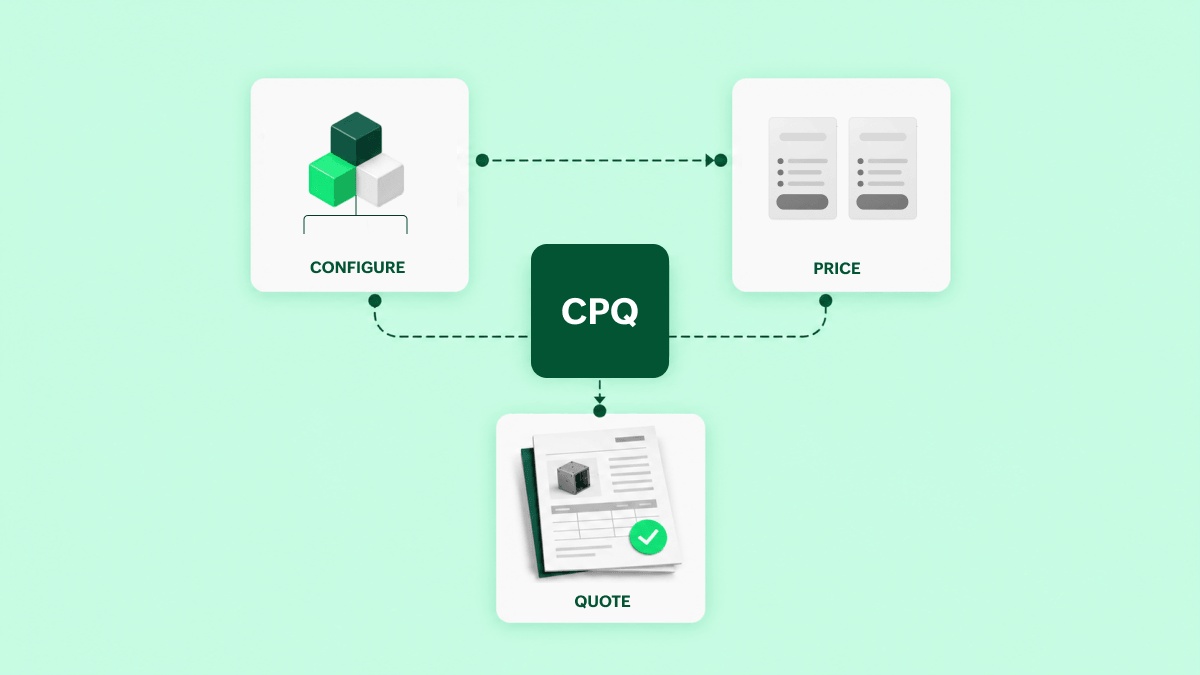
Configure, Price, Quote (CPQ) automation is something that most businesses come to require at scale. Because, until a certain point, sales teams and finance teams are used to handling the processes manually as there are limited deals. Then comes the request for a unique bundle, a custom term length, or a discount — which eventually multiplies and grows at a rate where the process of manually customizing a quote with these requirements becomes monotonous and time-consuming. This is the space CPQ fills — what you sell to customers and raising the accurate quote.
What exactly is CPQ?
CPQ stands for configure, price, quote. It refers to the process (and the software that runs it) of configuring plans, add-ons, and currency in the backend based on customer requirements, applying the right price to it, and producing a quote that the sales team can send and finance can stand behind.
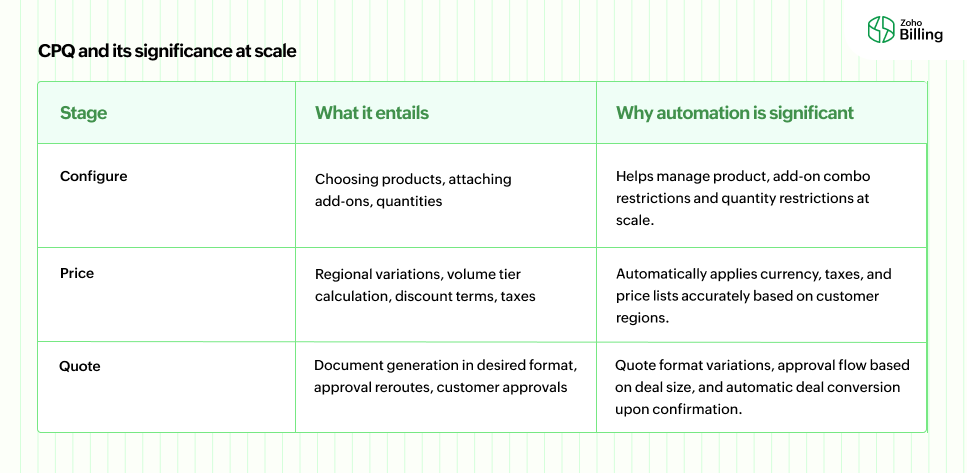
Configure: Configuring a product catalog and choosing the products, plans, add-ons, quantities, and terms the customer actually wants. All the while, the system blocks combinations that are not sellable or not supported.
Price: Applying list prices, contracted rates, volume tiers, currency, taxes, promotional terms, and discount limits.
Quote: Generating the document itself, with line items, validity dates, and terms, then moving it along for acceptance, signature, and eventually an invoice.
CPQ is often described as a sales tool, though in practice, it behaves more like a translation layer. It takes commercial policy (what you charge, who gets what discount, which bundles are allowed) and converts it into something a salesperson can execute without having to memorizing a rule book, as it is codified into the system they daily use.
Simple scenario: With and without a CPQ tool
Say a customer wants 180 licenses on an annual plan, a premium support tier, and a 60-day payment term because their procurement team insists on it.
Without CPQ, the rep builds this by hand, checks the volume slab with a colleague, asks finance whether 60 days is allowed, and sends a PDF. With CPQ, the 180 licenses automatically land in the correct slab, premium support gets attached only because the plan supports it, the 60-day term triggers an approval request, and the quote carries a single version number that everybody downstream can trace.
Same deal, but handled differently. And the benefits will start to show in the long term.
Why modern businesses are automating CPQ much earlier in their journey
With opportunities, the challenges businesses face today have grown too, warranting a need for CPQ automation.
Global markets are more accessible than they have ever been, and businesses now reach customers across regions within months of launch, that too in considerable volume. This means, a 30-person company can be selling in four currencies, under two tax regimes, with usage-based and flat-fee plans running side by side. All of these heavily weigh down the teams who take care of global deals and multicurrency pricing. The workflow complexity that used to appear only inside large enterprises arrives much earlier now due to such reasons.
The pressure is coming from the buyer's side too. Forrester's Buyers' Journey Survey from 2025 found that 73% of purchases involve three or more departments, with an average of 13 people inside the buying organization and nine from outside taking part in the decision. Every one of those people can ask a question that changes the shape of the quote. A quoting process built without accounting for the back-and-forth's invited by such a large number of stakeholders, will not hold up to that.
Then there is the money itself. McKinsey's analysis puts a 1% price increase at an operating profit uplift of 6 to 14%, while a 5% price drop needs an average 21% volume increase just to break even. This shows how a seemingly small number has a humongous impact on the organizational revenue goals at higher volumes. Small, undisciplined concessions at the quote stage start compounding, and they can compound against you. Due to factors like this, CFO's are also getting more involved in CPQ, which used to be a predominantly sales space.
So the goal is clear: clean, structured, rule-based quoting data, powered by CPQ automation. Even if AI and agents step into this arena down the line, this becomes the prerequisite every business has to build.
Signs your quoting process is ready for this
A few patterns show up without even having to do a formal audit:
Deals start to involve too many variables and conditions that sales reps have to refer to documents or ask individuals questions over chat more frequently.
The additional steps (taxes, currency conversions, seasonal promotions) invited by regional variations, begin to cause errors in quotes.
Two customers on comparable deals are paying noticeably different amounts, and the "why" is hard to trace. This warrants another case where processes are people-centric and organizations lose key information when they leave.
Finance regularly corrects invoices because what was quoted and what was contracted drifted apart during the long sales process.
Deals stall at the approval stage and it gets hard to pin point on whose desk it currently is.
Launching a new plan takes weeks, because configuration and the rules are scattered across sheets, tools, and minds.
If you are facing these, your quoting process has probably outgrown your current process and a quoting software can serve you better.
Benefits of automating CPQ for different stakeholders
Advanced CPQ does more than just firefighting and keeping day-to-day processes smooth. The benefit shows in the form of improved cross-sell and upsell flow via guided selling, insights into buyer preferences, and better experiences for the prospects. Here's how different stakeholders benefit from automating CPQ.
Sales teams
Sales have the most visible impact, as CPQ covers almost all repetitive work so they could spend more time on the actual conversation, vetting out the best solution for cohorts. This guided configuration also means that even a newer rep can build a complex deal correctly in their first month, and it removes a lot of awkward "let me check and get back to you" pauses mid-call.
Deal desks & revenue operations
A huge benefit here stems from the pricing policy being centralized. When discount bands, bundles, and term rules are configured once, changing them becomes a well-planned update that doesn't cause operational disruptions.
Finance and compliance
Quotes are the part where the prospects turn into customers; they don't indicate an end. It carries the structure that invoicing and revenue recognition need. The handoff from signed quote to subscription to invoice happens without hiccups, which closes off a common source of leakage and reconciliation work at month's end. On top of this, audit trails are clearly documented at every stage.
Product and pricing teams
Running a pricing experiment gets easier and faster. You can introduce a new tier for one region or one cohort, analyze what it does to deal size and win rate, and then roll it back (or wider) without pulling in the engineering teams for minor changes.
Customers
They get a faster, clearer document that matches what they discussed. That sounds minor until you compare it with waiting a week for a revised quote with three line items they do not recognize. It reduces a ton of hidden frustration that they might harbor when these processes stretch.
How various industries are leveraging CPQ
SaaS and subscription businesses
The complexity is commercial rather than physical. Tiers, seats, usage meters, ramp deals, mid-term upgrades, and multi-year commitments all have to resolve into a billing schedule. CPQ is where that schedule gets defined.
Professional and managed services
Rate cards by role, by seniority, or by region are often blended into a single engagement. Quoting these by hand is how margin disappears without anyone noticing until the project closes.
Telecom and connectivity
High volume, heavily bundled, frequently promotional — pricing changes often enough that manual maintenance is not realistic past a certain scale.
Logistics and distribution
Freight, fuel surcharges, zone-based rates, and customer-specific agreements that change quarterly. CPQ keeps the quoted rate and the invoiced rate in agreement.
How platforms like Zoho Billing help with CPQ automation
CPQ is a key process that helps close the deal fast and without headaches. And that's where a new set of complexities arise. The quote should turn into revenue, which means the quoting layer and the billing layer need to understand each other. Many organizations run these separately and spend a surprising amount of effort keeping them synchronized.
Zoho Billing takes care of both without having to stitch tools together and worrying about integrations failing. Plans, add-ons, recommendations, pricing models, and discount structures are defined once as part of your product catalog in Zoho Billing. Then the quote is built from the same objects which will also drive the subscription and the invoice.
A few billing things that follow from that:
Usage-based, tiered, flat-fee, and hybrid models can coexist in the same quote without workarounds.
Mid-term changes (upgrades, downgrades, add-ons) recalculate against the original agreement rather than starting from scratch.
Multicurrency and tax handling are applied at quote time, so the number the customer sees doesn't confuse them.
Revenue recognition picks up the contract structure directly, which keeps compliance work from becoming a manual reconstruction exercise.
Moreover, Zoho Billing operates within the wider Zoho ecosystem where key operations draw from a single source. An operational core where your inventory, CPQ, billing, CRM, revenue recognition, and other essential operational systems stay connected, process efficiency can go a long way.
How AI is bringing innovation in CPQ
As always, AI's value in anything is directly proportional to the quality of the data that is available for it to work on. In CPQ, that is the catalog, the quotes you build, and what your customers purchase. AI's value in CPQ comes from learning from records and putting that to work at the moment of the deal. For example, it can suggest the bundles that similar customers actually bought.
Another huge impact comes out of anomaly finding — for example, flagging a discount that cuts deeper than comparable deals. Now the rep's focus moves away from entering the information into the system and resides in making judgment that boosts revenue.
But for any of this to happen, the data needs to be clean. Because, AI can only amplify the existing setup. If what is stored happens to be impartial historical data, efficiency magnifies or the inverse happens. This is also why clever businesses are structuring their quoting data before ever touching anything related to AI.
Where to begin if you are considering this
Quoting is at the crucial point where all your product strategies and sales team's efforts reflect. After that, it becomes a real commitment as they become your customer. Getting that moment right is more than a reasonable place to put your next improvement. You can begin by analyzing the quote you send most often. Map out how it gets built today, count the number of people it touches, and note every point where someone has to ask a question before they can proceed. If there is data on this already, then that is your gold mine on identifying current gaps. This map usually makes the case on its own, and it gives you something concrete to configure first rather than attempting to revamp the whole catalog at once.
If you would like to understand how Zoho Billing takes care of everything end-to-end, from setting up your pricing plans to raising quotes, invoices, and collecting revenue, connect with our experts here. They will listen to your business requirements and help you with a customized demo with features that matter to you.
Frequently Asked Questions
A CRM tracks deals and relationships, and billing software handles invoices and collections. CPQ sits between them, turning deal requirements into an accurate, policy-compliant quote. Connecting all three keeps the quote, subscription, and invoice consistent throughout the lead/customer lifecycle.
On a high level, look for flexible pricing models like tiered, usage-based, and hybrid models. Also check multicurrency and tax handling, approval workflows, and quote-to-invoice continuity. Easy rule updates without developer help also matter. But it trickles down to what your priority is and what gives you more ROI, because everything looks useful at a point.
Yes. Selling across regions or running multiple pricing models can create enterprise-level complexity even in a small team. Starting with your most frequent quote type (which also determines how advanced your CPQ tool needs to be) keeps the rollout manageable.