

- HOME
- Enterprise
- The FTC's click-to-cancel rule: The recent movements in the US subscription world
The FTC's click-to-cancel rule: The recent movements in the US subscription world
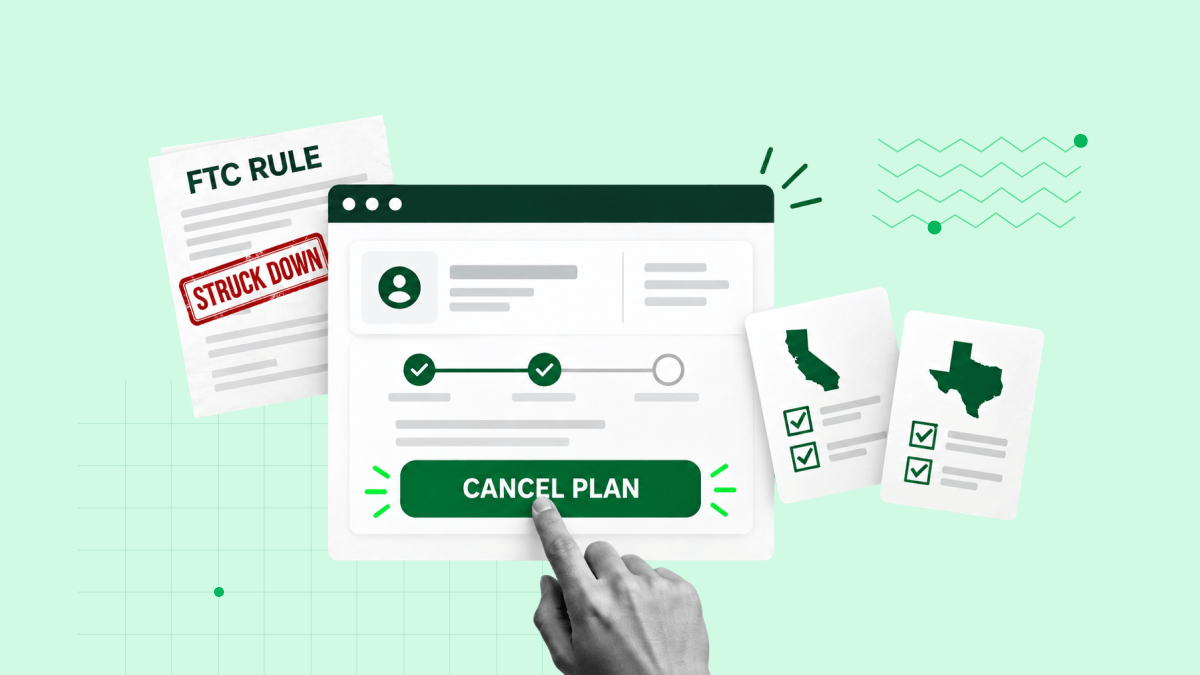
There have been various rules, controls, and lawsuits around onboarding practices and subscription cancellations which has kept all businesses, regardless of size, treading around this matter carefully. A slip up here can cost millions or even billions depending on the issue and the size of the organization.
One popular example is Amazon Prime's $2.5 billion FTC settlement in 2025: a $1 billion civil penalty and $1.5 billion in consumer refunds for deceptive enrollment and intentionally complex cancellation processes that affected 35 million customers.
If you run any kind of subscription business in the US, you've probably heard "click-to-cancel" tossed around a lot in the last two years, usually followed by some confusion about whether it's actually a rule you need to follow. Fair enough, because the answer keeps changing.
The short version: A federal rule was finalized, then got struck down in court based on a procedural technicality, essentially a paperwork step the FTC skipped during rulemaking. While that federal legal battle was playing out, states went ahead and passed their own versions. So the federal rule is off the table (for now), but the underlying push isn't. It's just living at the state (and now city) level.
This article's goal is to explain what is actually going on and what it means if you sell anything on a recurring billing model.
What is the click-to-cancel (CTC) rule?
Negative Option Rule, popularly known as the "click-to-cancel" rule. The core idea was simple: If a business lets customers sign up for a subscription online in a couple of clicks, it should let them cancel just as easily, not force them into a phone call, a retention agent, or a maze of settings pages to do it.
The rule would have also required clear, upfront disclosure of subscription terms and affirmative consent before charging anyone, meaning no pre-checked boxes doing the enrolling on a customer's behalf. But, it never fully took effect because it was vacated by the US Court of Appeals for the Eighth Circuit in 2025 after it was found that the FTC skipped necessary procedural steps as well as a mandatory cost-benefit analysis.
How this can benefit consumers and businesses
It's easy to frame this purely as a consumer win, but that misses half the picture. Difficult cancellation flows do generate short-term revenue, but they also generate a slow build-up of resentment, chargebacks, and reputational damage that shows up later, often in a class action or churned customers who are gone for good.
California's Automatic Renewal Law alone has been the backdrop for lawsuits against fairly recognizable names, and multi-million dollar settlements aren't rare in this space anymore. So the compliance conversation isn't just about avoiding a fine. It's about not letting your cancellation flow become the reason customers stop trusting your billing practices altogether.
The Minnesota Star Tribune moved cancellation online after initially worrying it would hurt them. Instead, they saw an online save rate of 18.5%, a full 10 percentage points higher than what their call center was converting.
None of this is to say the rule (or its state versions) are painless to implement. For enterprises running multiple product lines, currencies, and billing systems, rebuilding a cancellation flow to be genuinely one-step isn't trivial. But treating it as a pure downside isn't accurate either. In the long run, this helps businesses score high on customer satisfaction ranks, which will eventually contribute to revenue that sustains.
A quick timeline overview of the FTC's click-to-cancel rule
Here's what actually took place, from the beginning.
September 24, 2024: California Governor Gavin Newsom signs an amendment to the state's Automatic Renewal Law, adding its own click-to-cancel requirement.
October 2024: The FTC finalizes its amended Negative Option Rule, the click-to-cancel rule, citing rising complaints about difficult cancellations.
May 2025: The FTC delays enforcement of most of the rule from May 14 to July 14, 2025.
July 1, 2025: California's amended provisions take effect for consumers in the state.
July 8, 2025: The Eighth Circuit vacates the entire rule, six days before it was due to take full effect, while noting it wasn't endorsing deceptive subscription practices, but based on the fact that the FTC skipped a required cost-benefit analysis during rulemaking.
February 12, 2026: The FTC restores its narrower, pre-2024 version of the Negative Option Rule as a placeholder.
March 13, 2026: The FTC opens a new rulemaking notice, signaling it intends to rebuild the rule with the missing analysis done upfront this time.
So, as things stand today, there's no active federal click-to-cancel rule. But that's a gap in process, not a change in direction, and it's certainly not a sign that regulators have moved on from the issue. The key thing to notice is that the states and cities aren't waiting for Washington to sort it out.
Which states already have some version of this in place ?
At least nine states (not an exact number), have click-to-cancel style requirements already on their books, and depending on how you count related automatic renewal provisions, other trackers put the number closer to 20 states with some form of subscription cancellation law.
Here are a few worth knowing by name:
California has had their Automatic Renewal Law for years, but its 2024 amendment specifically added the click-to-cancel language, effective July, 2025. It applies to consumer (B2C) contracts entered into or renewed after that date.
Colorado requires a "one-step online cancellation link" under its Online Cancellation Act, effective for consumer subscriptions as of August 2025, and extended to cover business-to-business (B2B) subscriptions from February, 2026.
Massachusetts brought in a regulation effective September 2025 requiring pre-renewal notices 5 to 30 days ahead of any charge, for subscription terms longer than 31 days.
Illinois, Minnesota, Vermont, Oregon, Maryland, Tennessee, Virginia, and a handful of others also have automatic renewal law statutes on record, with varying degrees of strictness around save offers, disclosure timing, and what counts as a "simple" cancellation method.
Which states have recently rolled it out
A few states moved on this more recently, which is worth flagging separately since compliance teams may not have caught up yet.
Connecticut's automatic renewal law, similar to that of other states, took effect July, 2026.
New York State amended its General Business Law (Part W of S-3008), effective November 5, 2025. It requires advance notice before any subscription price increase, and gives customers 14 days to cancel and get a prorated refund if they weren't given that notice.
Then, there's New York City, which took things a step further than any other jurisdiction. In July 2026, New York City Mayor Zohran Mamdani and the city's Department of Consumer and Worker Protection finalized a municipal click-to-cancel rule, the first of its kind in the country, set to take effect October 1, 2026.
The city's own estimate, based on analysis from the Roosevelt Institute, puts potential annual savings for New Yorkers somewhere between $21.5 million and $162.5 million, a fairly wide range that says more about how hard this is to measure than anything else.
Which states are planning to bring this in
A handful of states currently without a dedicated law have bills sitting in committee. Michigan introduced its own click-to-cancel bill in August 2025, and it's currently before the House Committee on Economic Competitiveness. Texas, Georgia, and Pennsylvania reportedly have similar automatic renewal law bills pending in their 2026 legislative sessions, several of which are said to be modeled loosely on California's approach.
At the federal level, the Click to Cancel Act was reintroduced in Congress in August 2025 by a bipartisan group of representatives, with companion legislation in the Senate. It hasn't moved much since, while the states are rolling out rules on their own.
What you should ensure, regardless of where you operate
The defaults and consequences
As mentioned before, malpractice around cancellations can incur a huge penalty on a business. Chegg, an EdTech Provider, had to pay $7.5 million to settle FTC allegations concerning unlawful cancellation practices. Likewise, Adobe reached $150 million settlement in a US lawsuit over termination fees and difficult subscription cancellations.
Since the applicable law depends on where your customer lives, not where your company is headquartered, a national subscription business is effectively subject to the strictest rule in its customer base, whether it intends to be or not. Here are a few things worth having in place regardless of the state-by-state patchwork:
Configurations to avert compliance fires
Once you are clear about what is required, the next thing you should do is think about how to codify those in your day-to-day processes.
Compliance, here, runs across three touchpoints that need to stay in sync: the website or app where the subscription starts, the policy documents that set expectations, and the billing system that actually runs the recurring charge underneath all of it.
On the website, some businesses provide login options with dedicated portals. This is an area where the customer expects to find the unsubscribe option easily accessible. Some states require one-click to cancel, some require you to mirror the sign up flow—make sure the flow is set.
On policy, your terms of service and subscription disclosures need to spell out the price, billing cadence, and cancellation steps clearly, ideally in the same place a customer signs up.
A few things that can be incorporated into your billing system:
Trigger renewal and price-change notices automatically, timed to each state's specific notice window, rather than one blanket policy applied everywhere.
Let a cancellation initiated online end the subscription immediately, without needing a manual step from an agent on the back end. A billing system's portal makes sure of this.
Send an automatic cancellation confirmation to the customer the moment it's processed to close the loop so there's no dispute later over whether a request actually went through.
A business doesn't need to rebuild its system from scratch every time a new state law lands, provided the billing platform was built with this kind of flexibility from the start. That's part of what Zoho Billing is designed for: letting businesses configure cancellation flows, renewal notices, and consent logging around whichever law applies, without an engineering sprint every few months.
If you'd like to see how it fits into your existing setup, connect with our experts.
Frequently Asked Questions
The Federal Trade Commission (FTC) is a US federal agency that enforces consumer protection and antitrust law. Its consumer protection mandate covers unfair or deceptive business practices, which is the authority it used to write the Negative Option Rule, better known as the click-to-cancel rule. Even without an active federal click-to-cancel rule right now, the FTC can still act against deceptive subscription practices under its existing statutory powers, along with laws like the Restore Online Shoppers' Confidence Act (ROSCA). FTC has penalized fairly recognizable names for malpractice with multi-million dollar settlements.
It's a municipal rule adopted by the city's Department of Consumer and Worker Protection (DCWP) on July 10, 2026, following Mayor Zohran Mamdani's Executive Order 10. It takes effect from October 1, 2026, and requires any business offering automatic renewal or continuous service subscriptions to New York City consumers to provide a simple, straightforward way to cancel, largely mirroring what New York State's law already requires, but with its own citywide enforcement authority and civil penalties. It's the first rule of its kind adopted by a US city rather than a state or the federal government.
There's no single federal standard right now, so the specifics vary, but a few patterns show up across most state amendments: Cancellation has to be at least as easy as signing up (often called the "symmetry" requirement), businesses need affirmative consent before enrolling someone in a subscription, and customers need clear disclosure of price, billing frequency, and renewal terms upfront. Some have also added requirements around advance notice before a price increase, and some require explicit consent before a save offer can even be shown during cancellation.