

- HOME
- Revenue Recognition
- What is ASC 606 revenue recognition? Key cases and distinctions
What is ASC 606 revenue recognition? Key cases and distinctions
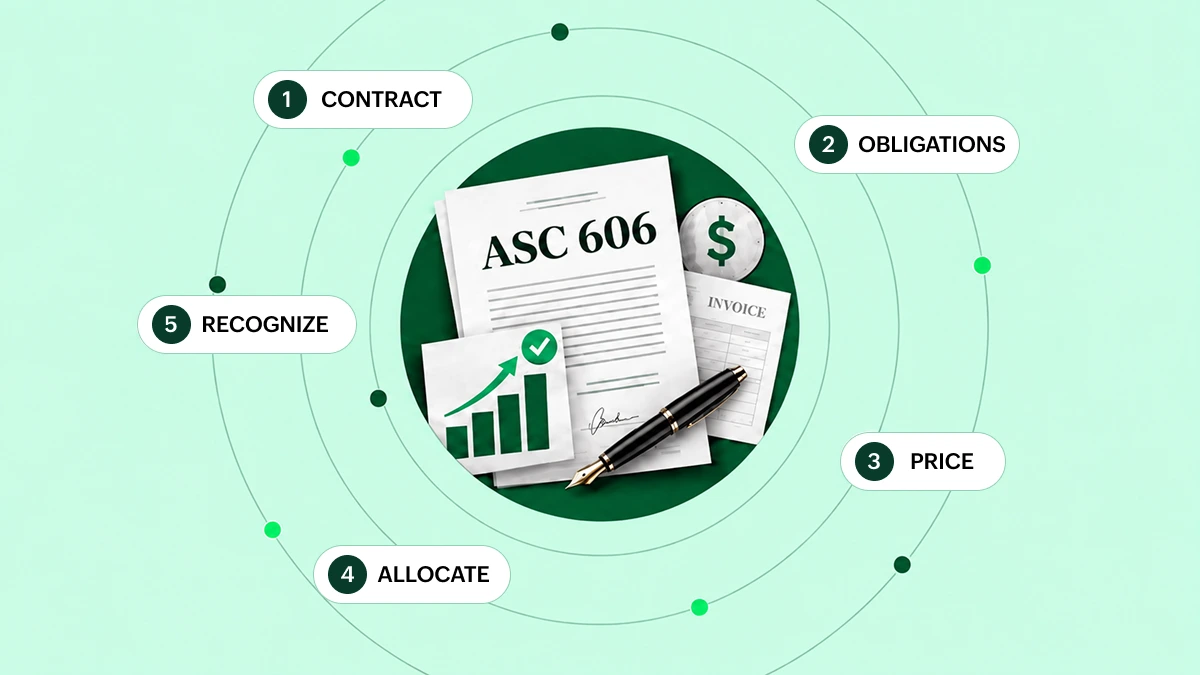
For any US business selling on contracts, ASC 606 decides when money on a contract actually becomes revenue on the books. Getting that timing wrong misstates how the business is actually performing. This guide covers what ASC 606 requires, where it gets into the most detail, and how it lines up against its international counterpart, IFRS 15.
What is ASC 606?
ASC 606, formally titled Revenue from Contracts with Customers, is the revenue recognition standard under US GAAP (Generally Accepted Accounting Principles), issued by the Financial Accounting Standards Board (FASB). It applies to any entity reporting under US GAAP—public or private, nonprofits included—across essentially every industry. Public companies adopted it for annual periods beginning after December 15, 2017, while private companies got an extra year. In general, ASC 606 gives more leeway for private companies than IFRS 15 does.
It runs on the same five-step model used internationally:
Identify the contract. Both parties have approved it, rights and payment terms are clear, and collecting payment is probable. A signed order form works, but so does a purchase order matched to a confirmation email, as long as those conditions are met.
Identify the performance obligations. Each distinct promise to deliver a good or service gets accounted for on its own. A sale bundled with installation and a service warranty usually counts as three separate obligations, not one lump sum.
Determine the transaction price. The amount the business expects to receive for delivering on the contract, including variable components like usage fees or rebates. A contract charging a fixed service fee plus usage-based overage has to estimate that overage too, not just the fixed part.
Allocate the transaction price. Split that price across the performance obligations based on what each would sell for standalone. A $10,000 contract covering equipment, installation, and a service plan gets divided proportionally, not assigned arbitrarily to whichever line is easiest.
Recognize revenue. Record revenue as, or when, each performance obligation actually gets satisfied. A one-time setup fee might be recognized upfront, while an ongoing service portion gets recognized evenly across the contract term.
Learn more about the foundational five-step model that global standards like IFRS 15, ASC 606, and Ind AS 115 are all built on.
Where ASC 606 gets specific
Variable pricing needs an up-front, conservative estimate.
Usage tiers, rebates, and credits mean the price isn't fixed upfront, unlike the fixed offerings where you know how much you will earn for sure. ASC 606 requires "estimating" it early, but only the portion a business is confident about, so revenue doesn't get booked now and reversed later.
There are two prescribed methods: the expected value method and most likely value method. Historical data or cohort analysis are common ways to get there. In case the data is insufficient, and if there is higher probability for any marked revenue to be reversed in future, then the value can be kept at zero. At the end of each reporting period, the estimate can be revisited as more data comes in, and a firmer number will take its place.
A few opt-in shortcuts cut down the busywork.
Recognition is simply writing "I earned x amount on y day," which translates to defining two things: how much and when. Within that "how much" lives the definition of what money is actually yours. In such cases, the taxes which are paid to the government can have an option to be not included under revenue at all so that you don't have to struggle with reconciling them. Under ASC 606, businesses can elect, once, to exclude sales tax from the transaction price.
Similarly, the post-sale shipping can be treated as a plain cost (order or service fulfillment costs) rather than a separate obligation.
Disclosures go beyond the income statement.
ASC 606 requires breaking revenue into categories, showing contract balances like receivables and deferred revenue, and disclosing what's promised but not yet delivered. This clearly determines how much you are owed, how much you owe, and how busy you will be.
Private companies get lighter requirements, while the public companies get scrutinized a lot more as there are huge number of stakeholders.
How it lines up against IFRS 15
ASC 606 and IFRS 15 came out of a joint FASB-IASB project aimed at closing the gap between US and international revenue rules, and they align closely on the core model. Where they still differ tends to show up during multi-entity reporting:
Aspect | ASC 606 (US GAAP) | IFRS 15 (IFRS Accounting Standards) |
Effective date | Public entities: periods beginning after Dec 15, 2017. Private entities: after Dec 15, 2018 | All entities: periods beginning on or after Jan 1, 2018 |
Collectability threshold | Historically read closer to a near-certainty standard | "More likely than not," a comparatively lower bar |
Sales tax and shipping expedients | Explicit policy elections available | No equivalent blanket elections; assessed case by case |
Contract cost impairment | Reversal not permitted once recognized | Reversal permitted if circumstances improve |
Disclosure relief for private entities | Reduced disclosure package available | Same disclosures apply regardless of size, barring IFRS for SMEs |
Where subscription businesses feel this most
Subscription businesses run into these rules more often than most, since prepaid annual contracts, recurring commissions, and usage-based add-ons are built into how they operate. A business collecting a full year's payment up front has to track that as deferred revenue and release it as service is delivered, not the moment the cash lands. Plan upgrades, downgrades, mid-term changes, and bundles trigger a fresh look at performance obligations and transaction price each time they happen. Sales commissions tied to renewals also keep that capitalized cost asset in near-constant motion, since every renewal resets the clock on amortization. For a business selling one-off contracts, these rules apply occasionally. For a subscription business, they're closer to a routine part of the billing cycle.
Why this matters
These mechanics don't stay theoretical for long once a business scales. A company growing its sales team runs straight into the commission capitalization question. One expanding into new markets runs into the tax election. One preparing to report to investors or lenders runs into the disclosure requirements. Getting ASC 606 right isn't a one-time exercise done at adoption; it's a standing part of how contracts get priced, sold, and reported from here on.
Zoho Billing is built to apply the right recognition rules, audit trails, and disclosures that automatically saves a lot of manual reconciliation, especially for businesses managing this at scale. Connect with our experts to see how it can operationalize your organization's revenue recognition policy.
Frequently Asked Questions
ASC 606 is a revenue recognition standard and a set of principles that define when the money collected from a customer actually counts as "earned" revenue. It helps businesses not book revenue too early or too late, so the numbers actually reflect what's been delivered so far.
Pretty much any US business that reports under US GAAP has to follow ASC 606, no matter the size or industry.
Not really. It's meant to be a one-time call, not something you flip back and forth on deal by deal. Once you decide to leave sales tax out of your revenue numbers, you're expected to stick with that approach going forward rather than treating each contract differently.