

- HOME
- Revenue Recognition
- Gift card revenue recognition: Handling uncertainties and breakages
Gift card revenue recognition: Handling uncertainties and breakages
Festivals and gifting seasons earn businesses tons of cash in the name of gift card sales. Sales and marketing teams love coming up with various combinations with rules for gift cards to make it as attractive as they can to the customers. Predictably, you see your cash flow increase, the customers are happy, but you haven't delivered anything yet. And this is why gift card revenue complicates things for accountants and finance leaders who have to take care of revenue recognition.
A gift card here is just the record of a promise that you made to deliver the services in a stipulated time. So, until that handover happens, the money belongs on the liability side of your balance sheet. The scale of these promises is easy to underestimate. A Bankrate survey found 43% of US adults were holding at least one unused gift card, voucher, or store credit, averaging $244 a person, totaling roughly $27 billion in obligations that businesses have collected on and not settled.
The hard part for a finance team or a business leader is that the release of this liability into revenue depends on what your customers choose to do, and you have no control over those actions. So before getting anywhere near accounting treatment, it helps to map the routes.
Possible paths a gift card can take
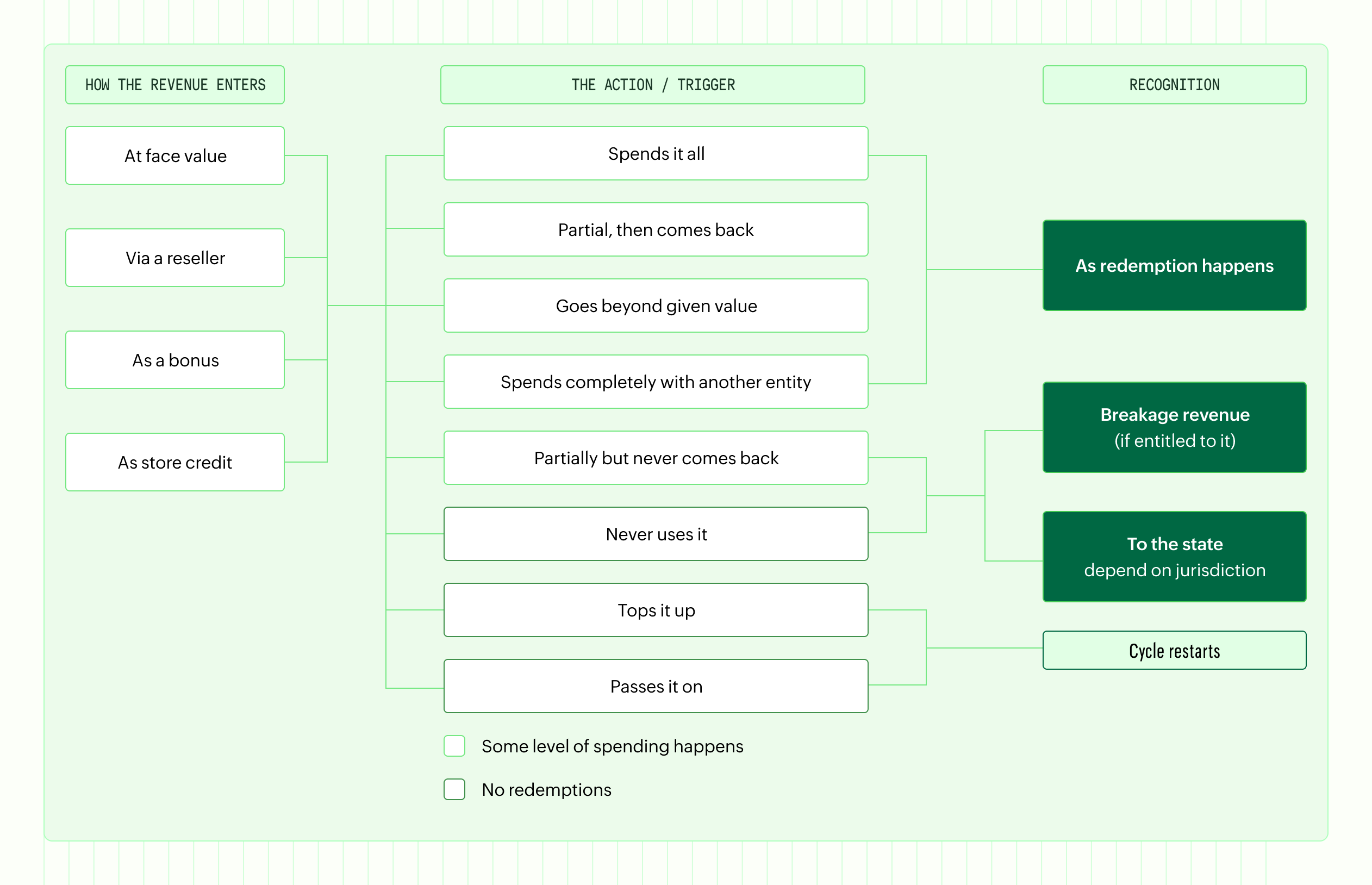
A gift card may be redeemed fully, or partially, or may never be redeemed. All the while, the entire concept of revenue recognition relies on having conditions on when to mark the revenue as earned (mostly when the services are delivered). So, here are the scenarios that could happen after your customer makes a gift card purchase.
Here are the scenarios where recognition can be pretty straight forward.
Spends it all in one visit: Revenue that day, obligation closed.
Spends part, comes back: A $200 card run down over four visits is four conversion events.
Spends past the card value: If a customer maxes out the gift card and covers the remainder of the purchase with card or cash, this would be two revenue sources, but one transaction.
Here are the scenarios where recognition involves judgment and statute.
Spends part, never returns for the rest: The stub. This is the most common outcome in the population and the hardest to call.
Never uses it: It just lies in people's drawers or wallets, while digital versions go stale in email folders.
Tops it up: A reload restarts the cycle, and in some states the dormancy clock too.
Passes it on: Whether gifted, resold, or handed to a colleague, your obligation doesn't move.
Redeems it elsewhere in the group: Issued by one entity, spent at another, so there's an intercompany settlement riding on the revenue event.
Where the money lands
As revenue at redemption: You delivered.
As breakage revenue: The customer isn't coming and you're entitled to keep it.
To the government (amended only in certain regions): Unclaimed property rules hand the balance to the government in many jurisdictions. This is what is generally called escheatment.
There are two less common endings too: The card expires where local law permits it, or the customer cashes out a small remaining balance, which several US states require below a set threshold.
So, when have you actually earned it?
Under both ASC 606 and IFRS 15, the answer is when you satisfy the promise. For gift cards, that moment is mostly redemption. At the point of sale, you record cash on one side and a contract liability on the other. If that is booked as revenue at the point of sale, then you are overstating income in that period and understating what you owe customers, and it is the first thing an auditor sees.
Redemption releases the "matching slice" of that liability into revenue. It's straightforward for the customer who spends the whole lot in one go, considerably less so across a population of half-used and unredeemed cards.
A dive into breakage
Breakage is the value customers paid for but never claimed. Left alone, those balances would stay on your balance sheet forever as an obligation to people who are not coming back.
The global revenue recognition standards accept that this misrepresents the position, so they let you recognize "expected" breakage before you are legally released from the obligation. They also put some rails around how.
If you expect to be entitled to the money
In such cases, you recognize breakage in proportion to the pattern of redemptions. Breakage flows into revenue alongside actual usage rather than arriving in one lump.
Say you issue $1,000 of cards and your redemption history supports an expectation that 20%, or $200, will never come back. Once $400 has been redeemed, you are halfway through the $800 you expect will ever be used, so you take half the breakage: $100. That gives you $400 of redemption revenue and $100 of breakage revenue, with $500 still sitting in the liability account.
If you cannot support an estimate yet, you wait.
A new program with no redemption history has no basis for a percentage, so you recognize nothing beyond actual redemptions until the chance of a given card being redeemed becomes remote, then take it in one go.
Expiry
This is common in a lot of markets. Where a card is allowed to lapse, expiry ends the customer's right to redeem it, but it doesn't automatically hand you the revenue. You still recognize it the same way as any other breakage. You need to be entitled to the balance, and redemption needs to have become remote.
Separately, some jurisdictions let a customer cash out a small remaining balance once it drops below a set threshold, rather than letting it lapse at all.
The rule that overrides estimates (for businesses incorporated in select US states)
If you are required to remit unredeemed balances to a government under unclaimed property law, that money never becomes revenue, however confident your breakage model is. It stays a liability until you hand it over.
These are not options to choose between on preference. Your circumstances decide which applies, and you reassess each reporting period as redemption data accumulates.
What may affect the estimates
One rate for every card
Cards sent by email get used faster and more completely than plastic ones, and corporate bulk cards behave differently from both. Splitting your cards into groups by issue date, channel, value, and region gives you a much stronger number than one average across the lot.
Infrequent estimate revisions
How customers use cards does change, and it changed a fair bit as programs moved online. Any revision has to be pushed through in one adjustment, and that adjustment can land big enough to need explaining.
The same logic applies well beyond gift cards. Loyalty points, prepaid service blocks, unused retainer hours, and rolled-over subscription credits all behave the same way on your balance sheet.
What finally matters in gift card recognition
Gift cards are a genuinely good instrument. They pull cash forward, bring in customers who routinely spend past the card value, and show you how your brand travels as a gift. Blackhawk Network's 2026 gifting research found that US shoppers overspend by an average of $81 on a $100 card and $103 on a $500 card.
The accounting just asks for more discipline right from launch, while the thinking stays clear once you separate the two questions:
When did you earn it, answered by redemption.
What happens to the part that never comes back, answered by your entitlement to breakage and your escheatment exposure.
The rest comes down to having data granular enough to support the answer, whichever way it goes.
Frequently Asked Questions
No. Under both ASC 606 and IFRS 15, a gift card sale is cash received for a promise you haven't yet delivered on. At the point of sale, you record the cash alongside a contract liability. Revenue is recognized when the customer redeems the card and you deliver the goods or services. Booking it at the point of sale overstates income for that period and understates what you owe customers, which is one of the first things an auditor will flag.
Breakage is the portion of a gift card's value that customers paid for but never redeem. If your redemption history supports a reliable estimate, you can recognize expected breakage as revenue in proportion to the pattern of actual redemptions, rather than in one lump sum. For example, if you issue $1,000 in cards and expect 20% ($200) to go unredeemed, then once $400 has been redeemed you recognize $100 of breakage alongside it. If you can't yet support an estimate, as with a new program, you recognize only actual redemptions until the likelihood of redemption becomes remote. Note that where unclaimed property laws require you to remit unredeemed balances to the government, that money never becomes revenue and stays a liability until you hand it over.