

- HOME
- Revenue Recognition
- Performance obligations in revenue recognition
Performance obligations in revenue recognition

Every contract, at its core, is primarily a list of promises. A vendor agrees to hand over something of value, a customer agrees to pay for it, and revenue recognition exists to answer at what point a business actually earns the money that's sitting in the bank account. The answer stays simple until a contract has more than one moving part. A single deal might bundle in software access, onboarding, premium support, and a hardware component, each with its own timeline of delivery and its own claim to a slice of the revenue. Recognizing the full contract value the moment the ink dries would overstate what you've actually delivered, but waiting until every last obligation is closed out would understate it. Somewhere in between lies the real answer, and performance obligations are what help you find it.
This article walks through what performance obligations are, how they show up inside a contract, the common ways they get fulfilled, and what happens when real-world situations like upgrades, downgrades, and cancelations start pulling at the edges of a clean recognition schedule.
What are performance obligations in revenue recognition?
A performance obligation is a distinct promise within a contract to transfer a good or service to a customer. In the core five-step model that defines revenue recognition, this comes second, after a business identifies a contract with the customer. Under frameworks like ASC 606 and IFRS 15, revenue only gets recognized once (or as) that specific promise is fulfilled, not when the invoice goes out and not necessarily when the cash comes in.
The word "distinct" is doing a lot of work here. A promise counts as distinct when the customer can benefit from it either on its own (say, a tangible product), when paired with resources they already have easy access to (maintenance provided for that product), or when it isn't so tightly bundled with other promises in the contract that separating it out wouldn't make sense (a custom fitting made specifically for that product, so the two can't really be sold or delivered apart).
Take a fairly common deal in SaaS.
A company sells a software subscription along with implementation services and a year of premium support. Are these three obligations or one? If a customer could reasonably hire a third party to implement the software, and the support tier is genuinely separable from the core product, these are likely three distinct obligations, each recognized on its own path. But if the implementation is so specific to this vendor's system that no outside party could realistically do it, and the software is functionally unusable without it, the two might get bundled and treated as a single obligation.
This judgment call lives right at the center of revenue recognition, and it's the decision that separates well-run finance functions from ones constantly explaining variances to their auditors. A recent industry report on restatement trends found that revenue recognition remains the second most common category behind debt and equity issues, accounting for roughly 14% of all restatements filed in 2025.
What does it look like in a contract?
On paper, a contract doesn't spell out "performance obligation one" and "performance obligation two." That's the finance team's job to unpack. But the raw material is usually right there in the scope of work/deliverables, the pricing schedule, and the service-level terms.
Here's a simplified version of how a single enterprise contract might break down once you've mapped it out:
Line item in the contract | Is it distinct? | Performance obligation | How value transfers |
Software subscription (12 months) | Yes, usable independently | Access to the platform | Over time, across the subscription term |
Implementation and setup | Yes, could theoretically be outsourced | One-time setup service (or phased) | Point in time, on completion |
Premium support tier | Yes, sold separately | Ongoing support | Over time, across the support period |
Training sessions (3 included) | Yes, delivered as discrete sessions | Training | Point in time, per session delivered |
This is where a lot of the initial friction happens. Sales teams are, understandably, focused on closing the deal at a number that works. Finance then figures out how that number breaks down into obligations that may not have been priced individually anywhere.
The operations behind fulfilling your performance obligations
Once an obligation is defined, the next decision is how its revenue actually gets recognized over the life of the contract. This usually comes down to two separate settings that are easy to lump together but really shouldn't be: how often revenue gets recognized and how it gets spread within each of those periods.
Recognition frequency
This is simply the period revenue gets bucketed into.
Monthly: The most commonly used option in practice, mostly because it's operationally simpler to reconcile against a monthly close
Example: A $6,000, six-month support retainer recognized monthly ends up booking $1,000 each month as the support is delivered.
Quarterly: A middle ground that suits contracts billed or reviewed on a quarterly rhythm, without needing month-by-month granularity
Example: A $40,000 annual compliance contract reviewed every quarter recognizes $10,000 at each quarterly checkpoint.
Yearly: Relevant for long-term engagements spanning several years, where reporting happens annually rather than monthly
Example: A three-year IT consulting contract, billed upfront in full, recognizes one-third of the total value at the end of each year as the service is delivered.
Once: For obligations settled in a single event rather than spread out at all, revenue is recognized in one shot.
Example: A one-time setup fee for onboarding a new customer gets recognized entirely the moment the setup is completed.
Custom: For contracts that don't follow a standard interval, letting a business define its own fixed frequency, like every two months or every six months
Example: A support contract that reports and recognizes revenue once every six months, since a standard quarterly or yearly bucket doesn't line up with how the engagement is billed.
Manual: For anything that doesn't fit a standard interval, letting a business define its own recognition periods
Example: A construction contract tied to project milestones (foundation, framing, and finishing) recognizes revenue on whatever irregular schedule those milestones actually land on, not a fixed calendar interval.
Distribution method
Once the frequency is set, the next question is how the revenue for each period actually gets divided.
Daily: Revenue is split according to the number of days that fall within the selected recognition frequency rather than an equal chunk per period. This tends to suit obligations tied closely to actual time elapsed, and it mirrors reality more precisely when periods aren't uniform in length.
Evenly distributed (straight-line): The total obligation value is divided equally across each recognition period, regardless of how many days are in it or how much was actually used.
Evenly distributed with prorated values: This works the same way as even distribution for every full period in between, but when a subscription's start or end date falls in the middle of a period, that first or last period is prorated based on the days actually covered in it, rather than getting the same full share as the periods in between.
Alongside both of these, there's a third, seemingly smaller decision: when within a period revenue actually gets recognized, commonly at the start of the period versus spread as it progresses. It's a detail that rarely gets debated the way frequency or distribution does, but it still shapes exactly which accounting period a given dollar lands in.
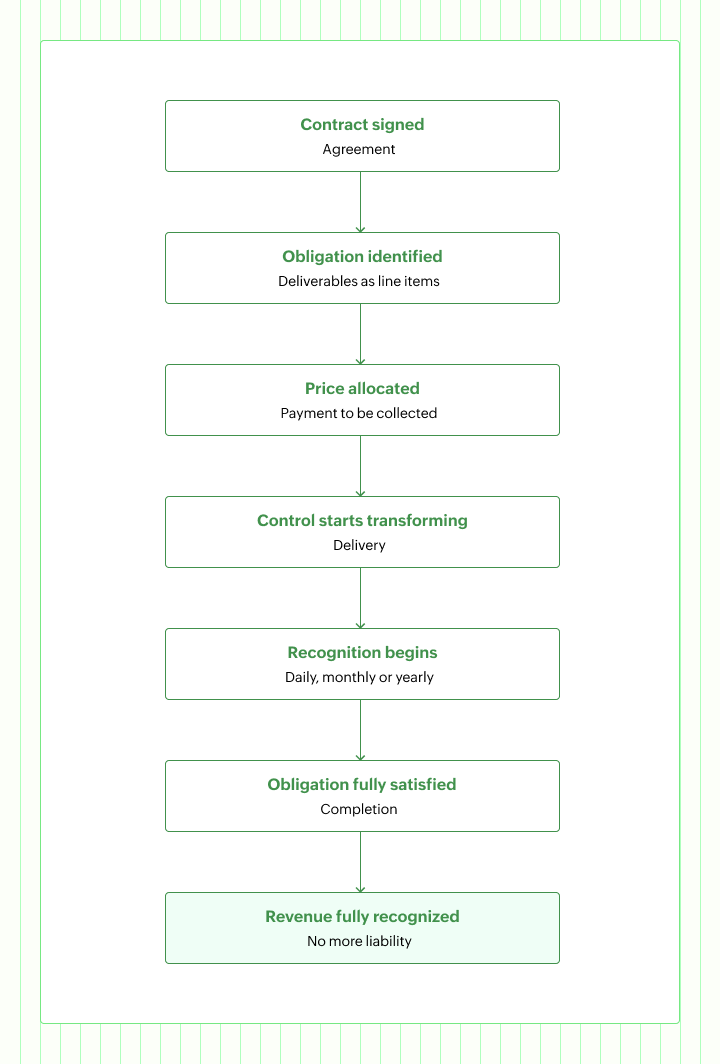
Here's a simple way to picture how a single obligation moves from contract signing to recognized revenue:
The deviations in performance obligations and handling them in day-to-day operations
A clean recognition schedule looks great on the day a contract is signed. Real customers, though, upgrade mid-cycle, downgrade when budgets tighten, cancel early, ask for refunds, and occasionally just want to pause. Each of these events forces a recalculation of what's left to be earned, and getting this wrong quietly compounds into the kind of misstatement that shows up much later during an audit or a board review.
Upgrades, downgrades, and pauses
When a customer moves from a standard to a premium tier mid-subscription, the contract changes shape. A new, distinct add-on priced at its own value is typically treated as a separate obligation, recognized from that point forward.
Downgrades run into the same problem in reverse, and they're trickier, since they often raise the question of whether the customer is owed something back for value not yet used at the higher tier.
A pause freezes the obligation without canceling it. No revenue gets recognized while paused, since nothing is being delivered, but the obligation itself stays intact. Once the subscription resumes, recognition picks up from where it left off, so the system needs to track the pause duration accurately to avoid over- or under-recognizing revenue later.
Cancellations and refunds
A cancellation closes out the remaining obligations early. Whatever's already been recognized stays recognized, but any deferred revenue tied to undelivered work needs to be handled.
Refunds fall under variable consideration. If a contract includes a right of return, the expected refund portion shouldn't be recognized as revenue at all; it sits as a liability until the return window closes. This is standard in retail, but it applies just as much to SaaS trials with a money-back clause.
Operationalizing contract deviations and subscription changes in performance obligations
There are various allocation methods that you could adopt to automate the revenue recognition process when mid-contract changes happen. For example, platforms like Zoho Billing provide different models in which the additional revenue that comes in mid-cycle because of contract change can be recognized. The common ones are prospective and retrospective methods.
As per various compliance standards, they don't disturb the already recognized revenue in previous months. They just differ in the way the future revenue (new revenue from contract change plus unrecognized revenue from the previous contract) gets recognized.
These have become the ordinary texture of running a subscription or contract-based business at scale, and manually recalculating obligations every time a customer changes their mind isn't a realistic long-term plan for any growing enterprise. A recent look at ASC 606 compliance work put it plainly: the standard demands a proactive and continuous evaluation of contracts and pricing structures, not a one-time exercise done at the point of signing (BDO).
Getting this right consistently comes down to having a system that can identify obligations at the contract level, allocate value accurately, and automatically re-measure everything the moment a contract changes, whether that's an upgrade, a pause, or a refund. If you'd like to see how Zoho Billing fits into your business's revenue recognition practices, connect with our experts to learn more.
Frequently Asked Questions
It's a distinct promise in a contract to give the customer a specific product or service. Revenue only gets counted as earned once that particular promise has actually been delivered, not when the contract is signed or when payment comes in.
Yes, this is actually very common. A single contract can include several separate promises, each moving through revenue recognition at its own pace, so one part might be recognized all at once while another gets spread out over months.
A promise counts as distinct if the customer could benefit from it on its own or alongside things they already have easy access to. It also needs to be separable enough from the other promises in the contract that it wouldn't make sense to lump it in with them.
No, contracts don't usually spell out performance obligations on their own. It's up to the business to look past how the contract is priced or worded and figure out what the actual separate promises are underneath it.