- HOME
- Revenue Recognition
- Revenue recognition reports: From compliance to planning
Revenue recognition reports: From compliance to planning
If you want to know how healthy your company’s operations really are, a look at the revenue recognition schedules gives a clear path. A sudden surge in unbilled receivables can signal a billing team waiting on elusive milestones. A growing pile of manual journal entries usually means your product catalog outpaced your accounting software six months ago. To you, as well as to any outsiders like auditors, these reports reveal every wrinkle in your contract lifecycle.
Understanding the mechanics of revenue recognition reports serves you in two ways:
Surviving your annual audit without audit fatigue
Turning complex ASC 606/IFRS 15 rules into actionable strategic intelligence
Pulling a specific answer out of the reports becomes a small project in itself if these schedules are being manually built. This method also carries a cost beyond just the hours it eats up. The Center for Audit Quality's ten-year review of US restatement data, built on Audit Analytics research, found that inappropriate accounting for accruals, reserves, and estimates was cited most often in restatement announcements, showing up in 30% of them, and recognition schedules are made of little else.
This article explores what gets tested when someone from outside goes through your schedules, as well as what the same numbers will tell you about delivery, cash, and the state of your systems.
A quick look into the basics - What the reports produce
Recognized revenue for the period
What you earned between the opening and closing date, cut by contract, product, or plan, depending on what you asked the system for. It's the figure that reaches the income statement, and it travels with a schedule behind it showing which portion of which contract contributed.
Deferred revenue
Money already collected or invoiced for work you haven't delivered yet. It behaves as a liability, since the customer is owed delivery, and it releases into recognized revenue as that delivery happens.
Unbilled receivables
The mirror image of deferred revenue. You have delivered and earned, though the invoice has not gone out yet, often because the contract bills in arrears or on a milestone that hasn't been reached. Teams tend to overlook it, but it's the line connecting your delivery pace to your cash position.
A quick look into the basics - What builds these figures
All three figures are outputs. Underneath each one is a small set of records that determine the number.
The recognition schedule
A period-by-period plan for the performance obligations on the contract, running forward from its start date.
The revenue rule applied
Whether the item recognizes ratably across the term, on delivery, or based on measured usage.
Modifications
Upgrades, downgrades, added seats, and cancellations. Each one re-spreads the remaining balance from the change date, and each one is a point where a manually maintained schedule starts to cause issues.
Credits and reversals
These pull back revenue already recognized, sometimes affecting a period you've already closed.
Analysis from the outsider perspective: What an auditor looks for
Knowing what an auditor will is a practical way to judge whether your current setup can back up your numbers.
The path from contract to schedule: Any recognized amount can be traced back to the clause that created it, without someone rebuilding the logic from memory.
Consistency of policy: Two similar contracts signed in different regions should be treated the same way, and the report should make that visible.
Allocation on bundled deals: Where several deliverables share one negotiated price, auditors want the standalone selling prices used and the working behind the split.
Cut-off evidence: Proof that revenue landed in the period the delivery happened, especially around quarter ends.
Manual adjustments: Every override, who passed it, when, and why. A high count here will invite a longer conversation.
The rollforward that ties to the ledger: Opening deferred balance, additions, releases, adjustments, closing balance, agreeing to the general ledger without a bridging spreadsheet.
Remaining performance obligations: The disclosure of what you have promised and not yet delivered, which has to be assembled from the same schedules.
Analysis from the insider perspective: Utilizing revenue recognition reports for performance and strategy
Finance teams generally use the phrase "revenue recognition report" for a family of outputs. Knowing which report answers which question is the core skill. Reading more than the obvious answer out of each one is where it gets interesting, even if a little speculative.
The recognition schedule
Contract by contract, how much revenue is scheduled to be recognized in each future period. This is your forward visibility and one of the most underused inputs in annual planning. A spike or a curve moving either way may be describing your delivery capacity, your contract design, or a sales team that closes everything in the final stretch of the quarter.
The deferred revenue rollforward
A good scenario to explore here is a balance growing faster than the recognized revenue. It is generally read as a healthy signal, since it means you are selling further into the future than you are delivering. It can also mean something less comfortable. If delivery teams are falling behind (especially in milestone-based recognition cases), the balance swells for reasons that have nothing to do with demand, and pairing it with your open-item aging will tell you the reality.
Billed versus recognized
A period comparison of what was invoiced against what hit the income statement. A widening gap is not automatically a problem, though it always deserves a sentence of commentary.
Recognition schedules by segment
The same recognized total, but cut by what you actually sold. The segment could be product, plan, or country, each which is useful to teams beyond finance. For example, a plan-level cut often shows that the tier carrying the most bookings is not the one carrying the most earned revenue, and the distance between those two lists is usually where discounting has been living. If you cut it by country instead, you are looking at how much of next quarter's committed revenue leans on a single market.
When read this way, these reports become hypotheses you can test, rather than a mere filing obligation.
The common revenue recognition reports and what they show
Deferred revenue against recognized revenue, plotted together over several periods
Two lines moving in parallel means delivery is keeping pace with selling. The gap widening month on month is the view most worth a second look, since it reads as growth and can equally be a delivery backlog forming.
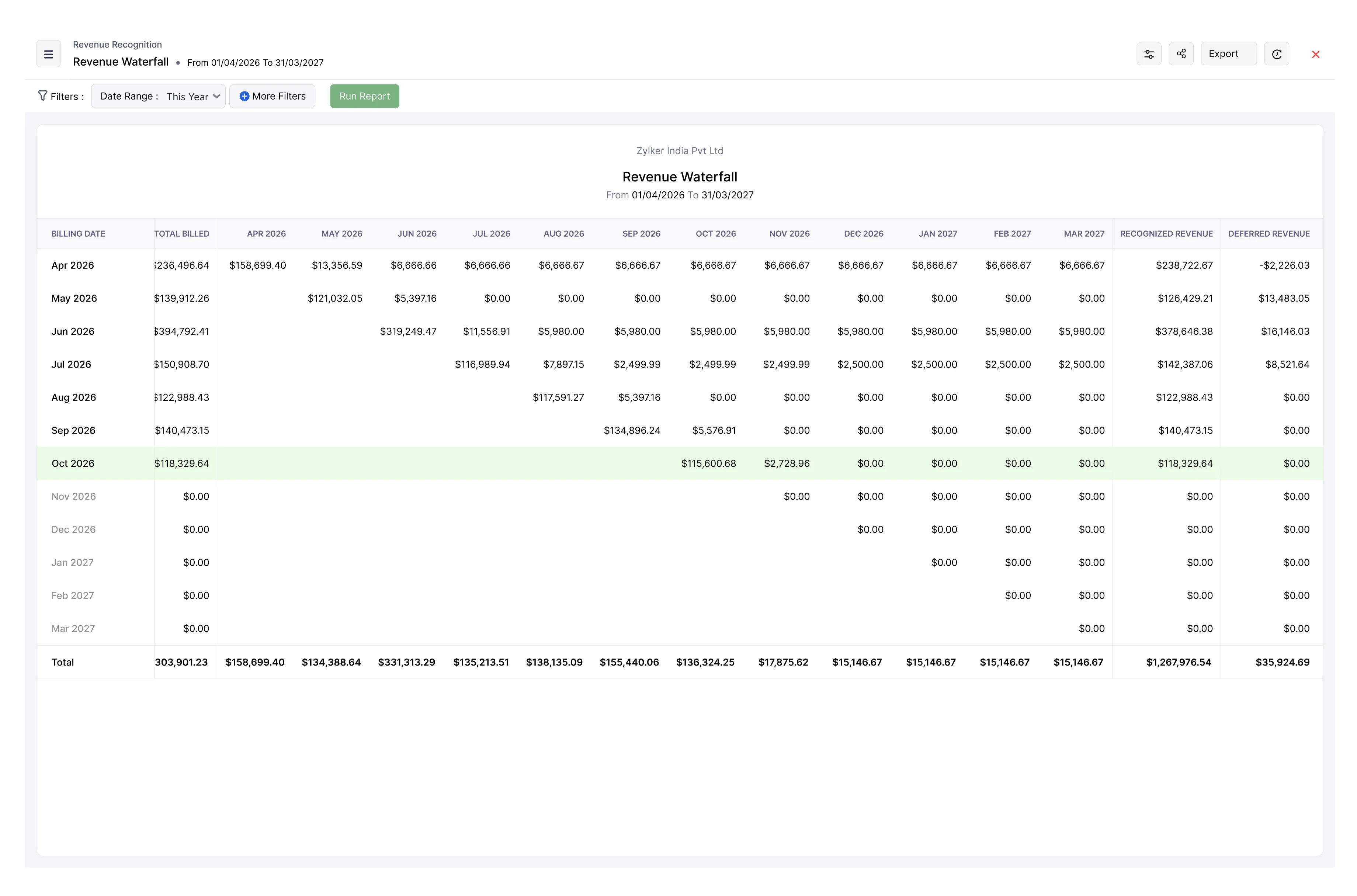
The recognition waterfall
Your current deferred balance spread across the periods it will release into. Leadership asks for forward revenue visibility; this view is the honest version of that answer, because it only counts what is already contracted.
Billed and recognized as a running comparison
Useful across a full year rather than a single month. The seasonality in the shape usually mirrors your contract renewal cycle, and a break in that shape means something changed in how deals are being written.
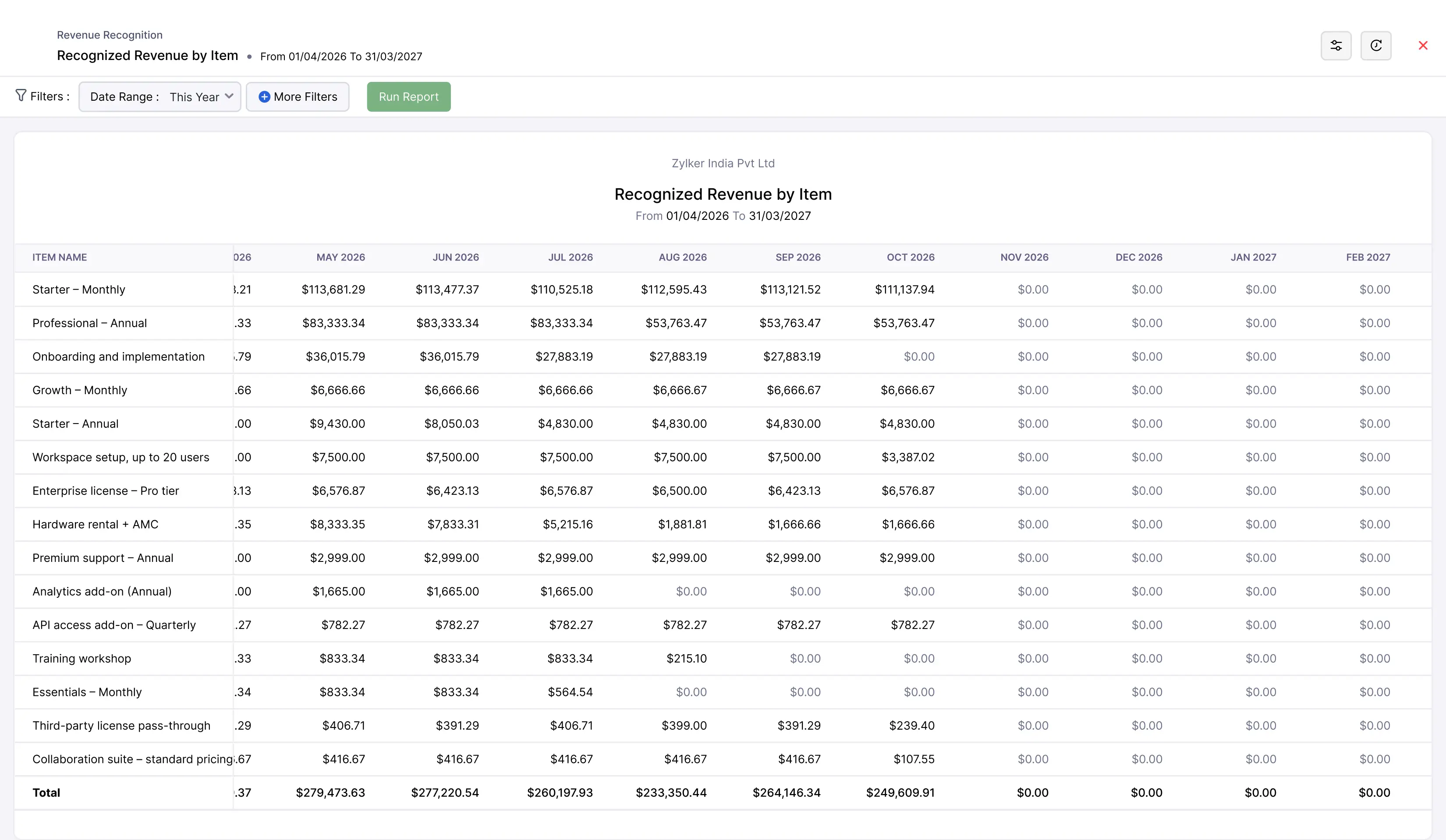
Recognized revenue by plan or product line
Stacked over time, it shows which parts of the catalog carry the earned revenue rather than the booked revenue. The two lists are seldom identical, and the difference tends to be where discounting lives.
Unbilled receivables trend
A flat line with occasional spikes is normal for milestone billing. A line climbing steadily means invoices are not going out when delivery completes, and that one belongs in front of whoever owns collections.
Making the data trustworthy first
Before you plan for any of the above, the mechanics underneath need to be error-free and well-built. A quick list to check your current setup against:
Schedules generated from the contract itself, rather than reconstructed afterwards from invoice data
Mid-term changes re-spreading the remaining balance automatically
Every recognized amount traceable to a source event with a timestamp
Periods that can be locked, with post-close adjustments leaving a visible trail
The same contract reportable in multiple books and currencies without duplicate entry
Reports that refresh without a configuration project each time
That last point carries more weight than it looks. ISG's benchmark research on the financial close found that 88% of companies applying substantial automation to the close complete their monthly books within six business days, against 40% of those applying little or none. The gap is largely made up of reconciliation work that is never needed if the systems are connected.
Keep recognition tied to the contract with Zoho Billing
Zoho Billing creates recognition schedules at the point the contract is created, re-spreads them when a customer changes plans mid-term, and posts the resulting entries into Zoho Books at ledger level. Deferred revenue, recognition schedules, and billed-versus-earned views come as standard reports, with the underlying transactions a click away when required. Because billing and accounting share the same record, the export-reconcile-adjust loop that eats the first week of your close will have considerably less to feed on.
Frequently Asked Questions
Deferred revenue is money collected or invoiced for work you haven't delivered yet, so it sits as a liability. Unbilled receivables are the reverse: work delivered and earned, but not yet invoiced. One tracks obligations ahead of you, the other tracks revenue you are yet to bill.
Billing follows when invoices are issued, while recognition follows delivery of the product or service. Annual prepayments, milestone billing, and arrears billing all pull the two apart. A gap is normal, but a widening one should be explained.
It can signal healthy demand, since you're selling further ahead than you deliver. It can also mean delivery is lagging, particularly with milestone-based contracts. Comparing it against open-item aging helps show which explanation applies.
Upgrades, downgrades, added seats, and cancellations all change the remaining balance, which must be re-spread from the change date. Doing this manually is error-prone and a common source of audit adjustments. Automated systems can recalculate the schedule as soon as the contract changes.
Zoho Billing provides a recognized revenue report, deferred revenue report, and revenue waterfall report for Premium plan users. The Enterprise edition includes six more ready-made reports: recognized revenue by country, item, and customer, and deferred revenue by country, item, and customer. Zoho Billing also integrates natively with Zoho Analytics for deeper, more specific cross-analysis.