

- HOME
- Revenue Recognition
- Revenue recognition for different industries: Learn what applies to you
Revenue recognition for different industries: Learn what applies to you
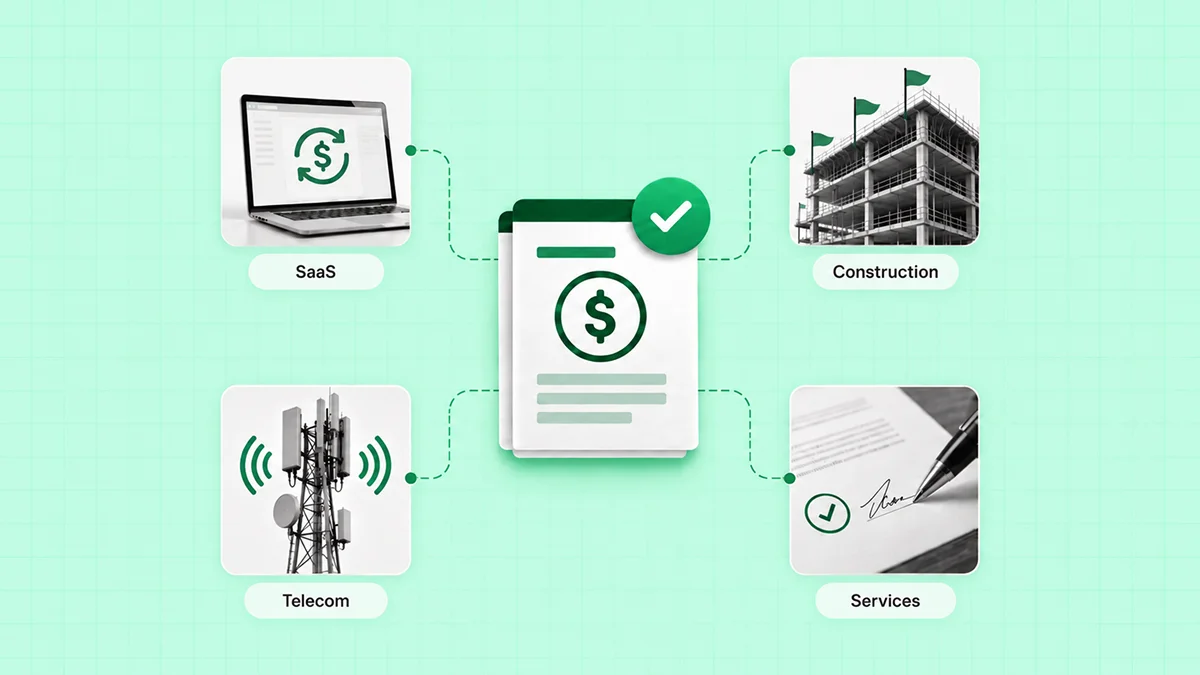
Revenue recognition looks deceptively settled. Because, clearly there's one framework, five steps, and a good amount of guidance around it given by IASB & FASB. Yet, when you ask a construction controller and a SaaS controller to describe their hardest month-end judgment call, you'll hear two completely unrelated answers.
That's the thing about standards like IFRS 15 and ASC 606. When they replaced the older patchwork of industry-specific rules, the intent was to get everyone speaking a common language. It largely worked but what it didn't and reasonably couldn't do was make the "judgments" straight forward, because the principles now have to be applied to business models the drafters could not anticipate one by one. A subscription business has so many mid-term changes, construction businesses work for a long time on a project where there is a risk for onerous contracts, membership businesses have abstract offerings that need to carefully allocated with obligations and price — all of these judgments should be made by businesses, while the global standards provide guardrails to make them.
Regulators are still watching those judgments closely. In EY's review of SEC staff comment letter trends for 2025, revenue recognition, again, ranked among the topics drawing the most scrutiny, behind MD&A, non-GAAP measures, and segment reporting. Nearly a decade after adoption, it has not dropped off the list.
The five-step revenue recognition model, briefly
| Step | The question it answers |
| 1. Identify the contract | Is there an enforceable arrangement, and is collection probable? |
| 2. Identify performance obligations | What distinct things have you promised? |
| 3. Determine the transaction price | What do you expect to be entitled to, including the uncertain parts? |
| 4. Allocate the price | How does that total split across each promise? |
| 5. Recognize revenue | When does control transfer, over time or at a point in time? |
Steps 2, 3, and 4 are where industries part ways. The rest of this article focuses on these sections. For a deeper walkthrough of the 5-step model, start here.
Revenue recognition for SaaS businesses
The subscription itself is usually straightforward. It's everything around it that gets argued about. Implementation and onboarding fees are the classic ones. If the setup doesn't transfer anything the customer could benefit from on its own, it isn't a distinct performance obligation, and the fee gets deferred and recognized over the period the customer is expected to benefit. That's the expected customer life, which is often longer than the contract term.
A few key areas to keep an eye on:
Term licenses versus hosted access – A license the customer can run themselves may be point-in-time revenue, while hosted access is over time. Hybrid deployments make this a real conversation.
Mid-term changes – Every plan change is a contract modification, and the treatment depends on whether the added scope is priced at standalone value. Subscriptions make it even more complex.
Renewal discounts – Promising cheap renewals can create a material right, which is its own performance obligation.
Consumer subscriptions and digital media
The accounting risk here comes from scale rather than complexity—high volume, low ticket size, and a lot of moving promotional parts.
Free trials, introductory pricing, and win-back offers all affect the transaction price and its allocation. Refunds and cancellations create variable consideration, so you need a refund liability based on historical behavior rather than a wait-and-see approach.
Bundles are the other soft spot. When a print edition, a digital pass, and an events membership are sold as one price, the discount has to be spread across all three on a standalone selling price basis.
Memberships, clubs, and associations
Membership models turn on one question: What is the member actually paying for over what period?
For example, a gym registration fee doesn't hand the member anything separable from the membership itself, so it usually gets recognized across the expected membership duration rather than banked in month one. Estimating that duration is a judgment you should be able to defend.
Then there are the benefits attached to the membership. A member magazine, a certification exam, a fixed number of guest passes, or discounted event tickets can each be distinct promises. Unused benefits raise a breakage question, similar to gift cards (more on those later).
Associations with tiered structures and multi-year dues have the added wrinkle of significant financing components when members prepay for months or years upfront.
Service contracts and professional services
The core judgment here is over time versus point-in-time, and then how you measure progress.
| Approach | How progress is measured | Common in |
| Input method | Costs incurred, labor hours consumed | Consulting, managed services |
| Output method | Deliverables completed, units produced, milestones achieved | Fixed-scope engagements |
| Right to invoice | Amount you're entitled to bill for work done | Time and materials |
Billing milestones are not recognition milestones. A contract may pay 40% upfront while only 12% of the work is done, and that gap becomes a contract liability rather than revenue.
Performance bonuses, service credits, and SLA penalties are variable consideration, and the constraint applies. You include them only to the extent a significant reversal is unlikely. On the other hand, there are change orders — they're negotiated verbally, delivered immediately, and papered weeks later, which leaves finance reconstructing intent after the fact.
Construction and long-term projects
A building project takes two or three years, and it isn't the norm to wait for the last door to be hung before reporting anything. Revenue follows the work, so one needs to answer the same question every month: How far along is this job, really?
The usual answer compares what you've spent so far against what the whole job should cost. Spend a third of the budget and you're a third of the way there. This holds up well, as long as the money going out reflects work actually getting done. Anything that consumes budget without advancing the work will flatter your progress that way, including site set-up costs booked before the real work starts. Some key situations include:
Money held back until sign-off is a payment term rather than a revenue question. You've earned it and you report it; you're just waiting to be paid.
Scope changes get built long before anyone agrees on a price, so you count only the portion you're reasonably confident of collecting.
Onerous contracts, or jobs heading for a loss, take the full hit as soon as you can see it coming, rather than bleeding across the remaining months.
Gift cards, vouchers, and prepaid balances
Selling a gift card creates a liability, as nothing can be recognized until redemption. Until this part, it remains simple.
Breakage is where it gets interesting and complicated. Some balances will never be redeemed, and you're allowed to recognize that portion as revenue in proportion to the pattern of actual redemption, provided you're not legally required to hand the money over to the state. Escheatment (transferal of unclaimed funds to the state government) rules differ by jurisdiction, and where unclaimed balances must be remitted, breakage revenue is off the table.
Usage-based and consumption billing
Usage models are growing across cloud, communications, logistics, and increasingly AI products, and they put pressure on the transaction price step.
Most consumption arrangements qualify as a series of distinct services, which allows variable amounts to be allocated to the period in which the usage occurs. Where the invoiced amount corresponds directly to the value delivered, the right-to-invoice expedient can save a lot of modelling work.
The practical issues tend to be operational instead of theoretical:
Usage that lands after the cut-off still belongs to the period it happened in, so unbilled revenue accruals need to be reliable.
Minimum commitments with overage need to be split between the guaranteed floor and the variable layer.
Tiered pricing that applies retroactively once a threshold is crossed behaves very differently from tiering that applies prospectively.
Prepaid credits and drawdown pools carry their own breakage estimate when they expire unused.
If your usage data is sitting in an application separate from your billing system, this is usually where reconciliation pain begins.
Telecom and bundled hardware
Any model that pairs subsidized hardware with a service commitment lands in the same place. A phone handed over for a nominal amount alongside a 24-month plan requires the total contract value to be allocated between the device and the service at standalone selling prices.
The result is a chunk of revenue recognized upfront on the device and a contract asset that unwinds across the service term. Cash flow and revenue stop tracking each other, which takes some explaining internally the first time it happens.
The same logic applies well beyond telecom, including equipment-plus-monitoring, appliance-plus-maintenance, and hardware-enabled subscription products.
Marketplaces and platforms
The question here is whether you report the full transaction value as your revenue or only the commission you keep, and the answer depends on the part you actually play in the sale. If you control the good or service before it reaches the customer, you are the principal and you report gross. If you are arranging for a seller to provide it, you are an agent and only your fee counts as revenue.
Working out which one applies is rarely obvious, so a few indicators help. Ask whether you carry the inventory risk, whether you set the price, and whether the customer holds you responsible when an order goes wrong. Any one of these on its own won't settle the question, though together they usually point somewhere.
It's worth getting right because gross reporting makes growth look stronger than it is, which is a good part of the reason regulators keep circling back to this area.
Many platforms are the principal on some transaction types and the agent on others. That distinction needs to be recorded for each type of transaction rather than decided once for the business as a whole.
What this means for the systems underneath
Reading through these, a pattern emerges. Almost every industry-specific difficulty traces back to the same three needs: knowing precisely what was promised, knowing what was delivered and when, and holding an audit trail that connects the two.
That's a data problem, in reality, before it ever turns into an accounting problem. Contract terms live somewhere alone, delivery and usage data somewhere else, invoices in another place, and the schedule gets assembled in a spreadsheet at the quarter's end. The judgment may be sound and still be impossible to evidence six months later.
A monetization platform like Zoho Billing that holds contracts, plans, usage, invoices, and recognition schedules in one place removes most of the reconstruction work. Deferred balances update as contracts change, schedules regenerate when a customer upgrades mid-cycle, and the trail from contract to recognized revenue stays intact without anyone rebuilding it by hand. If you'd like to see how automated revenue recognition works within a single revenue management platform, explore Zoho Billing or talk to our team about your setup.
Frequently Asked Questions
A principal controls the good or service before it reaches the customer, so it reports the full transaction value as revenue. An agent is just arranging for someone else to provide it, so only the commission or fee it keeps counts as revenue, not the full sale amount.
What is "breakage" in gift card revenue recognition?
Breakage is the portion of gift card or prepaid balances that customers never end up redeeming. Businesses are generally allowed to recognize that unredeemed portion as revenue over time, based on how redemptions typically pattern out, as long as they're not legally required to hand that unclaimed money over to the state instead.
The input method measures progress based on what's been spent so far, like costs incurred or labor hours worked. The output method, instead, looks at what's actually been delivered, like completed milestones or units produced, which tends to reflect real progress more directly.
An onerous contract is one that's clearly heading toward a loss, meaning it'll cost more to fulfill than the business will earn from it. Once that becomes apparent, the entire expected loss should be recognized right away, rather than spreading it out gradually across the rest of the contract.