

- HOME
- Revenue Recognition
- Revenue recognition automation: Why spreadsheets break at scale
Revenue recognition automation: Why spreadsheets break at scale
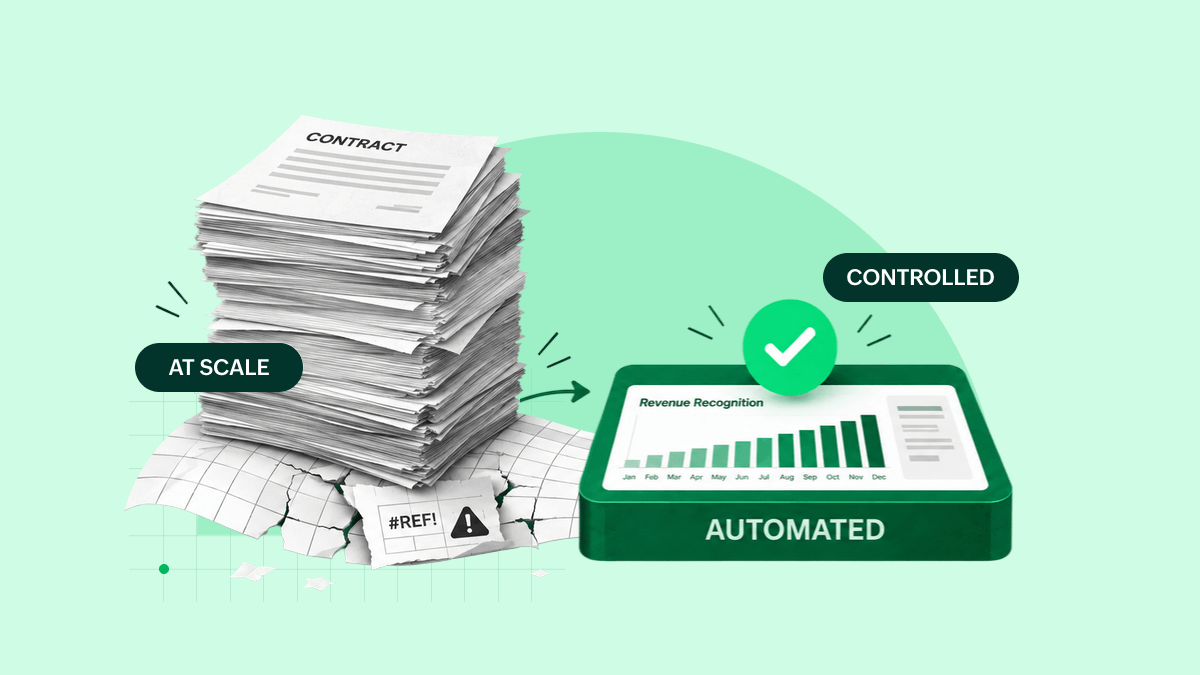
Most finance teams, both the larger and smaller ones, have that one workbook. It started with a handful of annual contracts and a clean monthly schedule. A few months or years later, it has 40 tabs with color codes and formulae that could be understood by very few. Without those few people, the whole thing turns into a risk item.
In bigger organizations, it is rarely one workbook. It's one per region, one per business unit, one for a new experimental offering roll-out, and another that arrived with an acquisition but never got folded in. Each file looks manageable on its own, while the picture they add up to at quarter end is where it gets difficult.
There's a natural pull to keep using it since the sheet has earned its keep over the years. Spreadsheets' capability is never a question, they held up operations for many for a good period of time. But when they are being asked to do work they were never designed for, especially in the areas where compliance is crucial, then that becomes an issue that's worth addressing at the earliest.
So, for revenue recognition, there are places where a spreadsheet can actually hold up. Let's have a quick look into that first before discussing why automation becomes essential after some time.
Where spreadsheets can truly manage revenue recognition
If your revenue looks like the list below, a well-built workbook and a disciplined process are perfectly adequate. Migrating to a system has its own cost in time, testing, and change management, and there's no prize for automating something that's working fine.
Low contract volume: A few dozen active contracts, where one person can eyeball the whole schedule in an afternoon.
Uniform, ratable terms: Straight-line recognition over a fixed term, single deliverable, no bundles.
Few mid-term changes: Customers rarely upgrade, downgrade, or pause halfway through.
One entity, one currency: No intercompany allocations or Foreign Exchange revaluation to worry about.
A reviewer who isn't the preparer: Someone independently checks the formulas each month.
Meeting most of those means your problem lies with process discipline rather than tooling. Fix the review step and carry on.
Where spreadsheets break while managing revenue recognition
The trouble is that every item on that list is a growth-sensitive condition. Each one stops being true as the business scales, and usually more than one goes at the same time.
Contract modifications turn into retroactive rework
Let's say one of your customers upgrades in month seven of a twelve-month term. Depending on how the modification is treated, you're either recognizing the change prospectively or retrospectively. Both mean touching historical rows, and in a spreadsheet, touching historical rows is how prior-period numbers change without anyone intending them to.
Bundled deals need allocation
The instant a deal includes an implementation fee, a support plan, and a discount across the bundle, revenue has to be split by standalone selling price (SSP) rather than by invoice line. Maintaining it across hundreds of deals, each with its own discount, becomes a modelling exercise your team is now running alongside the actual close. Negotiated enterprise contracts push this further, since almost no two of them allocate the same way.
Usage-based revenue introduces estimates
Variable consideration, especially for businesses with usage-based billing models, has to be estimated, constrained, and trued up when the actuals arrive. A workbook can hold the numbers, but it cannot tell you which estimates have been revised, by whom, or on what basis with needed clarity.
Close time grows with bookings
Every new contract adds rows while edge cases add columns and exceptions, and all of these together compounds review effort. It's a strange arrangement where a good sales quarter directly lengthens the close. APQC's benchmarking shows top performers finish the annual close in 10 days or less against a median of 18, and manual schedules are a reliable way to land on the wrong side of that gap.
Entities multiply everything
For groups operating across markets, the same schedule has to survive local currency, functional currency, group reporting, and sometimes two accounting frameworks running in parallel. Every subsidiary maintains its own version, consolidation happens through copy-paste, and one late correction in a regional file means the group numbers are rebuilt after they were already circulated.
There's no real audit trail
Version control by filename works until the auditor asks who changed the formula in the deferred revenue roll forward and when. A shared drive can tell you a file was modified. It can't tell you what the number was before, or why it moved.
Controls are hard to evidence
Beyond the trail itself, listed and regulated businesses have to show that preparation and approval were done by different people, and that nobody could edit a locked schedule after sign-off. A workbook can be protected, but protection that any admin can lift is a control on paper. Fixing this after an auditor raises it costs far more than designing it in.
Error rates are higher than most teams assume
A 2024 review published in Frontiers of Computer Science found that 94% of business spreadsheets used in decision-making contain errors. Most are harmless. The ones that aren't tend to surface in the quarter you least want them to.
Billing and revenue drift apart
As invoices live in one system and recognition schedules in another, reconciliation becomes a monthly negotiation between two sets of numbers that should not have been separated in the first place.
One person carries the model
This means that the workbook is only as available as the person who built it. In distributed finance teams, this repeats in every location, and the knowledge is siloed and doesn't travel between them.
A quick way to test where you stand
Ask your team these four questions before the next close:
How long would it take to answer, "how much of next quarter's revenue is already contracted?"
If a contract were amended today, how many tabs would need editing?
Could we reproduce last March's schedule as it stood in March, not as it stands now?
If the person who owns the model resigned tomorrow, what's the plan?
Hesitation on two or more of those is a fair signal that the workbook has outgrown its remit and that it is time to consider automating the process.
What revenue recognition automation actually changes
Automating revenue recognition isn't about removing spreadsheets from finance. Analysts almost always model in spreadsheets, like muscle memory. What changes here is where the source of truth lives. Platforms like Zoho Billing are made to address these issues at the root.
When recognition rules are configured against the contract itself, schedules generate when the contract is booked, amendments recalculate on their own, deferred revenue rolls forward without manual entry, and the audit trail builds itself as a by-product of the work. Moreover, everyone works off one rule set instead of 11 interpretations of it across entities. Your team moves from producing the numbers to reviewing them, which is a better use of the expertise you're paying for.
The teams who make this move early tend to do it while their data is still clean, rather than after a restatement forces the conversation. That timing is worth thinking about now instead of in the middle of a close. If your revenue schedules have started to feel fragile, Zoho Billing handles recognition, amendments, and reporting on deferred and recognized revenue. Connect with our experts to see how it maps to the way your contracts are actually structured.
Frequently Asked Questions
Spreadsheets can work perfectly well for smaller, simpler setups—think a few dozen contracts, one currency, straightforward terms, and someone reviewing the numbers each month. The moment contracts get more complex, volume grows, or entities multiply is when spreadsheets start becoming a real risk instead of just an inconvenience.
Standalone selling price is what a product or service would normally sell for on its own, outside of a bundle. It matters because when multiple items are sold together at one combined price, revenue needs to be split across them based on their individual SSPs, not just divided arbitrarily or based on how the invoice happens to list them.
The bigger risk is that there's no reliable way to prove who changed a number, when, or why, which becomes a real problem the moment an auditor starts asking questions. On top of that, the whole process often depends on one person who built and understands the model, so if they leave, that knowledge leaves with them.
A good way to check is asking yourself a few questions:
How long would it take to figure out how much of next quarter's revenue is already locked in?
How many tabs do you need to touch if a contract changed today?
Can you recreate an old schedule exactly as it looked back then?
Can you actually trace and map the changes to users and reasons?
If you find yourself hesitating on two or more of these, that's a fair sign you have outgrown the spreadsheets.