

- HOME
- Revenue Recognition
- Revenue recognition standards: What are they and what multi-geo companies should be aware of
Revenue recognition standards: What are they and what multi-geo companies should be aware of
Let's begin by picturing this: a company signs a customer for a two-year contract worth $240,000, paid upfront. The bank balance takes a leap overnight. But does that mean the company earned $240,000 the moment the check cleared? Not really. And this is where the revenue recognition concept steps in.
When a business operates in just the home country and sells little in few other markets, revenue recognition may be manageable with few conditions. But the moment operations spread across borders, revenue recognition becomes a genuine compliance concern instead of just being a back-office requirement. What counts as "earned" in one country doesn't always translate the same way in another, and getting it wrong may end up misleading your board, investors, and tax authorities.
This article breaks down what revenue recognition actually means, why it was standardized, where the standards still differ, and what multi-geo enterprises specifically need to keep an eye on.
What is revenue recognition in simple terms?
Revenue recognition is the accounting principle that decides when revenue should be recorded in the books, not when the cash physically arrives.
Think of an annual gym membership. If someone pays $1,200 upfront for a year, the gym hasn't "earned" the full amount on day one. It has only earned the service it has delivered so far. So logically, revenue is recognized progressively, usually $100 a month, as the gym continues to hold up its end of the deal.
If businesses recorded revenue the moment cash came in, a company could look wildly profitable in one quarter (because it had a good sales month) and disproportionately weak in the next (even if operations were smoothly delivering on prior commitments). Revenue recognition smooths this out and makes sure the numbers reflect the reality of what was actually delivered, not just what was billed or, even for that matter, collected.
In a nutshell, it's less about when a business gets paid and more about when they actually earn it.
Who standardized revenue recognition framework and why?
Before a common standard existed, revenue recognition practices varied heavily, not just across countries but even across industries within the same country. A software company, a construction firm, and a retailer could each apply different logic to something conceptually similar, making it nearly impossible for investors to compare financial statements with any real confidence.
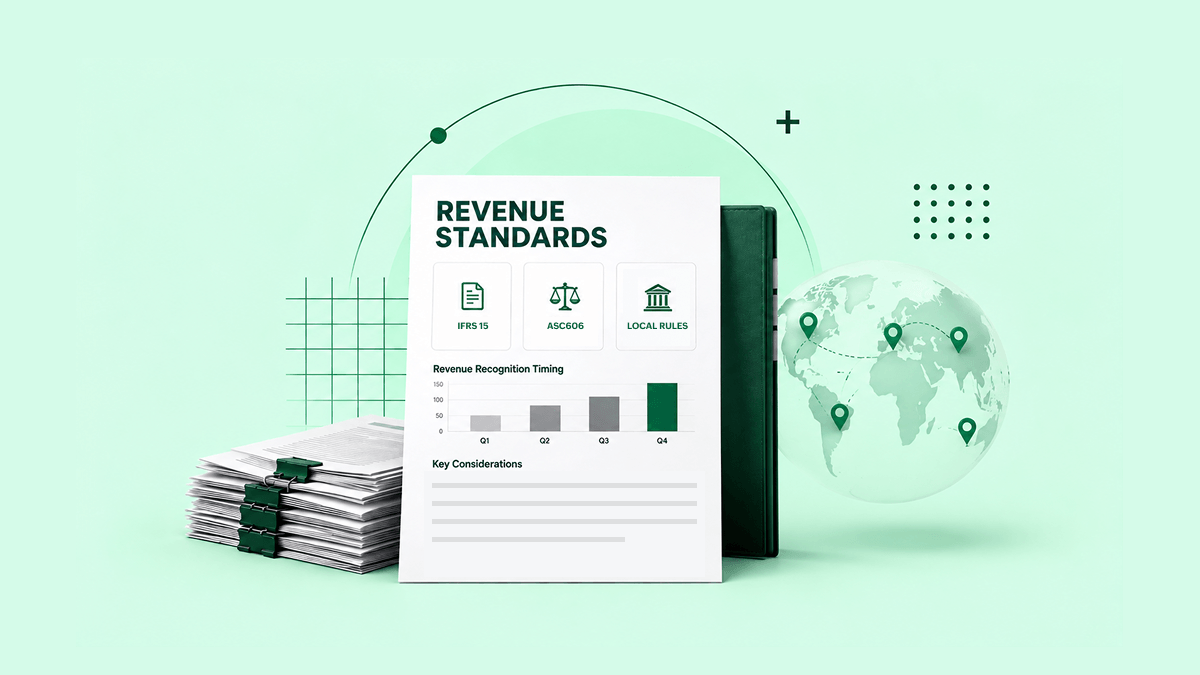
To fix this, the Financial Accounting Standards Board (FASB) in the US and the International Accounting Standards Board (IASB) globally began working together in 2002 on a joint project to build one common approach to revenue recognition. The result gave the US its own version, ASC 606, for companies reporting under US GAAP, while IFRS 15 became the reference point for companies reporting under International Financial Reporting Standards, the framework most countries outside the US work off of. From there, several individual countries went on to issue their own local versions built on the same underlying logic, largely to fit their own regulatory and reporting needs.
At the core, nearly all of these frameworks run on the same five-step model:
Identify the contract with the customer
Identify the distinct performance obligations in that contract
Determine the transaction price
Allocate that price across the performance obligations
Recognize revenue as each obligation is satisfied
The goal, as most accounting bodies describe it, was to bring consistency and comparability to revenue reporting, regardless of industry or geography. And largely, it worked. But "largely" is doing some heavy lifting in that sentence, because the two standards, while built from the same blueprint, aren't identical twins.
The common revenue recognition standards
Nearly every major economy has its own named standard, and while most of them are built on the same five-step skeleton, each carries its own local flesh and bone. For an enterprise reporting across regions, that's five or six rule books to keep straight.
Global (IFRS jurisdictions): IFRS 15
Issued by the IASB, IFRS 15 is the standard followed across 140-plus jurisdictions, spanning the EU, UK, most of Asia, and a large chunk of Latin America and Africa. For a genuinely global business, this is often the version that matters more, simply because of how much ground it covers. Being principles-based rather than heavily prescriptive, it leans on the substance of a contract over its exact wording, which gives finance teams room to apply it sensibly across very different industries and deal structures without needing a separate rule book for each one.
United States: ASC 606
Issued by the FASB, ASC 606 is the standard for companies reporting under US GAAP. Of all the regional versions, it's the strictest on paper. The FASB built in extra guidance specifically to help companies judge how confident they need to be that a customer will actually pay, and that confidence level generally works out to somewhere in the 70–80% range before revenue can be recognized at all.
India: Ind AS 115
India's version, notified by the Ministry of Corporate Affairs, follows the same five-step logic and replaced older standards that leaned on risk transfer instead of control. The core mechanics are the same as IFRS 15, but a few sectors like real estate and IT or software companies have more untangling to do before revenue can be split and recognized correctly.
China: CAS 14
Issued by China's Ministry of Finance, CAS 14 runs on the same five-step, control-based logic as IFRS 15, but it stays more tightly bound to China's tax and statutory reporting requirements than the other versions do, since Chinese GAAP has traditionally kept a closer link between book income and taxable income than IFRS or US GAAP. That extra layer of local compliance is something multi-geo companies with a China entity need to plan for separately from the accounting mechanics itself.
Japan: ASBJ Statement No. 29
Japan chose to write its own standard rather than adopt IFRS 15 directly. Issued under J-GAAP, it follows IFRS 15 closely in substance, with a handful of simplified, Japan-specific workarounds layered in. The detail that trips up multi-geo companies most: IFRS adoption itself is still optional in Japan, even for consolidated reporting. So a Japanese subsidiary can keep filing locally under J-GAAP while the parent consolidates everything under IFRS or US GAAP a level up.
Everyone else
Countries that haven't issued a dedicated local equivalent (or that permit IFRS adoption outright) generally default to IFRS 15 for consolidated reporting, but local statutory books can still run on older, country-specific frameworks until regulators catch up.
The common deviations among the various revenue recognition standards across the globe
Threshold for collectability
One of the more consequential differences lies in how "probable" the collection of payment needs to be before revenue can be recognized. Under ASC 606, this threshold sits around 70–80%, while IFRS 15 sets a lower bar of "more likely than not," which is roughly 50%. In practice, this means the same contract could technically qualify for revenue recognition earlier under IFRS 15 than it would under ASC 606.
Disclosure requirements
ASC 606 tends to be more detailed and rule-based in what it expects companies to disclose about their revenue. IFRS 15 leans on principles, giving companies more room to tailor disclosures to how their business model actually works. Neither approach is "better," but for a company reporting under both frameworks, it does mean double the disclosure planning.
Contract costs and licensing
There are also differences in how each standard treats the costs incurred to obtain a contract, along with how licenses of intellectual property are recognized. US GAAP tends to offer more specific, prescriptive guidance in these areas, while IFRS allows more judgment call room, with fewer industry-specific carve-outs.
Local GAAP layered on top
Many countries have their own local adaptation of IFRS 15, and while they're largely aligned, small local carve-outs do exist for tax purposes or regulatory oversight. India's Ind AS 115, for instance, mirrors IFRS 15 closely but is filtered through India's own company law requirements. Similarly, China's CAS 14 converges with IFRS in spirit, but statutory filings still run through local rules that can differ from what a parent company reports at a consolidated level.
Such variations make revenue recognition a genuine headache for enterprises operating across regions. A subsidiary might be fully compliant with its local statutory requirement while still needing adjustments before that same revenue rolls up cleanly into the group's consolidated financials.
It isn't just a theoretical concern either. A recent survey of finance leaders found that nearly half struggle to consistently adhere to standards like ASC 606 and IFRS 15 while also satisfying audit requirements, with about a third saying revenue recognition workflow issues have directly led to compliance risks or audit adjustments. When a single entity finds this difficult, the challenge only compounds once you add multiple jurisdictions, currencies, and local statutory books into the mix.
Things to keep in mind as a multi-geo company
If your enterprise operates in more than one country, here's where the actual work lies.
Review contracts region by region, not just centrally
The same type of contract (say, a multi-year software license bundled with implementation services) could get parsed into different performance obligations depending on which standard applies. What counts as "distinct" in one framework might not hold up the same way in another. Reviewing contracts only at a global template level, without checking how local teams interpret and apply them, is where inconsistencies creep in.
Plan for dual reporting from the start
Most multi-geo enterprises end up maintaining two versions of the truth: one for local statutory filing and one for group-level consolidation. Rather than treating this as an afterthought once numbers don't reconcile, it helps to build the chart of accounts and revenue recognition policies with both outcomes in mind from day one.
Keep documentation audit-ready, always
Multi-geo companies are more likely to face scrutiny simply because of the complexity involved. Judgment calls made on performance obligations, standalone selling prices, or variable consideration should be documented as they happen, not reconstructed months later when an auditor asks, "Why was this recognized this way?"
Invest in a system that doesn't force manual reconciliation
Spreadsheets can hold up for a single entity. They tend to fall apart the moment multiple subsidiaries, currencies, and local rules enter the picture. A billing or a revenue management system that can apply standard-specific rules, track obligations against contracts, and generate audit trails automatically removes a significant chunk of the manual risk that creeps in when teams try to reconcile everything by hand at quarter-end. If you're looking to bring more consistency and control to how your enterprise recognizes revenue across geographies, connect with our experts to see how Zoho Billing can fit into your existing setup.
Frequently Asked Questions
There isn't one exact number, since dozens of countries have their own local version, but the major ones include IFRS 15 (used across 160+ countries), ASC 606 (US), Ind AS 115 (India), CAS 14 (China), and Japan's ASBJ Statement No. 29. Countries without their own dedicated standard generally default to IFRS 15 for consolidated reporting.
The core five-step model stays the same everywhere, but the details differ: how confident you need to be that you'll get paid before recognizing revenue, how much detail you're required to disclose, and how contract costs or licensing get treated. Local versions also layer in country-specific tax and regulatory requirements on top of that shared foundation.
Review contracts at the local level, not just centrally, since the same contract can be split differently depending on which standard applies. It also helps to plan for dual reporting (local books plus group consolidation) from the start, keep documentation ready for audits as decisions are made, and use a system that doesn't rely on manual reconciliation across entities.
ASC 606 is more rule-based and prescriptive, requiring a higher level of confidence (roughly 70–80%) that a customer will actually pay before revenue can be recognized. IFRS 15 is more principles-based, sets a lower bar (around 50%, or "more likely than not"), and gives companies more room to use judgment in areas like disclosures and licensing.
The shared five steps are just the skeleton, not the fine print. Each country layers in its own rules on things like how sure you need to be about getting paid, how much detail to disclose, and how to handle contract costs, so two companies can follow the same five steps and still land on different numbers.