





- HOME
- Payroll compliance
- New WPS rules in the UAE - What changes from 1st June 2026
New WPS rules in the UAE - What changes from 1st June 2026
For UAE private sector employers, the way salaries are paid is about to change. On 12 May 2026, the Ministry of Human Resources and Emiratisation (MoHRE) issued Ministerial Resolution No. 340 of 2026, introducing significant changes to the Wage Protection System (WPS). The updated rules take effect on 1 June 2026 and standardise how, when, and to what extent salaries must be paid across every MoHRE-registered business.
The two most important changes are straightforward. Every private sector company in the UAE now follows the same payday calendar, and the buffer before penalties begin has been shortened. For finance, HR, and payroll teams, this represents a meaningful operational shift that requires careful planning ahead of the June effective date.
This guide walks through what’s changing, what the new enforcement timeline looks like, and what UAE employers should do in the weeks ahead to be ready.
A quick refresher on the Wage Protection System
The Wage Protection System was introduced in 2009 by MoHRE in coordination with the Central Bank of the UAE. It requires private sector employers to pay employees through approved electronic channels and gives the ministry direct visibility into whether wages are being paid on time and in full. Today, it covers more than 99% of private sector workers and processes over AED 35 billion in monthly wage transfers.
In December 2025, MoHRE launched an upgraded WPS in collaboration with the Central Bank, Al Etihad Payments, and several financial institutions, introducing real-time data integration that enables faster monitoring and enforcement under the new rules.
Until now, individual employment contracts often determined the exact salary due date, leading to varying payment schedules across companies and sectors. Ministerial Resolution No. 340 of 2026 removes that variability, creates a single unified payday across the entire private sector, and repeals the previous Ministerial Resolution No. 598 of 2022.
For a complete breakdown of how WPS works for employers, see our WPS employer guide.
What’s changing under Ministerial Resolution No. 340 of 2026
One unified payday for every private sector business
Salaries are now due on the 1st of every Gregorian month for the previous month’s work. Contract-based and sector-specific due dates no longer apply. In practice, this means June 2026 wages must be paid by 1st July 2026, July wages by 1st August 2026, and so on. Any salary payment that lands after the 1st is officially considered delayed under the new system.
A shorter grace period
Under the previous WPS rules, employers had a 15-day grace period after the salary due date before administrative penalties applied. The revised resolution reduces this window to 10 days. Administrative measures begin from the 11th day after the salary is due. The grace period continues to exist, but it now serves a much narrower function and should be treated as a safety net, not as part of routine payroll planning.
A new 85% compliance threshold
The resolution introduces a formal definition of what counts as on-time payment. An employee is considered to have been paid on time when at least 85% of their total monthly wages, as defined under the existing labour law, is paid by the deadline. The threshold accounts for legally permitted deductions and withholdings under Federal Decree-Law No. 33 of 2021, so partial payments tied to legitimate exceptions do not automatically classify the payment as delayed. Employees retain the full right to claim any unpaid balance.
Updated exemptions
The new rules apply to every private sector establishment registered with MoHRE. A few specific categories of workers and sectors remain outside the scope of WPS, including seafarers approved by the ministry, employees of overseas firms paid outside the UAE, workers on short-term mission permits of up to three months, and those on approved unpaid leave or reported absconding. Certain sectors are also excluded entirely, such as fishing boats and individually owned taxis, along with banks, financial institutions, and places of worship. Employers should confirm whether any segment of their workforce qualifies for an exemption well before the 1 June effective date.
Delegation of salary payments
The resolution also formalises the option for establishments to delegate wage payments to a third party, such as a payroll services provider, group treasury function, or staffing agency. Legal responsibility for on-time payment, however, remains with the establishment, and all enforcement measures continue to apply regardless of any delegation arrangement.
The new enforcement timeline
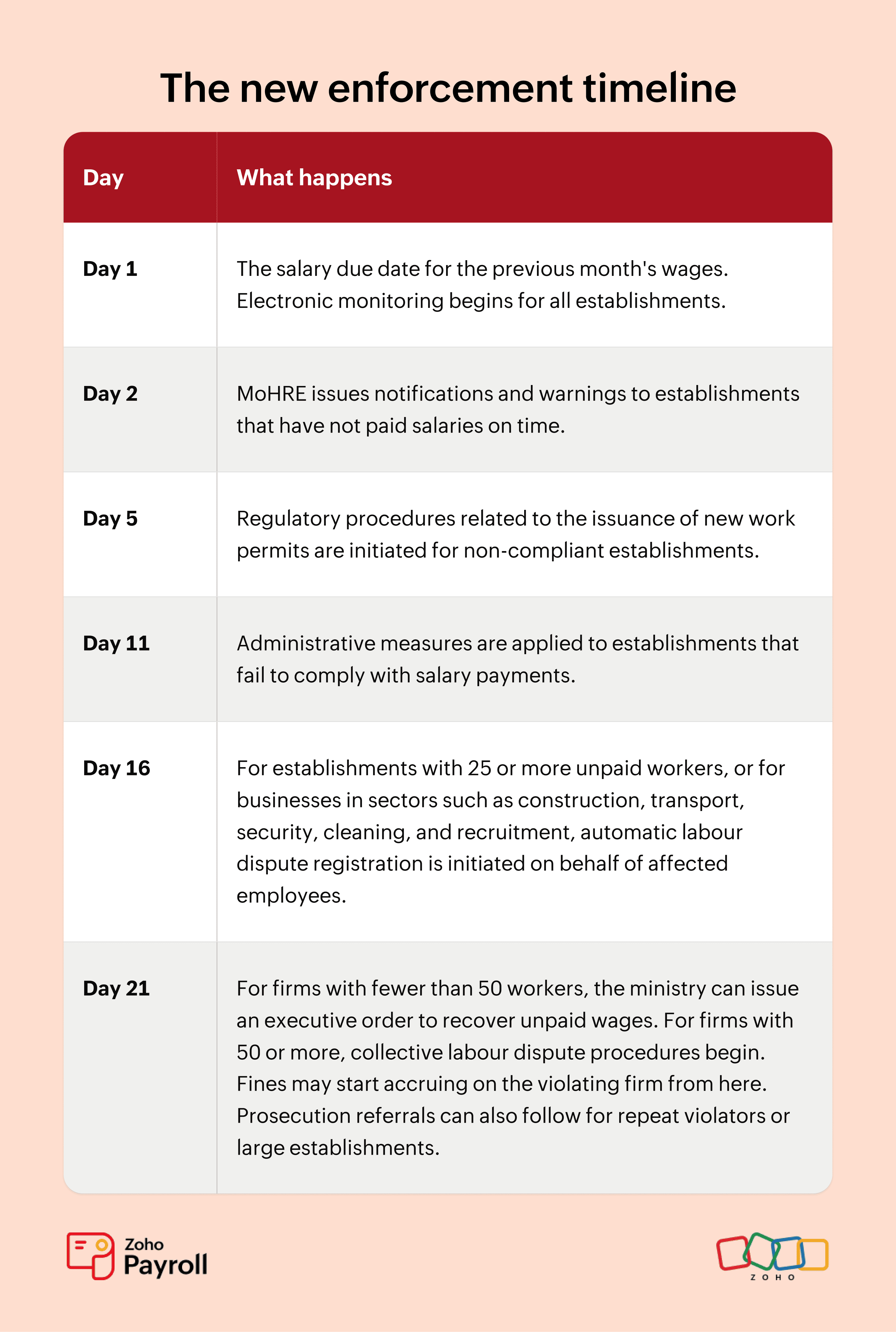
The resolution introduces a tiered enforcement framework that activates progressively if salaries remain unpaid past the due date.
When the real challenge is cashflow
For many UAE businesses, late salary payments are not caused by poor planning or oversight. They happen because the funds are not in place when payday arrives. A client paying late, an invoice stuck in an approval cycle, or an unexpected cost arriving at the wrong time are common reasons for these gaps.
The previous 15-day grace period under WPS gave businesses room to manage these timing issues without immediate penalty. The revised 10-day window reduces that flexibility, which means early visibility into monthly cashflow becomes critical.
Strong forecasting and the ability to identify cashflow risks well before payday allow finance teams to take action while there is still time. Following up on receivables, arranging a short-term credit line, or having an early conversation with a key client about payment terms are practical measures that depend on having that lead time in the first place.
A practical checklist for UAE employers
Five concrete steps to take in the weeks before 1 June 2026.
Audit your monthly payroll calendar. Confirm that salary runs are timed so funds clear into employee accounts by the 1st of the month, not just initiated on the 1st. Bank processing typically takes one to two working days, which should be factored into your timing.
Build a buffer for exceptions. New joiners, terminations, mid-cycle salary changes, and corrections are common sources of delay. These should be finalised well before the deadline rather than at the last moment.
Review your WPS file submission process end to end. Confirm that the Salary Information File (SIF) is generated in the format required by MoHRE and the Central Bank, and that your bank or payroll provider can process the submission within your monthly timeline.
Brief your finance and HR teams. Everyone involved in the monthly payroll cycle should understand the new enforcement timeline, the 85% threshold, and the consequences of delay.
Confirm sector and worker exemptions. If any segment of your workforce falls outside WPS scope, ensure the supporting documentation is in place and readily available.
How Zoho Payroll helps
Zoho Payrollis built to handle the operational and compliance demands of UAE payroll, and the platform is fully aligned with the new WPS rules taking effect on 1 June 2026.
You can schedule monthly pay runs so that salaries are processed and cleared into employee accounts before the deadline. The SIF file is automatically generated in the format approved by MoHRE and accepted by participating UAE banks, which removes the manual work and risk of formatting errors that often delay submissions.
Real-time compliance reporting gives finance and HR teams continuous visibility into the status of every monthly cycle. When potential gaps are detected, early warnings give you time to take corrective action well before the grace period expires. As MoHRE rules continue to evolve, the platform is updated to reflect the latest requirements, so you don’t have to keep track of every regulatory change yourself.
The new Wage Protection System rules represent a meaningful step toward a more structured and transparent labour market in the UAE. For private sector employers, the practical work between now and 1 June 2026 is manageable. Audit your payroll calendar, brief your teams, and make sure your WPS file process is ready for the new timeline.
If you’d like to see how Zoho Payrollhandles UAE payroll under the new WPS framework, you can explore the platform with a 14-day free trial.
Frequently asked questions
1. When does the new WPS rule take effect?
On 1st June 2026, MoHRE issued Ministerial Resolution No. 340 of 2026 which was announced on 12 May 2026.
2. What is the new salary payment deadline?
Salaries for the previous month are due on the 1st of every Gregorian month. Contract-based due dates no longer apply.
3. How has the grace period changed?
The 15-day grace period has been shortened to 10 days. Administrative measures begin from Day 11.
4. What is the new 85% compliance threshold?
An employee is considered paid on time when at least 85% of their total monthly wages, as defined under existing labour law, is paid by the deadline. Employees retain the right to claim any unpaid balance.
5. What is the new enforcement timeline?
Warnings begin Day 2, work permit restrictions Day 5, administrative measures Day 11, automatic labour disputes Day 16, and executive orders, asset seizures, travel bans, and Public Prosecution referrals from Day 21.
6. Does the new resolution replace the previous WPS rules?
Yes. It replaces Ministerial Resolution No. 598 of 2022 in its entirety.
7. Does the new resolution apply to free zone companies?
DIFC and ADGM operate under their own employment frameworks and are exempt. Most other free zones, including JAFZA, DAFZA, and DMCC, fall under federal labour law and must comply.
8. What if our employment contracts specify a different pay date?
The new rule supersedes contractual terms. Contracts don't need formal amendment, but internal payroll processes must align with the 1st of every month.
9. How does Zoho Payroll help with WPS compliance?
Zoho Payroll can schedule pay runs, auto-generate SIF files in MoHRE's approved format, and give finance teams real-time visibility into every monthly cycle.