

- HOME
- Taxes & compliance
- What taxes do new businesses pay in the UK?
What taxes do new businesses pay in the UK?
A new business rarely feels profitable when the first customer pays.
By that point, the owner may already have spent money on equipment, software, insurance, a website, and a dozen smaller things that seem to appear from nowhere. The payment lands, covers some of those costs, and leaves a little behind. It is tempting to see whatever remains in the bank as available cash.
That is where tax can quietly become a problem.
The bill does not arrive every time a customer pays. It may not arrive for months. In the meantime, the money gets used for stock, advertising, rent, or simply keeping the business going. When HMRC eventually asks for its share, the original payment can feel like a distant memory.
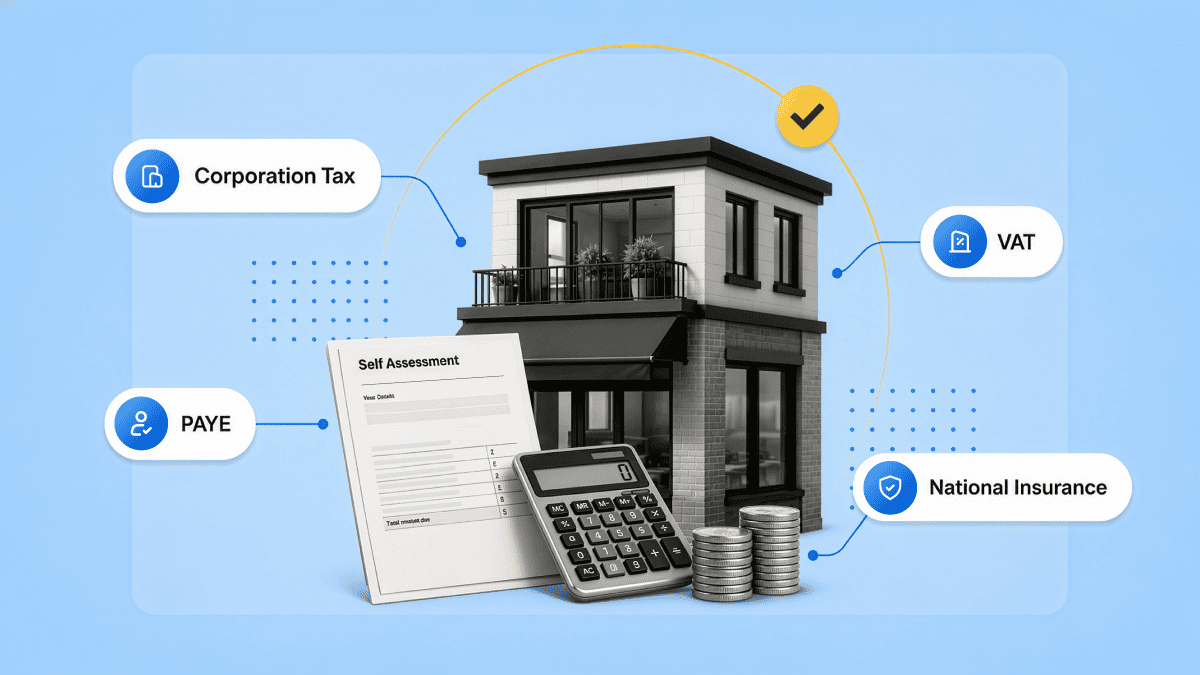
There is no single tax charged simply because a business is new. Some owners pay income tax and National Insurance through Self Assessment. Companies pay Corporation Tax. VAT begins when taxable sales reach the registration threshold, unless the business chooses to register earlier. Employing someone introduces payroll deductions and employer costs. Moving into commercial premises may bring business rates.
Not all of these will apply at once. Quite often, only one or two matter at the beginning.
The first thing to settle is how the business is being run.
The structure changes the answer
Consider two people offering the same service. They charge similar prices, work from home, and have roughly the same running costs. One trades under their own name as a sole trader. The other invoices through a limited company.
From the customer’s point of view, there may be very little difference. For tax, they are completely different.
A sole trader is personally responsible for their business income. Sales are recorded, allowable costs are deducted, and the profit is included in the owner’s Self Assessment return.
A partnership follows a similar idea, except that the profit is divided between the partners. Each person pays tax on the share allocated to them.
A limited company stands on its own. Legally, the company earns the money. It pays Corporation Tax on its taxable profit, and the people behind it may later pay personal tax when they receive a salary or dividend.
That separation matters. Money in a company account does not automatically become the director’s money. Taking it out needs to be recorded in the right way.
Sales and profit are not the same thing for a sole trader
Suppose a freelance designer invoices £45,000 during the year.
That figure is turnover. It tells you how much the business sold, but not how much the owner actually made. The designer may have paid for software, insurance, advertising, a computer, professional advice, and travel connected with client work.
If the allowable costs come to £9,000, the starting profit is £36,000. Income tax is worked out from the profit rather than the full £45,000 of sales.
This is reassuring until every purchase starts being treated as a business expense.
The fact that something was paid for with a business card does not make it allowable. The spending needs to have a genuine business purpose and meet HMRC’s conditions. An accounting subscription used only for work is fairly clear. A mobile phone used for both business and personal calls may need to be split. Ordinary clothing will not normally qualify just because it was worn while meeting a customer.
Receipts matter, but so does the reason behind the purchase.
Most sole traders need to register for Self Assessment once their gross trading income goes above £1,000 during a tax year. That £1,000 test looks at income before expenses.
For a small side business with very few costs, the trading allowance may be useful. Someone who earns £3,500 and spends £150 might choose the £1,000 allowance instead of claiming the £150. Another person with the same income but £1,200 of genuine expenses would probably claim the actual costs.
Normally, the allowance and actual expenses cannot both be used against the same trading income.
Income tax is only part of the sole trader bill
For 2026–27, the standard personal allowance is £12,570. That does not mean every sole trader can earn £12,570 from the business without tax. The allowance applies to the person’s overall taxable income.
Someone who already earns a salary may have used some or all of it before their business profit is added. There is no second allowance waiting for the self-employed income.
In England, Wales, and Northern Ireland, taxable income then moves through the 20%, 40%, and 45% income tax bands. Scotland uses different rates and bands for earnings.
A sole trader may also pay Class 4 National Insurance. For 2026–27, it is charged at 6% on profits between £12,570 and £50,270, then at 2% above £50,270.
Class 2 works differently now. When annual profits are at least £7,105, the contribution is generally treated as paid without money being collected. This helps protect the person’s National Insurance record. Someone with lower profits may choose to make voluntary Class 2 payments, which cost £3.65 a week for 2026–27.
There is another point that often causes confusion. Sole traders are taxed on profit, not on the amount they withdraw.
Leaving £8,000 in the business account does not remove it from the tax calculation. If it forms part of the year’s profit, it is still counted.
Why the first Self Assessment payment can hurt
Most new sole traders expect to pay tax. What they do not always expect is the gap between earning the money and paying the bill.
The UK tax year ends on 5 April. An online return is normally due by the following 31 January, along with any balancing payment.
That can put a long stretch of time between the work and the tax. Income earned near the beginning of one tax year may still be sitting in the business account many months later. Or, more realistically, it may have been spent.
Payments on account can add to the shock.
These are advance payments towards the following year’s bill. Each one is normally based on half of the previous year’s qualifying liability. The first is due on 31 January and the second on 31 July.
Imagine a new sole trader whose first bill is £4,000. The amount requested in January could be £6,000: the £4,000 already owed and another £2,000 towards the next year. A second £2,000 would follow in July.
The extra amount is not a second tax on the same income. It is credited towards the following bill. That explanation may be technically comforting. It does not make £6,000 any easier to find.
Payments on account are usually not required when the relevant bill is below £1,000 or when more than 80% of the tax has already been collected elsewhere.
This is why many sole traders move money into a separate savings account as soon as an invoice is paid. The percentage will vary from one person to another, but separating something is better than assuming January will sort itself out.
Partnerships come with one easily missed detail
A traditional partnership prepares accounts for the whole business and reports how the profit has been shared. Each partner then includes their portion on a personal Self Assessment return. The tax follows the allocated profit, not necessarily the cash taken from the account.
Say two partners make a total profit of £70,000 and divide it equally. Each would generally be taxed on £35,000. They cannot reduce that figure simply by leaving part of the money in the partnership to pay future bills.
That is worth discussing early, especially when one partner takes more cash from the business than the other. The partnership agreement, the profit split, and the day-to-day withdrawals should not be allowed to drift into three different arrangements.
As the business grows, the partnership may also need to deal with VAT, payroll, and workplace pensions.
A company pays its own tax first
Limited companies pay Corporation Tax on their taxable profit.
The small-profits rate is 19% for companies with profits of £50,000 or less. The main rate is 25% when profits are above £250,000. Between those limits, Marginal Relief produces a gradual increase in the effective rate.
The limits can be reduced when companies are associated with one another. An owner with several companies should not assume that each receives the full £50,000 lower limit.
Again, the tax is charged on profit rather than turnover.
A company could invoice £180,000 and have a taxable profit of £40,000 once wages, stock, rent, and other allowable costs have been considered.
There can still be an unpleasant surprise. Profit in the accounts is not the same as cash in the bank.
Some customers may not have paid. Money may be tied up in stock. The company may have bought equipment or repaid borrowing. None of that necessarily removes the Corporation Tax bill.
For most smaller companies, Corporation Tax is due nine months and one day after the accounting period ends. The Company Tax Return is generally due later, within 12 months of the period's end.
That difference catches people by surprise. The payment deadline can arrive before the return deadline.
Salary and dividends are two different things
A company director may receive a salary. The salary goes through payroll, with income tax and employee National Insurance deducted where required. The company may also owe employer National Insurance.
A qualifying salary is normally deducted when the company works out its taxable profit.
Dividends come from a different place. They are paid out of profits available for distribution after Corporation Tax. They do not reduce the company’s profit in the way a salary usually does.
For 2026–27, the dividend allowance remains £500. Dividend income above the available allowance is taxed at 10.75% for basic-rate taxpayers, 35.75% for higher-rate taxpayers, and 39.35% for additional-rate taxpayers.
This does not make dividends automatically better than salary.
The sensible mix depends on the director’s other income, the company’s profit, National Insurance, and the allowances available. The company also needs enough distributable profit before it can legally declare a dividend.
A healthy bank balance is not proof that a dividend can be paid.
VAT can arrive while the business still feels small
A business must generally register for VAT when its taxable turnover goes above £90,000 during any rolling 12-month period.
Rolling is the important word.
It is not enough to check sales at the end of December, the end of the tax year, or the company year's end. A growing business should look back over the previous 12 months at the end of every month.
There is also a separate test where taxable sales are expected to exceed £90,000 during the next 30 days alone. One unusually large contract could be enough.
VAT is based on sales rather than profit. A business can therefore cross the threshold even when its margins are poor.
After registering, a business normally charges VAT on taxable sales, keeps digital VAT records, submits returns, and pays HMRC the difference between the VAT collected and any eligible VAT reclaimed on purchases.
The standard rate is 20%, but not everything is standard-rated. Some supplies are charged at 5% or 0%. Others are exempt or outside the scope of UK VAT.
The money collected needs to be treated carefully.
If an invoice totals £1,200, including £200 of VAT, the full £1,200 is not ordinary sales income. Some or all of the £200 may have to be passed to HMRC.
It is remarkably easy to spend that money because it sits in the same account as everything else. The mistake only becomes visible when the VAT return is due.
Voluntary registration is possible below £90,000. It can be useful when the business has substantial VAT costs and sells mainly to VAT-registered customers. It may be less appealing when customers are members of the public and cannot reclaim the VAT added to the price.
The first employee costs more than the advertised salary
Hiring someone introduces PAYE, employee deductions, and employer costs.
The business normally registers as an employer before the first payday. It then reports payroll information to HMRC whenever employees are paid.
For most employees, employer National Insurance is charged at 15% on earnings above the £5,000 annual Secondary Threshold in 2026–27.
There may also be pension contributions, equipment, software access, insurance, training, and paid leave.
So a £30,000 employee does not cost the business £30,000.
Eligible employers may reduce their National Insurance bill through the Employment Allowance, worth up to £10,500. A company where the only employee above the threshold is also the sole director will generally not qualify.
Payroll is one of those jobs that becomes much harder when it is set up after the first salary has already been promised.
Premises and specialist work can add more
A shop, office, warehouse, or studio may bring business rates into the mix.
In England, an eligible business using one property may pay no business rates when its rateable value is £12,000 or less. Relief is gradually reduced for properties valued between £12,001 and £15,000.
Scotland, Wales, and Northern Ireland have their own systems.
Working from home does not automatically create a business-rates bill. A desk in a spare bedroom is unlikely to be treated in the same way as a room converted into a salon, clinic, or customer-facing workshop.
Some industries also have rules of their own. Construction businesses may need to operate the Construction Industry Scheme. Importers can face customs duty and import VAT. Alcohol, tobacco, and fuel may bring excise duties. Selling a business asset can result in Capital Gains Tax for an individual or Corporation Tax on a company’s gain.
These are not issues every founder needs to worry about. They are, however, worth checking before the first sale when the business deals with regulated goods, property, construction, or international trade.
Making Tax Digital has changed the routine for some sole traders
Making Tax Digital for Income Tax began on 6 April 2026.
It applies first to sole traders and landlords whose combined qualifying income from self-employment and property was more than £50,000 on their 2024–25 Self Assessment return.
The test uses gross income before expenses, not profit.
Someone with £55,000 of sales and £25,000 of costs may therefore be included even though only £30,000 remains before tax.
The threshold falls to more than £30,000 from April 2027, based on the 2025–26 return. It then falls to more than £20,000 from April 2028, based on the 2026–27 return.
People within the system must keep digital records and use compatible software to send quarterly updates and complete their annual return.
Quarterly updates do not mean income tax is paid every quarter. The usual Self Assessment payment timetable still applies.
The most difficult tax bills are not always the biggest. Often, they are simply the ones nobody saw coming.
A sole trader has a strong summer and spends the cash before January. A company makes a profit but has most of its money tied up in unpaid invoices. A growing business crosses the VAT threshold and notices three months too late.
None of this begins with a complicated tax rule. It begins with records being left until later. Keeping the accounts current shows what the business earned, what it spent, what customers still owe, and how much of the bank balance may need to be left alone.
Zoho Books can help UK businesses record income and expenses, follow up on unpaid invoices, maintain digital VAT records, submit VAT returns to HMRC, and manage Making Tax Digital for Income Tax requirements for supported sole traders and landlords.
A founder does not need to memorise every rate and deadline. They do need to know when sales are climbing towards a threshold, what the business has actually made, and which part of the money in the account is not available to spend. That is usually what keeps a routine tax bill from turning into a cash-flow crisis.