

- HOME
- Taxes & compliance
- Sole trader vs. Limited company: Which one is right for you?
Sole trader vs. Limited company: Which one is right for you?
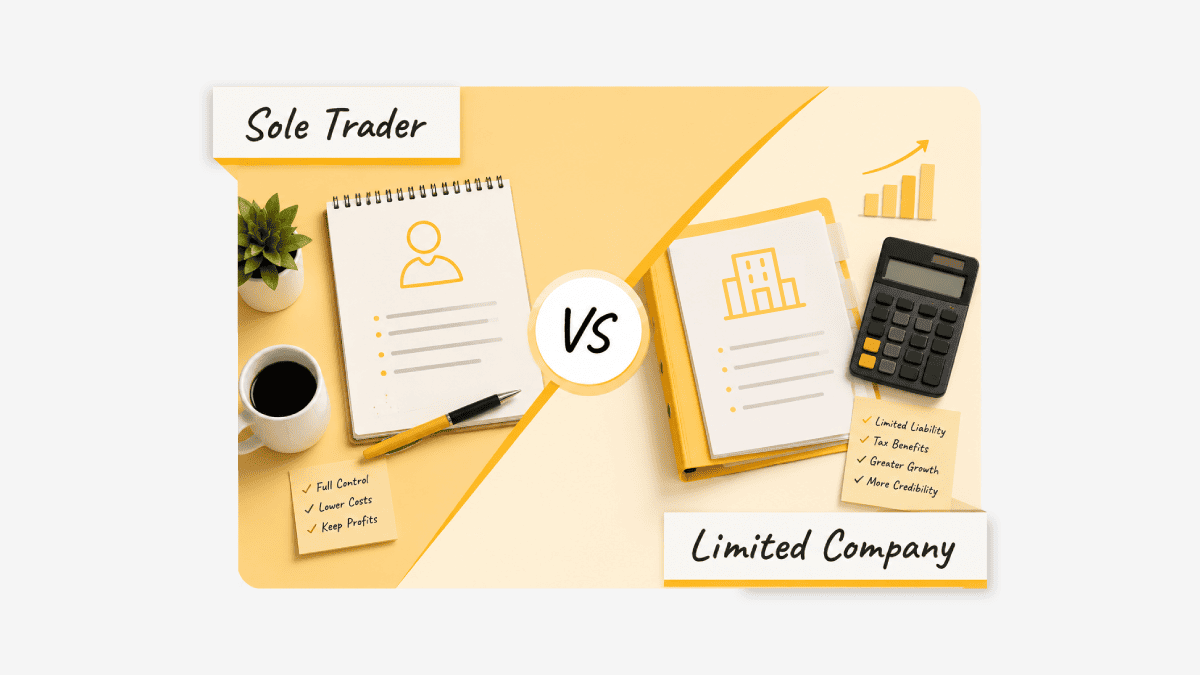
Starting a business means making numerous decisions early on, and one of the most consequential is choosing what entity you register as. The two most common options are operating as a sole trader or setting up a limited company, while there are other options like partnerships and limited liability partnerships (LLPs). Each comes with its own tax implications, legal responsibilities, and administrative requirements. The right choice depends on where you are in your business journey and where you plan to go.
What is a sole trader?
A sole trader is the simplest form of business structure in the UK. There is no legal distinction between you and your business; you are one and the same. You register as self-employed with HMRC, file a Self Assessment tax return each year, and keep all profits after tax.
It is easy to see why this structure is so popular. In 2025, the Federation of Small Businesses claimed that the UK private sector business population is made up of 3.2 million sole proprietorships, accounting to 57% of the total. For many business owners, the appeal lies in how quickly and easily you can get started because there is no Companies House registration, no filing fees, and no waiting.
What is a limited company?
A limited company is a separate legal entity, distinct from the people who own or run it. It can enter contracts, own assets, and carry debt in its own name. As a director, you are an officer of the company and typically draw income through a combination of salary and dividends.
Registration with Companies House takes 24 to 48 hours online and costs £100–160 as of 2026. Along with that comes a broader set of ongoing obligations, annual accounts, a Corporation Tax return, and a confirmation statement that sole traders are not required to file. It is more involved, but for many businesses as they grow, what it offers in return is worth it.
To help you understand the setup better, let's take two founders with two different paths. Both are first-timers, but their situations are different.
The first is a freelance graphic designer. They have three clients lined up, all individuals and small independent businesses. Their expected income in year one is around £35,000. They have no employees or physical premises, and their clients are not asking for anything formal in terms of business structure. Hence, they opt for the sole trader model..
The second founder is launching a B2B software consultancy. They expect to pitch to mid-size companies and NHS procurement teams from the start. They also have a co-founder, expect to bring in a developer within six months, and is projecting £90,000 in year-one revenue, with significant upside if the NHS contracts come through. Therefore, they plan to register as a limited company.
| Sole trader | Limited company |
Setup time | 24–48 hours (HMRC registration) | 24–48 hours (Companies House + HMRC) |
Setup cost | Free | £100 (as of 2026) |
Tax | Income tax + National Insurance on profits via Self Assessment | Corporation Tax on profits; can take salary + dividends as director/shareholder |
Admin burden | Low with an annual self-assessment return | Higher with annual accounts, confirmation statements, payroll |
Client perception | Fine for individuals and small businesses | Expected by corporates and public sector procurement |
Personal liability | Full; personal assets are exposed | Protected; the company is a separate legal entity |
Right fit reasoning | Low overheads, solo operation, no complex client requirements | Co-founder involved, corporate clients, personal asset protection needed from day one |
How the two structures actually differ
Setup and cost
Registering with HMRC as a sole trader costs nothing and can be done in minutes. However, a limited company costs around £100 to register with Companies House and requires more steps before you can start operating.
Registrations
VAT registration becomes mandatory once your taxable turnover exceeds £90,000 in a 12-month period, regardless of business structure. Some businesses register voluntarily before that point, either to reclaim VAT on purchases or to signal a level of establishment to clients.
If you take on employees, both structures require you to register as an employer with HMRC and operate PAYE. The one distinction worth noting is that a limited company director paying themselves a salary must run payroll even with no other employees, since the director is treated as an employee of the company.
While not legally required for sole traders, a separate business bank account is strongly advisable. It keeps personal and business finances distinct and makes recordkeeping considerably easier.
Depending on your industry, specific licenses or permits may also apply. Food businesses, financial services, and certain trades all have regulatory requirements that sit alongside your business structure registration.
Tax
As of 2026, there are specific tax requirements for sole traders and limited companies.
As a sole trader, your profits are treated as personal income. You pay income tax at 20%, 40%, or 45% depending on how much you earn. Similarly, the National Insurance also varies, at 6% on profits between £12,570 and £50,270 and 2% above that. Learn more about National Insurance here.
A limited company pays Corporation Tax on its profits, 19% up to £50,000 and 25% above £250,000. Directors draw income through a salary and dividend combination, which is typically more tax-efficient at higher profit levels.
Making Tax Digital for Income Tax requires businesses to submit quarterly digital records to HMRC rather than a single annual return. The qualifying income that determines when you should start using MTD is mentioned here in detail.
Reporting obligations
Sole traders file one Self Assessment return a year by 31 January; the ones who registered for MTD should also file an End of Period Statement by the same date after sending quarterly updates. That is the core obligation.
Limited companies file annual statutory accounts, a Corporation Tax return, a Companies House confirmation statement, and run payroll if paying a director's salary. Each has its own deadline. Most limited company directors work with an accountant to manage the annual cycle, which adds to the ongoing cost of operating through this structure.
Personal liability
As a sole trader, there is no legal boundary between your finances and your business's finances. This means, a dispute, a debt, or a claim against the business can put your personal assets at risk.
A limited company provides a layer of separation. Its debts belong to the company, and your liability is generally limited to what you have invested. That protection is not unconditional, personal guarantees and director misconduct are exceptions, but it is a meaningful safeguard, particularly as the business grows and takes on greater financial exposure.
Investment and growth
Sole traders cannot issue shares, which limits their options when it comes to raising external funding or formalising arrangements with co-founders.
Limited companies can issue shares and are eligible for government-backed schemes such as EIS and SEIS, which offer investors significant tax relief. For businesses with plans to scale or seek investment, this distinction often becomes relevant sooner than expected.
Advantages and disadvantages of sole trader
Advantages | Disadvantages |
Free to set up; same day | Unlimited personal liability |
Light admin; one tax return a year | Less tax-efficient as profits grow |
Cash basis accounting available | Hard to raise external investments |
Low accountancy costs | Some larger clients might not work with you |
Advantages and disadvantages of a limited company
Advantages | Disadvantages |
Personal liability protection | More admin; accounts, CT600, confirmation statement |
More tax-efficient after reaching certain profit value | Higher accountancy costs |
Can retain earnings at Corporation Tax rate | Financial records filed publicly |
Can issue shares and raise investments | Costs money to set up |
Moving from sole trader to limited company
A few reasons to transition from a sole trader entity to a limited company are:
Your profits are consistently above ~£60,000–70,000.
A client or contract is requiring you to operate as a limited company.
You are ready to bring in investors or a co-founder.
The personal liability exposure is starting to feel like too much of a risk.
Moving from sole trader to a limited company involves incorporating a new company, transferring assets and contracts, notifying HMRC that you have ceased self-employment, and setting up payroll. It requires some planning but is manageable; most business owners complete the transition over a few weeks.
Accounting software for sole traders and limited companies
Having your records in order before the transition makes the process considerably smoother. Zoho Books keeps your financial history intact and accessible, which simplifies the handover whether you are changing structure or bringing a new accountant on board.
For day-to-day financial management under either structure, accurate recordkeeping is the foundation of compliance. Zoho Books supports MTD-ready VAT and income tax submissions, Self Assessment preparation, and real-time financial reporting, so your books are always in order, whichever structure you operate under.
In summary
A sole trader structure suits those starting out small, operating at modest profit levels, or running a business with limited financial risk. A limited company is generally the better fit for higher profits, growth ambitions, and situations where liability protection or investor-readiness matters. The right answer depends on your specific circumstances, and if you are unsure, an accountant who works with small businesses can model both options and help you decide.
FAQs
How would I register as a sole trader?
You register with HMRC for Self Assessment, either online through the gov.uk website or by post. You'll need your National Insurance number and basic details about your business, including when you started trading. You should register by 5 October following the end of the tax year in which you started trading, to avoid penalties.
Can a sole trader have employees?
Yes. Being a sole trader refers to your own legal and tax status, not the size of your business. If you hire staff, you'll need to register as an employer with HMRC, run PAYE, and meet standard employment obligations like workplace pensions and right-to-work checks.
How do I register as self-employed in the UK?
Registering as self-employed and registering as a sole trader are effectively the same process. You register for Self Assessment with HMRC, which then sets you up to file tax returns and pay income tax and National Insurance on your business profits.
What is public liability insurance for sole traders and how do I get it?
Public liability insurance covers compensation costs if your business activities injure a third party or damage their property. It isn't legally required, but is often expected by clients, particularly in trades or services involving site visits. You can get a quote and buy a policy directly from insurers or through a broker, with the cost depending on your trade and level of risk.
What is HMRC and Companies House?
HMRC (His Majesty's Revenue and Customs) is the UK government body responsible for collecting tax, including income tax, VAT, and National Insurance. Companies House is the registrar of companies in the UK; it incorporates limited companies and maintains the public register of company information, including accounts and confirmation statements.
What are the benefits of registering as a limited company?
A limited company gives you limited liability, meaning your personal assets are generally protected if, for example, the business runs into debt. It can also be more tax-efficient at higher profit levels, since you can pay yourself through a mix of salary and dividends. Limited company status can also lend more credibility with clients, lenders, and suppliers, and makes it easier to sell or transfer ownership of the business later.