- HOME
- Email sending
- Marketing vs. transactional emails: Differences and best practices for 2026
Marketing vs. transactional emails: Differences and best practices for 2026
- Published : September 29, 2023
- Last Updated : April 21, 2026
- 1.7K Views
- 6 Min Read

If you run any online business, you already send emails. Some confirm sign ups and payments, or share purchase details. Others promote offers, new products, or include newsletters. Not all of these emails are drafted equally or sent with the same purpose.
So if you've ever wondered why your order confirmation lands in the inbox instantly while your newsletter sometimes ends up in spam folder, the answer lies in the type of email you're sending.
Understanding the difference between transactional vs. marketing email isn't just a technicality. It directly affects your deliverability, your customer experience, and even your legal compliance. Whether you're a startup or an established business, getting this right matters.
Transactional emails
Transactional emails are personalized emails sent automatically in response to a specific action a user takes. These emails carry information that users actually need right now, such as a receipt after a purchase, a link to reset their password, or a code to verify their account. These emails are expected and often urgent, so they have good open rates. A delayed or undelivered transactional email can create real friction for your user.
Because of that urgency, transactional emails need to be sent through a reliable, dedicated infrastructure—not your regular marketing platform. Platforms such as Zoho ZeptoMail are built specifically for this, offering high deliverability and fast sending speeds.
Marketing emails
Marketing emails are messages you send to a group of subscribers to promote your product, share news, generate new leads, nurture potential customers, and build relationships. Unlike transactional emails, these aren't triggered by a specific user action, they're planned and scheduled by your marketing team.
Marketing emails are the backbone of email marketing campaigns. Done well, they drive sales, increase retention, and keep your brand top-of-mind. Use these emails when you want to reach out to your audience actively. One critical factor is that people on your marketing list should have opted in. This isn't just good practice but it's required by laws such as GDPR (EU), CAN-SPAM Act (USA) and CASL (Canada).
Marketing emails also need clear unsubscribe links. If you ignore that, you may risk your domain's reputation and, potentially, a legal fine.
Marketing vs. transactional emails: Key differences
Both transactional and marketing emails are unique and essential in their own right, and understanding their differences will help you use them to your advantage. Let's take a look at these differences below.
Purpose
Transactional emails are used to deliver critical, action-triggered information. They're functional first. Timely delivery of these emails increases customer satisfaction and cements their faith in your business.
Marketing emails are used to inform, engage, and persuade. They're promotional by nature. The content and structure is the main thing, and it should match your audience's needs and preferences.
Customer interaction
Transactional emails are sent one-to-one, so they're unique to each customer. Here's where the customer initiates the exchange. They buy something, reset their password, or sign up, and your system just responds. There's a clear expectation from your customer's side.
Marketing emails, on the other hand, target a large group of people with the same message. Here, you initiate the contact. That means you need to earn attention with a compelling subject line, valuable content, and the right timing.
Deliverability
Transactional emails, such as security code requests, order confirmations, and password reset emails are time-sensitive and they need to land in the inbox instantly. Any delays can cause a terrible user experience.
Marketing emails are typically sent in large batches, which makes deliverability harder to maintain. Your sender reputation, domain warm up, and list quality all matter a lot here.
This is one of the biggest reasons to keep them separate. If a spam complaint from a marketing campaign affects your sending IP, it can delay your transactional emails, too.
Type of content
The purpose of transactional emails is to provide information about a transaction. The content should be concise and clear, giving just the required data with the necessary CTAs. It’s best to avoid additional and unnecessary promotional content within the body of the email to help maintain good deliverability.
Marketing emails intend on selling or promoting a product. They usually focus on educating the user on certain aspects of the product or service, and provide occasional offers and regular product updates. So, the content should be compelling for the user to make a purchase, or at the least establish some contact with the company.
Opt-ins and Unsubscribe choices
Transactional emails don't require opt-in because they're part of the service the user signed up for. However, they still must not include promotional content.
Marketing emails require opt-in, and every one of them must include an unsubscribe option. This is legally required in most countries and is fundamental to building a healthy email list.
Here's a quick side-by-side comparison to help you decide which type fits your business.
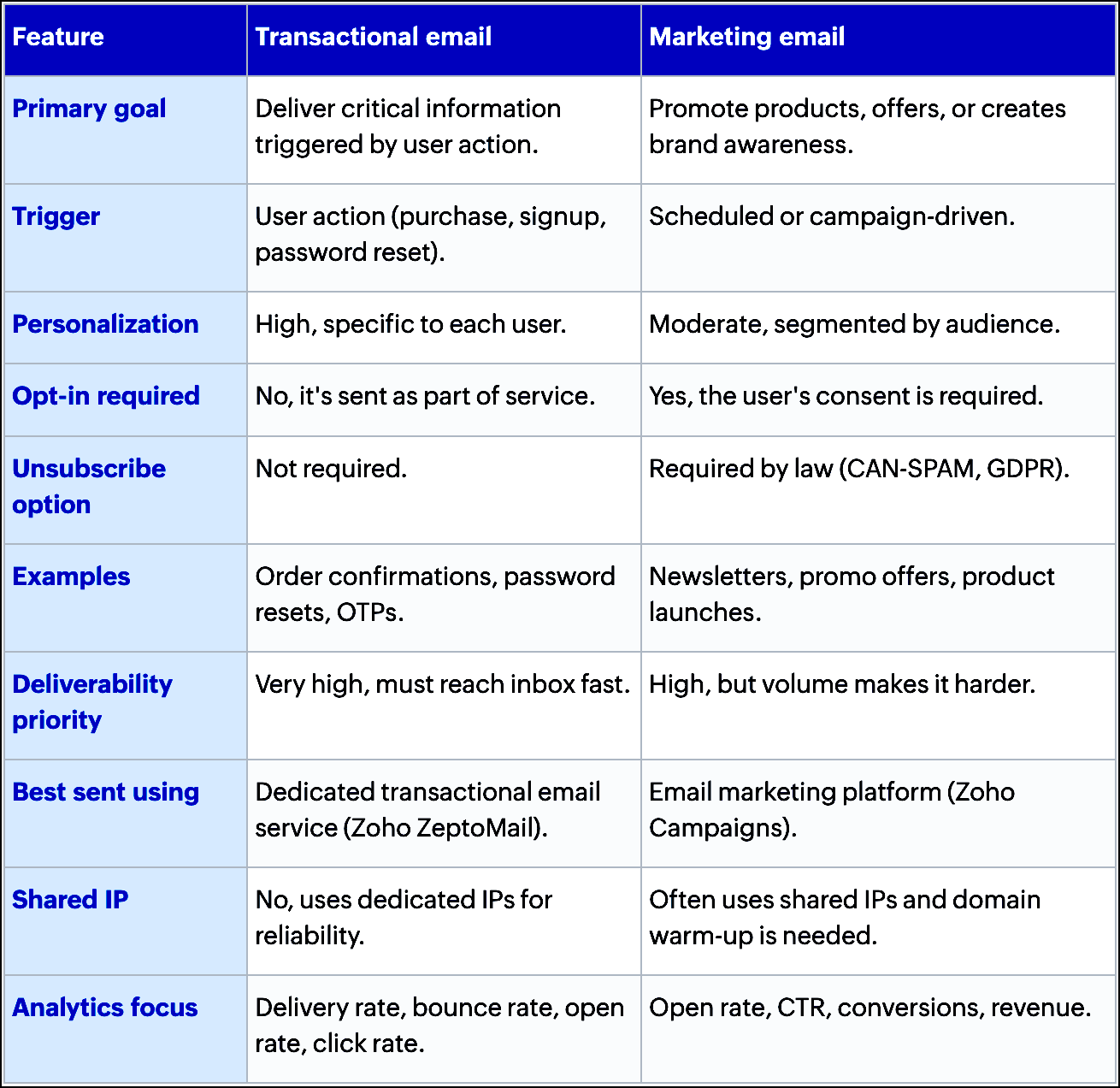
These are the key differences between transactional and marketing emails. Both types of email are pivotal in your company's operations. Understanding their purpose and operation will help you better utilize them in your business.
Common transactional emails examples
Order confirmation emails
Sent immediately after a customer completes a purchase, this email confirms that their order went through and gives them a record of what they bought.
Shipping and delivery notifications
Keep customers informed about order progress, including shipping confirmation, tracking details, and delivery updates.
Account activation and welcome emails
Sent after signup to verify the user’s email and introduce them to your product or service.
Password reset emails
Triggered when a user requests to reset their password, providing a secure link or OTP to regain account access.
Two-factor authentication (2FA)/OTP emails
These time-sensitive emails deliver a one-time code to verify a user's identity. For these emails, speed and reliability are non-negotiable, because a delayed OTP can lock someone out of their account.
Common marketing emails examples
Weekly or monthly newsletters
Regular emails that keep your audience engaged with curated content, updates, tips, or company news, helping you stay top-of-mind.
Product launch announcements
Introduce a new product or feature, highlighting its value and encouraging users to explore or try it.
Promotions and discount offers
Drive conversions with limited-time deals tied to holidays, seasons, or special events.
Feedbacks and surveys
Collect details about customer experience, preferences and challenges.
Why you should separate marketing and transactional emails?
Many businesses start by sending all emails through the same tool. It feels simple, but it can hurt your deliverability as time progresses.
Common problems with a shared email system
- Spam complaints affect all emails: A spam complaint on a promotional email affects your transactional email deliverability.
- Your domain reputation takes a hit: Using the same domain increases risk. If your transactional email domain gets flagged, then critical messages start hitting users' spam folders.
- Unsubscribes create confusion: Users who unsubscribe from marketing emails may unintentionally stop receiving essential updates, too.
- Limited visibility into performance: Mixing both email types makes it harder to track results. You won’t clearly know whether issues are coming from marketing or transactional emails.
Advantages of dedicated email sending tools
- Better deliverability for transactional emails: Transactional emails are expected and time-sensitive. Sending them using a dependable service ensures that they're prioritized and consistently delivered to the inbox.
- Improved sender reputation: Each email type builds its own reputation. Even if users disengage from your marketing emails and mark them as spam, it won't affect transactional email delivery.
- Cleaner and more actionable analytics: Separate systems give you clearer insights into performance. You can easily identify what’s working and fix issues faster.
- Stronger compliance and user trust: Marketing emails require consent and unsubscribe options, while transactional emails follow different rules. Separation helps you stay compliant.
Best practices for managing marketing and transactional emails
- Use separate domains or subdomains: Use a separate domain or subdomain for transactional emails to protect them from marketing email performance issues.
- Use a dedicated transactional email service: Sharing IPs can cause reputation overlap, where other senders may affect your deliverability. Use a dedicated transactional email service with a good reputation, such as Zoho ZeptoMail for your transactional emails. This ensures reliable infrastructure and high deliverability.
- Maintain a strong domain and IP reputation: Monitor and manage your sender reputation regularly. A healthy reputation is key to consistent inbox placement.
Conclusion
Understanding marketing vs. transactional email helps you build a smarter email strategy. Using them correctly ensures that customers receive timely, useful information (from transactional emails) and are engaged with meaningful promotions (from marketing emails). By separating and optimizing them, you create a better experience for your customers, and better results for your business.