- HOME
- CPQ (Configure, Price, Quote)
- What is a deal desk? Role, team, benefits, and how software helps
What is a deal desk? Role, team, benefits, and how software helps
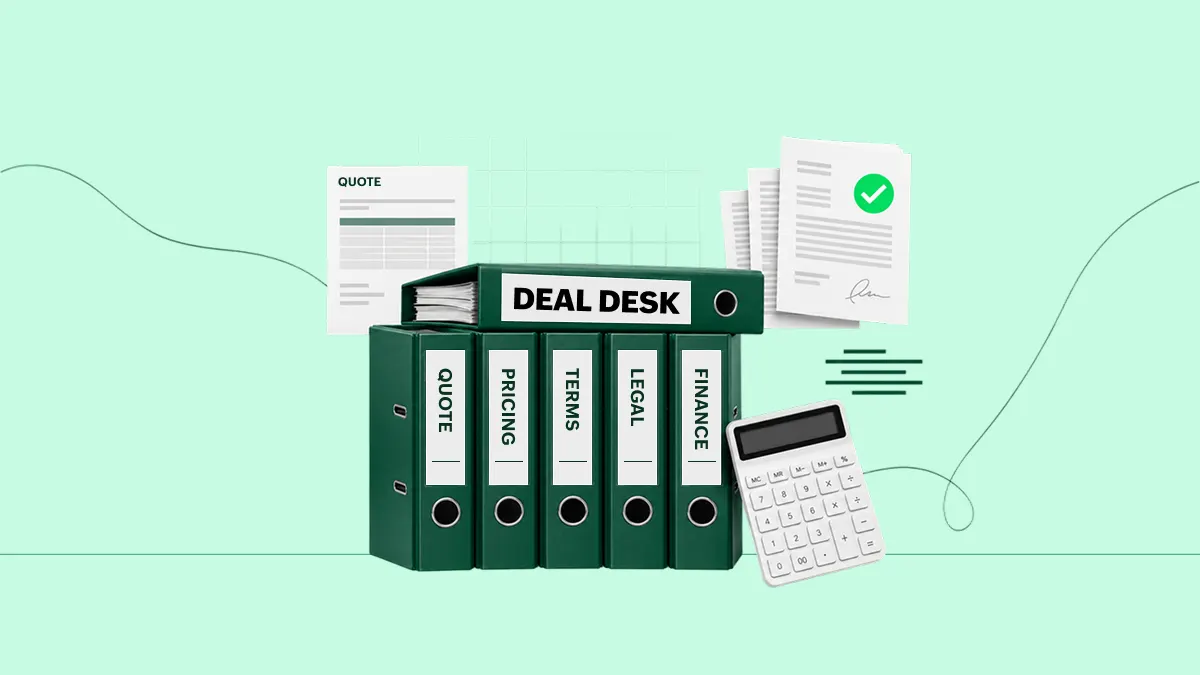
It is not uncommon for sales teams to encounter prospects where the deal doesn't fit the usual mix. A customer may want a higher discount, custom payment terms, or a product bundle that doesn't exist in the catalog yet. Out of target pressure, the sales rep says "yes" in the meeting, and then has to scramble to see if the company can actually honor the deal.
This is where a deal desk comes in. A deal desk sits between sales and finance. Its main job is to ensure unusual deals progress fast and are safe for the business.
This article explores what a deal desk is, what it does, who is on the team, how the role has changed, and how CPQ (Configure, Price, Quote) software makes the work easier.
What is a deal desk?
A deal desk is a team (or sometimes a single person) that reviews, structures, and facilitates deals that fall outside a company's standard pricing and terms. Think of any quote that needs an exception: a discount above the usual limit, a custom contract clause, a multi-year commitment, or an unusual billing schedule.
A good deal desk works to achieve two objectives: to help sales teams close deals faster and to protect the company's profit margins while negotiating deals. The two goals can sometimes conflict, so the deal desk's key role is to balance them.
Small businesses usually don't have a designated deal desk. The founder or the finance head approves unusual deals informally. As the company grows and deals get more complex, the process needs a more structured home.
What does a deal desk do?
The exact scope differs from company to company, but most deal desks handle specific responsibilities.
Reviewing non-standard quotes: They review proposed discounts, payment terms, and contract changes, and match them against the company's policy.
Structuring deals: When the customer's request doesn't seem to be doable, the deal desk finds a workable alternative in the best interests of the company.
Managing approvals: They route each deal to the right people (sales leaders, finance, legal) and ensure approvals happen quickly so quotes aren't stuck in someone's inbox.
Protecting margins: They make sure the final quote is acceptable for the company and leaves with a healthy profit margin.
Checking compliance: They confirm that deal terms don't create problems for revenue recognition, tax, or legal requirements.
Setting and updating policy: They set the permissible discount limits and approval thresholds so sales teams know the boundaries they can operate in while quoting.
Reporting and analysis: They track discount levels, approval times, and win rates to show where the process is working and where it isn't.
Who is part of a deal desk?
A deal desk is rarely made up of one type of person. It's usually a cross-functional team and works best as a mix of skills from across the business.
Deal desk manager: Owns the process and makes final calls on non-standard deals.
Sales operations or revenue operations (RevOps) analysts: Handle the day-to-day review of quotes, data, and reporting.
Finance representative: Checks margins, payment terms, and revenue recognition impact, and reviews compliance from a finance perspective.
Legal representative: Reviews contract changes and unusual clauses. They usually enter the process only for specific tricky deals.
Sales leadership: Approves higher-risk discounts and offers a view on the strategic value of a deal.
In a small business, one person might fill several of these roles. In a large enterprise, each one may be a dedicated team.
How the deal desk has evolved
The role and process behind the deal desk has changed a lot over the years, and the change is tied to how companies sell.
Email and spreadsheets
In the early days, approvals happened over emails and chat messages. Reps would ask for a discount, wait for approvals, and then close deals. There was no clear record of who approved what.
A dedicated team
As deals got larger and more complicated, companies set up formal deal desks to tighten up the process. This brought consistency, but also created a new problem. When the volume of deals grew, the same team that was created to strengthen the process became the bottleneck.
Software-driven workflows
CPQ software made it easy by automating repetitive work. Pricing rules, discount limits, and approval processes moved into the system, so the deal desk could focus only on the deals that needed human judgment.
Automation and AI today
Now the system checks each quote against the rules and automates most of the routine tasks and escalates only the exceptions. The deal desk's role is more about designing the rules, handling complex cases, advising sales on strategy, and updating the process as necessary.
Benefits of having a deal desk
When a deal desk works well, the whole business feels the difference.
Faster deal cycles: Automated approval workflows ensure quotes reach customers faster after a discussion.
Better margins: Proposed discounts are validated against the set policy before being sent to the customer. This ensures reps don't give more of a discount than what the business can absorb.
Consistent pricing: Customers with similar requirements get similar deals. This reduces unnecessary confusion and friction as deals are treated consistently.
Fewer errors: Most of the process is automated and manual entry is limited, thereby reducing errors.
Stronger compliance: Deal terms are reviewed against revenue recognition and legal requirements from the start, so finance isn't left fixing problems at quarter-end.
A better working relationship between sales and finance: Both sides work from the same rules and the same data, so there are fewer arguments about what was promised.
Useful data: Tracking approvals and discounts shows which deals are common, which discounts really help close deals, and where the process needs improving.
The challenges of running a deal desk manually
Even a solid team struggles when the process doesn't keep pace with the sales pipeline. The common problems include:
Approvals stuck in email or chat with no clear owner
Pricing and discount rules kept in spreadsheets that go out of date
Same requirements getting different price treatments
Reps waiting days for answers, which risks losing the deal
No single record of what was approved, by whom, and why
Quotes that don't match what finance later invoices
These problems get worse as the company grows and the number of non-standard deals rises.
How software can help the deal desk
This is where CPQ software makes a real difference for a deal desk.
Automated approval workflows: The software routes each quote to the relevant approver based on the deal value, discount percentage, region, and the like. Standard deals go through instantly, and only non-standard ones go through the approval workflows.
Built-in pricing rules: Permissible discounts, price lists, and product combinations are part of the same system. Sales reports quote only what's feasible right from the start.
A clear audit trail: Every action is recorded by the system. It's easy to see who quoted, who approved, and all the necessary details.
Faster quote creation: Everything is preconfigured making quote creation a breeze for sales teams.
Visibility and reporting: Detailed reports show insights on what's moving easily and what's getting stuck, thereby constantly giving feedback for process improvement.
A clean handoff to billing: When the approved quote flows directly into invoicing, nothing has to be re-entered or reinterpreted by finance.
How does Zoho Billing fit into all of this?
CPQ in Zoho Billing is built directly into the billing engine, so the deal desk's work doesn't stop at approval. Here's how it helps:
Businesses can set approval rules so that the non-standard ones enter the workflow and straightforward ones skip the queue.
Pricing and discount logic is stored in the system, which keeps quotes consistent across the sales team.
Every approval is logged, giving finance a clear record from quote to invoice.
Approved quotes carry straight into subscriptions and invoices, with no re-entry and no mismatch between what was agreed upon and what is billed.
Want to see how it works? Explore CPQ in Zoho Billing or schedule a demo with us.
Frequently asked questions (FAQ)
A deal desk is a team that reviews and approves sales deals that don't fit the company's standard pricing or terms. It helps sales close faster while keeping the business protected.
No. Small businesses often handle approvals informally. A deal desk becomes useful when the number of non-standard deals grows, when approvals start slowing down sales, or when finance needs more control over pricing and terms.
Sales operations covers the wider job of supporting the sales team, including tools, data, and processes. A deal desk focuses specifically on reviewing and approving individual deals. In many companies, the deal desk sits inside the sales operations or RevOps function.
Software can take over the routine work, such as standard approvals and pricing checks. It can't replace human judgment on complex or strategic deals. The best setup uses software for the repetitive tasks so the team can focus on the deals that need real thought.
CPQ automates approval workflows, stores pricing rules in one place, and keeps an audit trail of every change. This cuts delays and errors, and gives the deal desk more time for complex deals.
Once a deal is approved, its terms must match what gets invoiced. When the quote and the billing system are connected, the approved pricing, discounts, and payment terms carry straight into the invoice, with no manual re-entry.
CPQ in Zoho Billing lets the deal desk set the rules for what counts as a standard deal and what needs sign-off. Quotes within those limits move ahead without delay, and only exceptions reach the team. This frees the deal desk to focus on complex or high-value deals.