- HOME
- Billing basics
- A ready-reference guide to understanding the Nigerian e-Invoicing mandate
A ready-reference guide to understanding the Nigerian e-Invoicing mandate
Nigeria's e-Invoicing mandate isn't a single rule. Businesses remain uncertain about terminology, deadlines, and operational decisions.
This FAQ covers key terms, scope, timing, compliance, and more.
Bookmark this ready-reference guide!
What important terminology should one know before navigating the e-Invoicing domain?
- NRS: Nigerian Revenue Services, formerly Federal Inland Reserve Service (FIRS) is the central tax authority of Nigeria that was established under the Nigerian Revenue Service (Establishment) Act, 2025. It was created to modernize Nigeria's domestic revenue administration, bolster governance, increase the adoption of digital systems, and enhance efficiency, transparency and taxpayer service delivery.
- EFS: The Electronic Fiscal System is the country-wide digital tax reporting and e-Invoicing framework introduced by the NRS (formerly, FIRS). It exists to digitize and monitor commercial transactions in real-time. The operational framework that EFS works in, is the Continuous Transaction Control (CTC) or the "Clearance Model". This means that all businesses must automatically validate their invoices using the government's portal before sending them to validation.
- SI: The System Integrator is the primary bridge between your invoicing or ERP software and Nigeria's e-invoicing system. It's main task is to ensure that all essential fields or data points are mapped to mandatory NRS tags so that your invoices are fully compliant. To put simply, the SI is the bridge that ensures correct data transformation of fields such as customer data, item lists, tax rates, etc., into the fully-compliant UBL 2.1based XML and JSON formats that are accepted.
- APP: Once the SI confirms that the invoicing/ERP capability, is capable of creating invoices in the correct format, the Access Point Provider (APP) acts as a secure, external pathway that transmits data straight to the NRS MBS portal.
- MBS: The last piece of the trifecta that defines Nigeria's e-Invoicing framework, the Merchant Buyer Solution (MBS) is the nationwide cloud infrastructure introduced by the NRS to act as the engine behind e-Invoicing, automated clearance, and real-time transactions. It's primary functions are to perform automated checks on data formatting and data accuracy, perform real-time invoice data matching, and ensure that a centralized database exists listing all the SIs and the APPs being utilized.
What are Nigeria's e-Invoicing deadlines everyone must know before working?
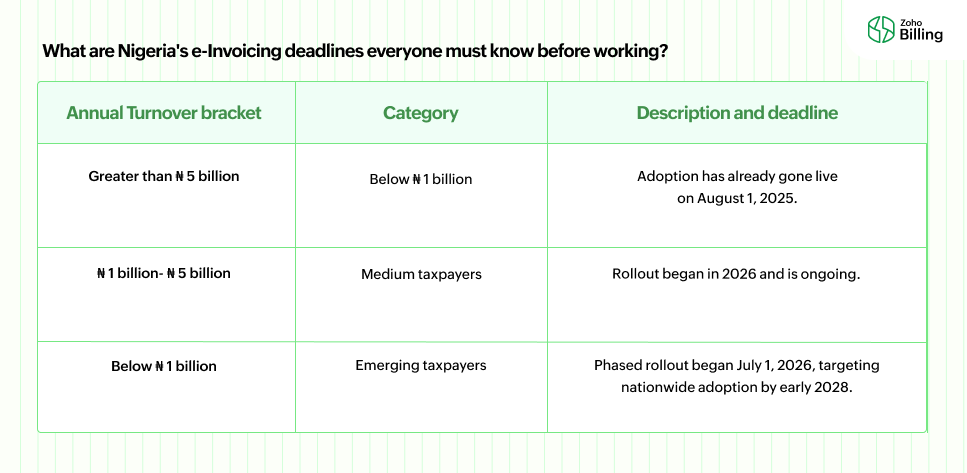
The official government's notice mandated that the e-Invoicing adoption would transpire in a five-stage phased rollout, depending on a businesses' annual turnover. The table shows Nigeria's phased e-Invoicing adoption timeline for businesses.
Is the scope for the phased enforcement of e-Invoicing based solely on annual turnover?
No. On the contrary, the NRS compliance documents clearly state that a businesses' annual turnover is not the only deciding factor to be categorized into a specific rollout duration. Simply put: even if your business falls in the later stage of the phased rollout, expect an earlier adoption if your business deals with someone already compliant with the e-Invoicing norms and has a valid Invoice Reference Number (IRN).
Consider this scenario: A supplier belonging to the medium taxpayers category supplies parts to a ₦ 20 Billion manufacturer who has already adopted the e-Invoicing mandates. In such a case, the manufacturer will not be able to accept the invoice from the supplier without a valid IRN and validation. In this scenario, market demands have forced the supplier to adopt the mandate earlier.
Are there businesses that are exempted from the e-Invoicing mandate?
No, there are no businesses currently defined by the NRS as permanently exempted from the e-Invoicing mandate. The NRS has deferred businesses with an annual turnover lesser than ₦ 1 Billion to a full implementation on January 2028.
The Nigerian Tax Act 2025 repeals older rules and establishes a centralized legal framework for taxation and transactions. The core e-Invoicing framework only applies to VAT-registered businesses that make taxable items. It excludes small businesses with a gross annual turnover less than ₦ 25 million, as these businesses do not need to register for VAT. Additionally, micro-businesses and small-scale informal traders also fall outside the purview of the tax act of 2025.
However, the NRS maintains the authority to eventually extend the mandate to businesses in this domain as well. This act governs all Nigerian tax obligations for residents, companies, and non-residents with economic ties.
What about zero-rated supplies— are they exempt from this mandate?
VAT exempt goods or zero-rated items are not exempt from e-Invoicing. The Nigerian Tax Act 2025 Sections 185-187 exempt VAT on items that are in scope, including: food, medical, agricultural, educational supplies, and exports excluding oil and gas.
The NRS MBS portal generates e-Invoices, but the relevant line items are tagged with the exempt tax code instead of the standard tax codes.
On a system level, what this accomplishes is the creation of an HS tariff code register that recognizes the VAT-exempted line items in the invoice generated.
Are non-residents also covered under the e-Invoicing mandate?
Yes. The Nigeria Tax Act 150(1) mandates that all non-residents supplying taxable goods and services in Nigeria, are also subject to the e-Invoicing procedure and must be VAT-registered. Announced by the FIRS (now the NRS) in July 2025, their effective adoption date stands undecided.
Furthermore, the NRS has assured a newer and a better cross-border plan in the pipeline. The option to mandate Pan European Public Procurement On-Line (PEPPOL) for cross-border transactions is still under discussion, and currently remains optional. Some examples of services by non-residents can include digital services like e-commerce, which can be considered a part of this mandate.
Click here to see all members of PEPPOL in Nigeria.
How does the e-Invoicing framework operate? What is the entire system based on?
The Nigerian e-invoicing framework is based on a hybrid operational system, that employs two models to handle invoices efficiently: Clearance Model and the Reporting Model.
The sole difference between the two, lies in the timing of tax validation. In short, if the validation occurs before the fulfillment of the transaction, then it follows the clearance model, and in the reporting model, the validation happens after the transaction fulfillment.
Clearance Model: This model is mandatory for all B2B and B2G transactions and operates under the Continuous Transactions Control (CTC). The caveat is that the supplier cannot issue an invoice directly to a buyer before the government's validation. The workflow is simple:
- The supplier generates the invoice in the required format.
- The invoice is then transmitted through the MBS via the APP or the API.
- The NRS validates the document in real-time.
- NRS returns invoice with the Invoice Reference Number (IRN), the Cryptographic Stamp Identifier (CSID), and a QR code, verifying document validity.
- The supplier can now legally send the invoice to the buyer.
Reporting Model: Here, businesses issue invoices immediately to consumers at the Point of Sale (POS) and report transactions to the tax authorities at a later point in time. This model is useful to bypass bottle-necks in fast moving consumer environments and is useful for low-value B2C transactions below ₦ 50,000.
The workflow here is:
- The seller issues a receipt or an invoice to the consumer immediately at the POS without waiting for live governmental approval.
- The transaction data is securely stored in the seller's system.
- Once the transaction clears, or via background API pushes, the data is transmitted to the NRS MBS portal, typically within 24-hours of the sales being made.
What are the formats accepted by the NRS MBS portal as mandated by the government?
As per the mandate issued by the NRS, all documents must be issued in a format compatible with the Universal Business Language 2.1 (UBL 2.1). PDF invoices are no longer legally compliant; XML and JSON are the accepted formats for machine-to-machine API transmission.
- XML (Extensible Markup Language): This is the foundational syntax required for B2B/B2G pre-clearance (or validation) tracking.
- JSON (JavaScript Object Notation): This format is more common with B2C transactions, as they deal with e-reporting and POS transactions. JSON is a developer-friendly format that is useful especially when APIs are involved to process invoices in the background.
Does Nigeria use Peppol's four-corner model, and how does it affect system connections?
Yes. The MBS framework is built on OpenPeppol's four-corner model, where the supplier (corner 1) and buyer (corner 4) never exchange invoices directly. Instead, each party works through their own APPs to handle transmission and validation on their behalf. These APPs occupy corners 2 and 3.
Practically, this means that your business doesn't need to integrate directly with every customer or vendor's system; only one connection is required, which is to your own APP. The network handles interoperability on one end, with APPs on the other. This also explains why choosing an NRS-accredited APP matters more than choosing a specific invoicing format. The model is designed in a manner that the network does the translation instead of your business.
What does it mean to be compliant in the context of the Nigerian e-Invoicing mandate?
Compliance is always an ongoing operational state and not a one-time technical checkbox. In practice, it means these three things are always true:
- A valid IRN is required for every invoice: According to the Nigerian e-Invoicing mandate, an invoice without a valid IRN, a Cryptographic Stamp Identifier (CSID) and a QR code is incomplete and legally invalid. This is usually specific to the clearance model, where the buyer isn't obligated to honor it.
- The validation chain matters: During compliance checks, auditors don't just check and confirm whether an invoice exists. They check whether it was validated, stamped, and transmitted correctly. In short, this means that in addition to the related invoice, it is paramount to retain the IRN, the CSID, and the validation result.
- Compliance extends to the receiving end: Since a buyer who is already subject to the e-Invoicing mandate cannot accept an invoice without a valid IRN, your own compliance timeline can effectively be forced earlier by your customers' obligations and not just your turnover bracket.
Summary: Compliance is less about the one-time submission of the right document, and more about maintaining a system that can consistently prove validation of every invoice, every time.
How does Zoho Billing help you navigate the mandate while ensuring compliance?
For most businesses, e-invoicing and VAT obligations aren't separate pieces; they show up together as part of everyday billing.
Zoho Billing applies VAT automatically, based on your registration details, the item's tax category, and your customer's address.
A Standard Rate (SR) of 7.5% or a Zero Rate (ZR) 0% is applied to each line item. From there, the invoices go straight to the NRS e-Invoicing portal either directly or through an approved service provider via the MBS, with no reformatting steps in between.
The result is a robust billing workflow, where compliance isn't checked at the end, but is built into the process itself.