

- HOME
- Revenue Recognition
- Revenue recognition audit checklist: What finance teams should prepare
Revenue recognition audit checklist: What finance teams should prepare
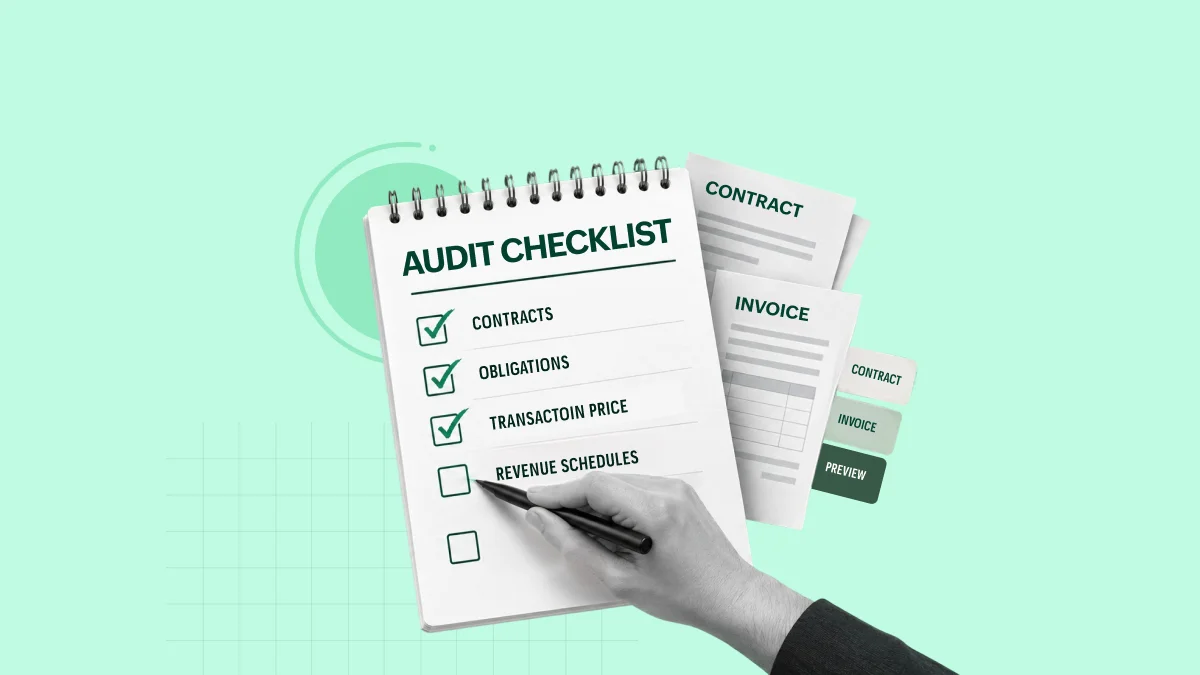
Revenue recognition is one of the areas auditors scrutinize intensely and that is understandable, as it is error prone. Any mistake in revenue recognition has a ripple effect that affects estimates, financial statements, and key judgment calls. A well-prepared finance team walks into an audit with documentation ready and answers to the obvious questions already worked out. An unprepared one spends audit season reconstructing contract histories and justifying estimates that should have been documented months earlier.
This checklist is built around what auditors actually ask for when reviewing revenue recognition under IFRS 15, ASC 606, Ind AS 115, or other regional variants. Use it to get ahead of the review and stay audit-ready at all points of time.
Contract management
All customer contracts are centrally stored and easily accessible, not scattered across email threads or individual sales reps' folders.
Contract documentation is complete, with no missing pages, schedules, exhibits, or referenced documents.
Contract amendments and renewals are labeled clearly with proper version numbering and linked to the original agreement.
Contracts are organized so they can easily be located by customer, region, contract, or reporting period.
- Non-standard contracts requiring additional review are clearly flagged.
Performance obligation identification
Each contract has been carefully assessed as to whether the promised goods or services are distinct.
Each promised good or service has been assessed to determine whether it represents a separate performance obligation.
Bundled arrangements (such as software licenses, implementation, onboarding, or support) have valid reasons as to why obligations were treated as separate or combined.
Each identified performance obligation has been mapped to the relevant terms in the contract.
- Any change in the way obligations are identified from one period to the next is explained and clearly documented.
Transaction price and variable consideration
The transaction price has been calculated for all the individual items in the contract. Judgments and assumptions made are noted clearly.
There is traceability for discounts, rebates, penalties, and performance bonuses from contract terms through to the transaction price.
The estimation method used for variable consideration (expected value or most likely amount) is documented for each contract type.
Variable consideration estimates are re-assessed each period and properly noted.
- The reasoning behind applying the variable consideration constraint on why a significant revenue reversal is not expected is documented.
Contract modifications
A log of all contract modifications like upgrades, downgrades, scope changes, new user seats, and the like, with the date and type of modification maintained.
Each modification has a documented assessment of whether it was treated prospectively or retrospectively or if it needs a separate contract, and the reasons behind the call.
Modification treatment is handled consistently for similar types of changes.
- Modifications are reviewed to ensure the revenue recognition treatment remains in line with the revised contract terms.
Deferred revenue and recognition schedules
Deferred revenue balances are accurately recorded for amounts received before the revenue is earned.
Recognition schedules tie back to the terms of the contract without unexplained changes.
For usage-based or metered contracts, recognized revenue is mappable to actual usage data.
Manual adjustments to deferred revenue or recognition schedules are documented and reviewed.
- Deferred revenue aging is reviewed periodically to identify contracts that should have completed recognition but haven't.
Point-in-time vs. Over-time assessment
Every individual performance obligation has a clear note on whether it's recognized at a point in time or over time.
Where recognized over time, the method used to measure progress (output method, input method, or straight-line) is stated and consistently applied.
For point-in-time obligations, the relevant indicators of transfer of control have been identified and noted.
Milestones, delivery terms, and other conditions affecting the timing of control transfer have been considered.
- Judgments made supporting the timing of recognition are properly recorded.
System, process, and access controls
Revenue recognition processes are formally documented and consistently followed.
Revenue recognition calculations are performed in a system with an audit trail, or, if done manually, changes to spreadsheets are version-controlled.
Revenue recognition details are access controlled, ensuring access for only required team members.
Access rights are periodically reviewed and outdated access is removed.
Reconciliations between the billing system, the revenue recognition schedule, and the general ledger are performed and reviewed regularly.
- System-generated revenue reports used for financial reporting are validated for accuracy and completeness.
Why this checklist matters more as contract volume grows
Most of the pointers in this checklist are manageable when handling a low volume of contracts. The real challenge is maintaining consistency and accuracy as the volume grows. That's where audit time becomes difficult to handle. It doesn't happen because the accounting was wrong, but because the documentation trail wasn't maintained properly as the business grew.
How Zoho Billing helps you stay audit-ready
A lot of this checklist comes down to having a reliable, traceable record behind every recognition decision. This is where a billing platform like Zoho Billing comes in. Zoho Billing keeps contract terms, modifications, and recognition schedules connected end to end, automatically unbundling contracts into separate performance obligations, recalculating transaction values as variable consideration changes, applying prospective or retrospective treatment for plan changes, and maintaining deferred revenue schedules with a full audit trail behind each one. That means most of this checklist is already documented, ensuring businesses are audit-ready at all points of time. If you want to see how it fits your own audit prep process, you can get in touch with our team for an exclusive demo of Zoho Billing.
Conclusion
An audit-ready revenue recognition process isn't something that is built in the weeks before the auditors arrive. It is the outcome of documenting judgment calls, tracking modifications, and reconciling schedules consistently throughout the year. Treat this checklist as an essential part of your monthly or quarterly close, and the audit itself becomes a matter of handing over records that already exist in your system.
Frequently asked questions (FAQ)
Most auditors start with a contract sample and a deferred revenue roll-forward. They want to review a handful of contracts from signing through to recognized revenue and see that the numbers match with what is accounted. Having these readily available is usually the biggest time saver in an audit.
At minimum, documentation should cover the period under audit, along with enough of the prior period to support opening balances. For estimates and judgment calls that span multiple periods (like long-term contracts with variable consideration), it is recommended to retain the full history of how the estimate was calculated.
Inconsistent treatment of similar contracts is one of the most common findings. For example, two comparable bundled contracts being unbundled differently, or contract modifications being treated prospectively in one case and retrospectively in a another, without any reason mentioned for the difference.
Yes, largely. All three standards share the same five-step model and the same documentation expectations around performance obligations, transaction price, and disclosures.
Yes. Zoho Billing maintains contract terms, modification history, and recognition schedules in one system, with an audit trail behind allocation, estimation, and recognition decisions. This makes it easy for finance teams to pull the records an audit requires directly from the system, rather than reconstructing them when asked for.
Zoho Billing tracks deferred revenue automatically as contracts are billed and revenue is recognized over the contract period, giving finance teams a ready roll-forward of opening balance, additions, recognized revenue, and closing balance.