

- HOME
- Revenue Recognition
- Revenue recognition for construction projects: Methods and challenges
Revenue recognition for construction projects: Methods and challenges
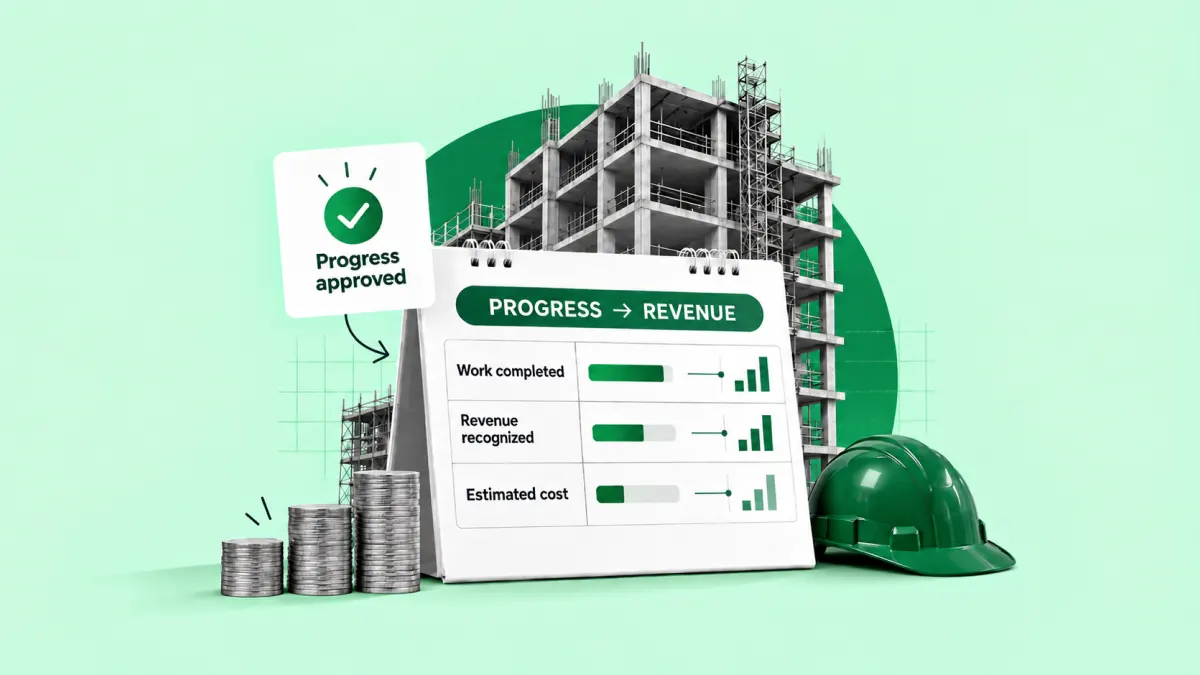
In construction projects, the contract signed this quarter might not see its final handover for another four years. In between, there will be weather causing delays, economic shifts, redesigns, and subcontractor relationships. Through all of these uncertainties, finance has to keep reporting revenue, quarter after quarter, long before handing over the completed project.
That's the peculiar bit about construction accounting. Most businesses recognize revenue when they deliver something. Construction companies are delivering one thing slowly over time, while the scope keeps modifying under them.
What does the five-step model look like for a construction business?
1. Identify the contract
The agreement scopes out estimates, timelines, and deliverables, signifying a legal project in place.
You might have a framework agreement with a developer, a letter of intent that let work begin while the main contract was still being drafted. Deciding whether that bundle is one contract or several will change the numbers you report.
2. Identify the performance obligations
Here you're asking what the client is actually buying, one finished asset or a set of separable services. Design, groundwork, structure, MEP, and fit-out may all be listed separately in the contract, but that doesn't automatically make them separate obligations. They are integrated into a single output the client contracted for, which usually collapses them into one.
Anything running after handover gets judged on its own terms. For example, a servicing or O&M arrangement the client could have bought is distinct, and takes a share of the transaction price recognized across its term.
3. Determine the transaction price
If there's one thing to be sure of in construction revenue reporting it's that the figure on page one of the contract is merely a starting point. What you're really "estimating" is how much you expect to collect by the time the job closes, and several things as stated in the beginning, push that number around.
Early-completion incentives: A bonus for finishing ahead of schedule. Money you may earn, or may not.
Deduction due to delays: A pre-agreed upon deduction for every week you run past the completion date. Money you may lose.
Claims: Amounts you've formally asked the client for, typically where their delays or site conditions cost you more than the contract allowed. Whether you recover them, and how much, often takes months of negotiation.
Instructed but unpriced change orders: The client has told you to build it, your crew is already on it, and the commercial terms are still being argued over.
Accounting standards apply a brake and limit the claim to such variable considerations. You estimate the amount, then include only the portion you're confident won't have to be taken back later.
4. Allocate the transaction price
With a single performance obligation, this step passes quickly. With several, the price gets allocated across them based on standalone selling prices, which in construction usually means building them up from cost plus a reasonable margin.
5. Recognize revenue as the obligation is satisfied
This is the step where reporting actually happens, quarter after quarter. Most construction work transfers to the client gradually rather than all at once, so revenue follows the same path.
Which leaves the practical question: How much of it have you transferred so far?
Different ways revenue can be recognized
Once you've established that an obligation is satisfied over time, the method you pick is about how you'll measure progress. Input methods look at what you've put in; output methods look at what you've produced.
| Method | How progress is measured | Works well when |
| Cost-to-cost (input) | Costs incurred to date divided by total estimated costs | Costs track closely with progress; the most widely used approach |
| Effort expended (input) | Labor hours or machine hours consumed against total estimated | Labor-intensive work like fit-out or refurbishment |
| Milestone (output) | Revenue recognized as defined stages complete | Phased builds with clear, certifiable stages |
| Units delivered or surveyed (output) | Physical units or certified work in place | Repetitive scope such as housing plots, roads, pipelines |
| Completed contract | All revenue at handover | Short contracts, or where over-time criteria aren't met |
For completed contracts, the standards may restrict the application. Whether you are reporting under IFRS 15, ASC 606, or any regional variations, it's advisable to check once before proceeding with the model. They apply where the over-time criteria fail, and in certain smaller-entity regimes.
And percentage of completion, the term commonly used, isn't a separate method. It's the outcome of whichever measurement basis you've applied.
Challenges for construction projects in revenue recognition
The commitment runs long, where estimates drift
Every percentage reported rests on a forecast of the total cost. So when the project stretches long, the forecast gets shakier, as expected.
Research on 662 energy infrastructure projects across 83 countries, published in Energy Research & Social Science, found that more than three-fifths of them ran over budget, with overruns most pronounced on the largest schemes (Find the study here). The broader mega project literature puts the figure higher still, at roughly nine in ten (Flyvbjerg).
For accounting, such changes disturb the denominator you've been measuring progress against and essential adjustments should be made.
Delays and price movement
A three-month delay pushes labor into a costlier quarter and pushes materials into a new price list. Both feed back into the estimate.
Push far enough and the contract turns onerous, meaning the cost of finishing the job now exceeds what you'll be paid for it. At that point, you can't spread the damage across the periods remaining. The full expected loss gets recognized as soon as the forecast reveals it.
Modifications come faster than paperwork
A US Department of Transportation review of construction change orders points to design-quality gaps, organizational culture, and funding pressure as recurring causes (Volpe Center report, 2025).
The accounting question, then, is whether a modification becomes part of the existing contract, or adjusted against work already done or, gets treated as a separate contract. Teams on the field, meanwhile, are getting on with the work while these things need to be figured out in the back.
Retention holds back cash on revenue you've already earned
A typical retention clause holds 5% of each certified payment until practical completion, and half of that until the defects period ends. The revenue was earned and recognized months or years earlier; the cash turns up much later.
If the gap is long enough, you may also need to consider whether a significant financing component exists.
Subcontractors, and whether you're principal or agent
Where you pass work to specialist trades, you'll need to establish whether you control that service before it transfers to the client. Principal treatment means recognizing the gross total amount. Agent treatment means recognizing only your fee. On a project heavy with nominated subcontractors, this single judgment can swing reported revenue considerably.
Incentives, penalties, and claims
These are all variable considerations, and they just don't resolve neatly. Constraining these estimates sensibly is what keeps a reversal from landing when recognizing them in the future.
Construction revenue recognition will never be a matter of pressing a button, because of the sheer number of complex judgments that lie underneath it. Firms that get the process right tend to run shorter gaps between the discussion held on site and what shows up in the ledger, and that gap is where you should plan to bring in the technology.
Frequently Asked Questions
Generally, no. The method should be chosen at the outset for each performance obligation and applied consistently until it's satisfied. What does change, and should, is the estimate feeding that method. Revising your total cost forecast is expected, though.
It's recognized as revenue when the work it relates to is complete, not when the money comes in. The unpaid portion becomes a receivable, and it's worth tracking that in its own aging bucket. Mixing retention into your ordinary overdue invoices makes your collections look worse than they are and hides the amounts genuinely at risk.
A work-in-progress schedule sets out, for every live contract, the total contract value, costs incurred to date, estimated costs to complete, revenue recognized so far, and amounts billed. It's where over-billing and under-billing become visible. Auditors go to it first because it shows whether your recognized revenue reconciles to what you've actually certified and invoiced.
The standards apply regardless of size, though some jurisdictions offer simplified regimes for smaller entities, and shorter contracts may not meet the over-time criteria at all. What differs with scale is the administrative load rather than the principles. A three-month fit-out job raises fewer judgment calls than a four-year infrastructure program, and the same five steps still run underneath it.