

- HOME
- Revenue Recognition
- Ind AS 115 revenue recognition: A complete guide with examples
Ind AS 115 revenue recognition: A complete guide with examples
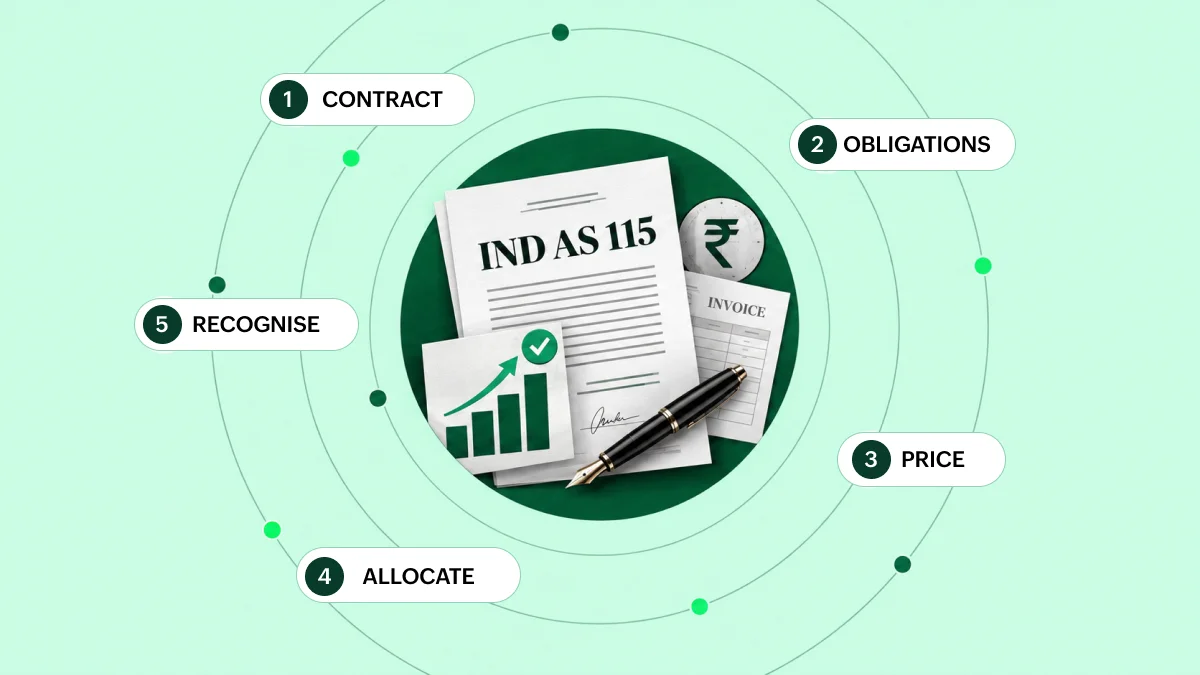
For Indian companies reporting under Indian Accounting Standards (Ind AS), revenue recognition is governed by Ind AS 115, the local counterpart of IFRS 15. The underlying core principle is the same for both the standards and they are built on the same five-step revenue recognition model. Ind AS 115 comes with its own effective dates, regulations, and a handful of India-specific provisions worth knowing for businesses preparing financial statements under the Ind AS framework.
This guide walks you through what Ind AS 115 is, its five-step model with India-specific examples, and how it differs from IFRS 15.
What is Ind AS 115?
Ind AS 115, Revenue from Contracts with Customers, is India's adapted version of IFRS 15. It is governed by the Ministry of Corporate Affairs (MCA) under the Companies Rules. It applies to all listed companies and unlisted companies meeting certain net worth criteria, along with their holding, subsidiary, joint ventures and associate companies.
Ind AS 115 came into effect for accounting periods from April 1, 2018, replacing the earlier Ind AS 11 (Construction Contracts) and Ind AS 18 (Revenue) and withdrawing ICAI's separate guidance note on real estate revenue recognition. It has since been updated through the Companies (Indian Accounting Standards) Amendment Rules, 2023, which refined certain disclosure and presentation requirements. The core principle carries over from IFRS 15 without change: Revenue should be recognized when control of a good or service transfers to the customer, in an amount that reflects what the entity expects to be entitled to in exchange.
The five-step model for revenue recognition
Ind AS 115 applies the same five-step model as IFRS 15 to every customer contract:
Identify the contract
A contract is an agreement that can be written or even verbal. It should have a commitment from both parties, carry clear payment terms, and have commercial substance.
Example: An Indian SaaS company signs a one-year contract with a customer to provide them access to their software license. This meets Step 1's criteria as soon as both parties agree on the terms, regardless of when the invoice is raised and payment happens.
Identify the performance obligations
Each commitment made to the customer to supply the good or provide the service is a performance obligation. Often, contracts have multiple performance obligations (bundled contracts) and each distinct promise needs to be accounted for and managed separately.
Example: The subscription contract of the Indian SaaS company in the previous step includes the software license fee, implementation, and ongoing support. All of these need to be treated as separate performance obligations instead of one.
Determine the transaction price
This is the amount or consideration expected in exchange for providing the product or service. This should include variable elements like discounts, bonuses, and penalties.
Example: An IT services contract includes a flat monthly fee, plus a performance bonus, that has to be paid if the project is completed ahead of schedule. The transaction price needs to include the flat fee as well as an accurate estimate of that bonus.
Allocate the price to each obligation
Once the total transaction price is determined, it is allocated across each performance obligation based on their relative standalone selling prices (SSP).
Example: A bundled contract priced at ₹8,00,000 covers software fee, implementation, and year-long support. If each were sold separately at ₹6,00,000, ₹2,00,000, and ₹1,00,000 respectively (₹9,00,000 total), the actual ₹8,00,000 contract price should be allocated proportionally across all three based on that ratio.
Recognize revenue as or when obligations are satisfied
Revenue is recognized when (point-in-time) or as (over time) control transfers to the customer.
Example: A SaaS company invoices a customer ₹12,000 upfront for a 12-month plan. Revenue shouldn't be recognized as soon as the payment is received. It has to be recognized at ₹1,000 per month, with the unrecognized balance carried as deferred revenue each month on the balance sheet.
For the full walkthrough of each step along with industry-specific examples, see our detailed guide on the five-step revenue recognition model.
Where Ind AS 115 differs from IFRS 15
Ind AS 115 is often described as largely converged with IFRS 15, with only minor, India-specific changes. The differences that matter most in practice are:
Regulatory basis – IFRS 15 is governed by the IASB, whereas Ind AS 115 is governed by India's Ministry of Corporate Affairs under the Companies Act framework. The amendments, effective dates, and applicability thresholds are decided per India's own rules rather than the IASB's.
Applicability – Ind AS 115 is not applicable to all Indian companies. It applies only to companies within the Ind AS roadmap. This includes all listed companies and unlisted companies with a net worth over ₹250 crore (Threshold as of September 2026).
Effective date alignment – Ind AS 115 came into effect for periods beginning from April 1, 2018, whereas IFRS came into effect a bit earlier from the start of that year.
Terminology and references – Ind AS 115 largely mirrors IFRS 15's text as the operating principle is the same. However, Ind AS 115 contains references to Indian laws and other Ind AS standards, whereas IFRS 15 refers to the IFRS accounting standards.
Where Indian subscription and services businesses run into complexity
Here are some of the scenarios where Indian businesses find it difficult under Ind AS 115.
Multi-element IT and services contracts: Software is mostly bundled along with add-ons like premium support, implementation, and the like. This is common among Indian SaaS and IT services companies. The multiple elements need to be properly unbundled into separate performance obligations.
Variable consideration in services contracts: Performance-linked incentives, penalties for project delays, and milestone-based payments are very common in Indian services contracts. They need to be accurately approximated and also re-estimated later as outcomes get clearer.
Upfront and annual billing: It's common for businesses to collect upfront payments for annual contracts. These need to be tracked as deferred revenue with periodic updates instead of recognizing the full invoiced amount at the beginning.
Contract modifications: Long-term contracts see their revisions in the form of upgrades, downgrades, scope changes, and similar modifications. All of these require assessing whether the change should be treated prospectively or retrospectively.
Scaling Ind AS 115 compliance with automation
Just like IFRS 15, Ind AS 115 is also pretty straightforward when a business has only a small number of contracts to manage. However, as the business scales, contract volumes go up and keeping track of performance obligations, pricing changes, contract modifications, and revenue schedules manually can get complicated.
Zoho Billing helps finance teams automate these processes by managing performance obligations, allocating transaction prices based on standalone selling prices, accounting for changes in variable consideration, and maintaining revenue schedules as contracts evolve. This reduces the reliance on spreadsheets and manual calculations while helping businesses apply Ind AS 115 requirements consistently at scale.
Frequently Asked Questions
Ind AS 115 is India's converged version of IFRS 15 — the accounting standard that governs how and when revenue from customer contracts should be recognized. It applies the same five-step model as IFRS 15 and is regulated by the Ministry of Corporate Affairs under the Companies Rules.
Ind AS 115 applies to all listed companies in India. It also applies to unlisted companies meeting specified net worth thresholds along with their holding, subsidiary, joint venture, and associate companies.
Yes, companies can choose to adopt Ind AS 115 voluntarily. This is common among growing businesses preparing for an IPO or external funding. Once adopted voluntarily, they can't opt out of it.
Yes. If the parent company falls within the Ind AS roadmap, its subsidiaries, joint ventures, and associate companies are required to follow Ind AS 115 too.
Non-compliance can result in financial statements being considered non-compliant with the Companies Act reporting requirements, leading to regulatory scrutiny from the MCA or auditors. This is why getting revenue recognition right the first time, instead of treating it as a year-end clean-up exercise, is important.
Yes. Zoho Billing automatically splits multi-element contracts into individual performance obligations based on standalone selling prices, recalculates transaction values as variable consideration changes, and handles prospective or retrospective revenue allocation for contract modifications to help finance teams stay compliant with Ind AS 115 as contract volume scales.
Yes. Rather than recognizing the full invoiced amount upfront, Zoho Billing tracks and updates deferred revenue over the correct service period for each contract, without requiring manual journal entries.