

- HOME
- Accounting trends & insights
- Why subscription-based pricing is winning in the AI accounting era
Why subscription-based pricing is winning in the AI accounting era
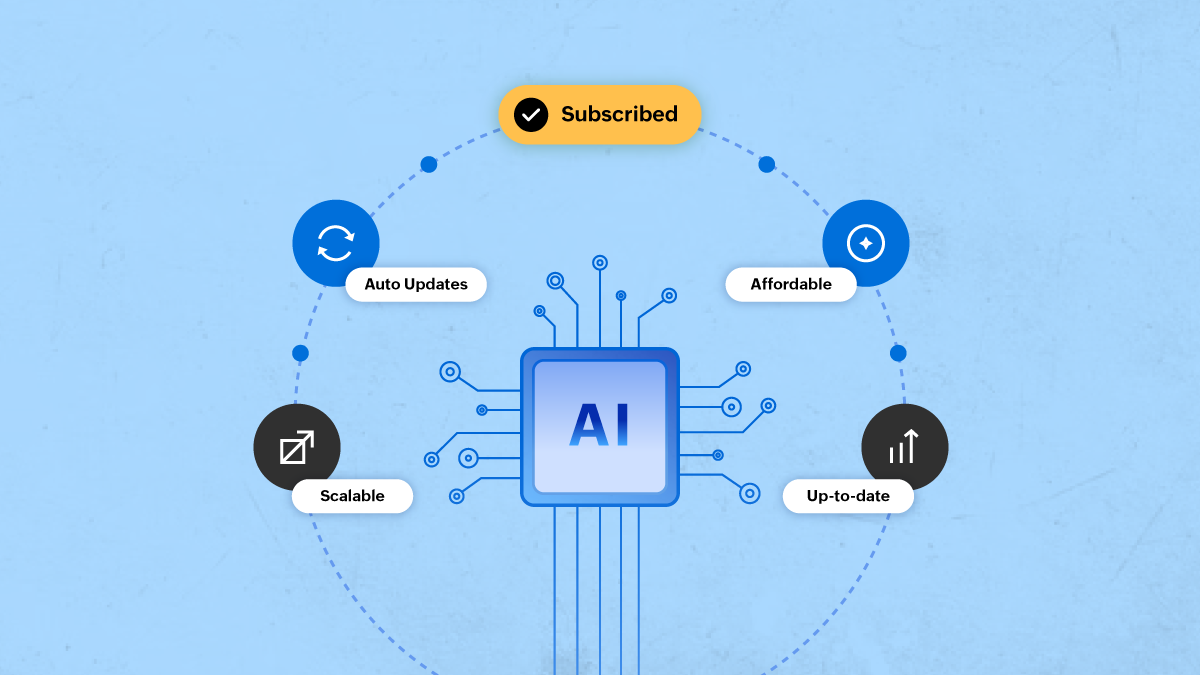
You are increasingly paying for access rather than ownership: Your music is rented, your movies are rented, and so is your accounting software. The industry has moved away from software that was priced with perpetual licenses to subscription models. Now, businesses are moving towards hybrid pricing models. Why is that the case? How is the subscription model still winning in the AI accounting era?
Let's start by learning the factors playing a huge role in this.
The ground is shifting
There has been a rapid and undeniable growth in the way users and software providers are navigating accounting. The exponential rise of AI agents has caused B2B vendors to change the way they capture value from customers while consumers expect a stronger connection between the price they pay and the value being delivered to them—and that's a reasonable ask. If you're asked to pay more for a tool, you would want to know what it is you're exactly paying for.
But there are visible gaps in this argument. A recent study cited that 47% of users struggle to define clear measurable outcomes from their AI tools. In other words, nearly half of the people paying for AI-powered software can't precisely pinpoint what they're getting for their money. This remains an area of tension in this entire pricing debate. As a result, there has been a rise in the concept of usage/consumption-based pricing, where you pay for what you actually use rather than a flat fee for accessing the product.
Adding fuel to that fire, BCG's IT survey revealed that with the increase in AI usage, 40% of buyers cited seat reductions and as a result are cutting spending on software. Fewer human users means fewer seats to bill for, which means the old per-seat subscription model isn't as viable anymore.
What was lost: Ownership
To understand where the market is going, it helps to remember what was lost. When the concept of perpetual licenses was still prominent, users got to own the product forever, with updates and upgrades coming once every few years, paying once for Version 1, then add-ons for Versions 2, 3, and onwards. In this setup, the software was yours without any recurring charge.
A perpetual license meant that even if the vendor raised prices, pivoted, or went under, you still had working software. You had leverage that the software would keep working and continue to work regardless of the external market circumstances or internal company situations.
But the problem lies in the fact that the software was also, in a way, frozen in time.
What was gained: Continuous innovation
That frozen software problem is the crux of why subscriptions won and why they are set to win in the AI accounting era too. As per a 2026 study by SAP-Forrester, 72% of companies annually undertake four or more enterprise-wide transformation initiatives. Transformation and change are no longer rare occurrences, they are the operating condition.
A rapidly changing tax and accounting landscape means constant changes and upgrades to your accounting software. What used to be a once-a-year update is now a multiple times a month update. Compliance requirements change, models get retrained, and integrations expand. The product you have in January is probably vastly different from the one you'll have in July because the underlying intelligence keeps evolving.
With a perpetual license, it's difficult to accommodate these updates realistically. With a quickly advancing tech landscape, a subscription-based pricing model fares better than a perpetual license in terms of giving accounting software providers more money to invest back into developing features and working on updates constantly. Unlike traditional software, AI features incur ongoing costs every time they are used. Subscription revenue helps vendors absorb these recurring infrastructure expenses. The revenue is predictable, which means the R&D budget is predictable, which means the improvements keep coming.
The hybrid model: A compromise or the future?
What's emerging now is neither pure subscription nor pure consumption, it's a hybrid model of usage-based pricing being layered on top of the existing subscription model. You pay a base monthly or annual fee to access core features, then additional costs kick in based on how heavily you use the AI layer. Issuing 10,000 automated invoices this month looks different on your bill than issuing 200.
This model is an attempt to close the gap that 47% of users reported experiencing: the struggle to connect price to value. If the AI is doing more, you pay more. If it's doing less, you pay less. In theory, it's fairer but in practice, it introduces a new kind of unpredictability: the unpredictable bill. For small business owners and finance teams who want to know exactly what something costs, that's a trade-off worth noting.
The bigger picture for businesses
For an average business owner, what does all this actually mean? Mostly, it means that the financial tools available to you are better than they've ever been. A bakery or a manufacturing company can now access cash flow forecasting, automated bookkeeping, and real-time tax compliance tools that would have cost much more a few years back. The subscription model made that possible by funding continuous development rather than banking on a once-in-a-while feature update.
However, it would be incomplete to discuss the subscription model's advantages without naming the dependency it creates. Access and ownership are not the same thing, and the distinction is crucial. If payments are discontinued, vendor terms shift, or a provider exits the market, businesses are left exposed. This is further complicated by a pattern across the market: Consumers are asked to pay more for accounting software based on features being AI-powered when, in reality, it is automation being disguised as AI. The two are not interchangeable, and understanding the difference matters—you can read more about that here.
The subscription model isn't winning because vendors figured out a clever way to extract more money from customers. It's winning because the pace of change in AI and accounting is making the perpetual license obsolete. When your software needs to update itself faster than you can issue an invoice, ownership starts to mean something different and pricing inevitably follows.