

- HOME
- Taxes & compliance
- Why choose Zoho Books as your UAE eInvoicing ASP?
Why choose Zoho Books as your UAE eInvoicing ASP?
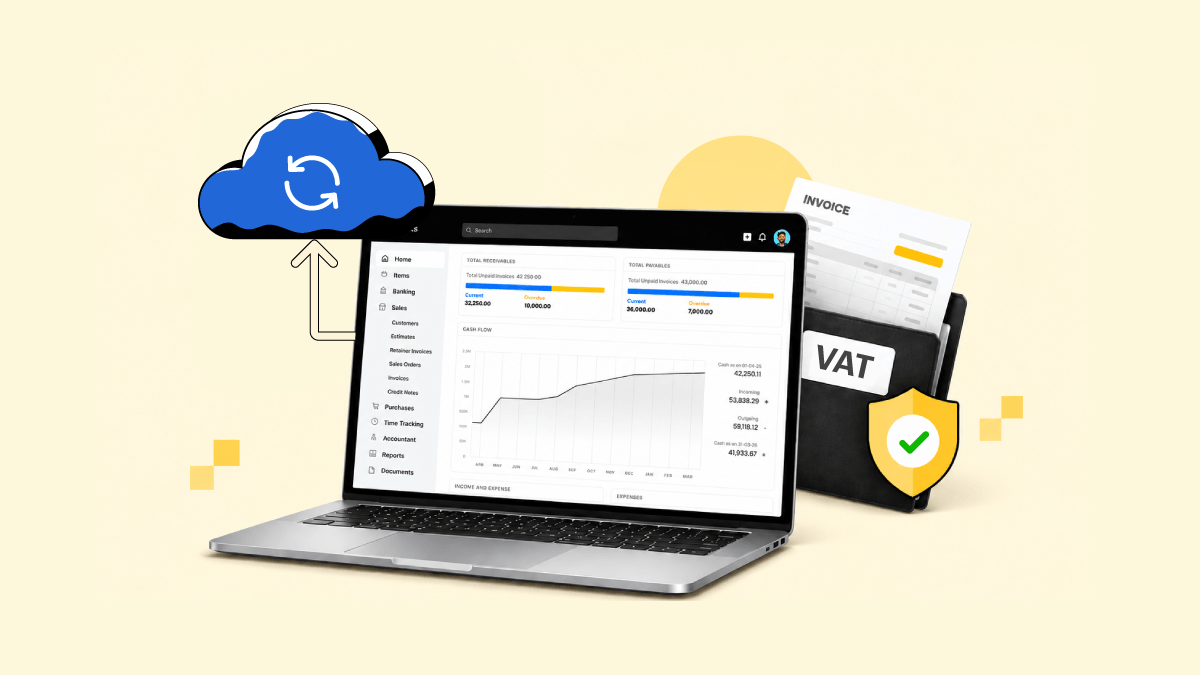
UAE eInvoicing is moving from a future compliance requirement to something businesses need to actively prepare for. With voluntary eInvoicing already underway from 1 July 2026, businesses are now choosing their Accredited Service Provider (ASP), preparing their systems, and working out how eInvoicing will fit into their day-to-day finance processes.
But choosing an ASP is not just about finding a provider on the Ministry of Finance's accredited list. Your ASP will sit at the centre of how your invoices are validated, exchanged with customers and suppliers, and reported to the Federal Tax Authority. So the more important question is: will your ASP work with the way you already run your business? This is where Zoho can help your business get ready for UAE eInvoicing.
Zoho Software Trading LLC is an eInvoicing Accredited Service Provider in the UAE(with accreditation number 121988). Zoho Books brings that eInvoicing capability into the same accounting environment businesses already use to manage invoices, expenses, banking, taxes, and financial reporting.
First, what exactly is UAE eInvoicing?
UAE eInvoicing is more than sending an invoice electronically. An eInvoice is structured invoice data that can be automatically processed, exchanged between the supplier and buyer, and reported to the FTA. A PDF, scanned invoice, Word document, or invoice sent as an email attachment does not qualify as an eInvoice under the UAE model. The UAE is adopting a Decentralized Continuous Transaction Control and Exchange (DCTCE) model, built around a five-corner framework.
You don't need to understand all five corners to start preparing. What matters for a business is that your finance system connects to an accredited ASP, and the ASP takes care of the technical exchange and reporting layer. This includes validating invoice data, converting it into the required UAE format, exchanging it with the buyer's ASP, and reporting the required tax data to the FTA. That is why your choice of ASP matters.
What does an Accredited Service Provider actually do?
Think of an ASP as the connection layer between your business and the UAE eInvoicing network. When you create an invoice, the ASP helps make sure the invoice contains the required information and follows the UAE's technical standards. It then handles the electronic exchange with the customer's ASP and the required reporting to the FTA.
For businesses, this means you shouldn't have to build and maintain the entire eInvoicing infrastructure yourself. The right ASP should make eInvoicing feel like part of your existing finance process, rather than another system your finance team has to manage.
When does eInvoicing become mandatory?
The UAE has a phased rollout.
For businesses with annual revenue of AED 50 million or more, the deadline to appoint an ASP was 31 July 2026, with mandatory eInvoicing implementation starting 1 January 2027.
For businesses with annual revenue below AED 50 million, the ASP appointment deadline is 31 March 2027, followed by mandatory implementation from 1 July 2027.
Government entities have the same ASP appointment deadline of 31 March 2027, with implementation from 1 October 2027.
If you're in the first phase and haven't appointed an ASP yet, the time to act is now. If you're in the second phase, you have more time, but choosing your ASP early gives you room to test, migrate data, integrate systems, and get your teams comfortable before eInvoicing becomes mandatory.
So, what should you look for in an ASP?
The Ministry of Finance recommends businesses consider factors such as accreditation, integration, security, support, scalability, pricing, and the provider's experience and reach. But what do these really mean when you're making the choice?
1. Start with accreditation
This is the non-negotiable. Your provider should be officially accredited by the UAE Ministry of Finance to operate as an eInvoicing ASP.
Zoho Software Trading LLC is on the Ministry of Finance's official list of Accredited Service Providers, with accreditation number 121988. That gives businesses a clear starting point. From there, the question becomes whether the provider is also a good fit for your finance setup.
2. Look at where eInvoicing sits in your finance workflow
This is one of the biggest differences between choosing an ASP and choosing an accounting platform with eInvoicing built in. If your accounting system, invoicing system, tax workflows and eInvoicing network are all separate, your finance team may have to move data between multiple systems.
With Zoho Books, eInvoicing is part of the accounting workflow. You can create invoices, manage credit notes, record expenses and payments, reconcile bank transactions, manage VAT, and handle your eInvoicing processes from the same platform. Zoho Books supports the PINT-AE XML format required for UAE eInvoicing. The benefit isn't simply having more features in one product. It's having fewer places for your team to switch between, maintain, and reconcile.
3. Make sure your ASP understands PINT-AE
PINT-AE is the UAE-specific implementation of the Peppol International Invoice standard. It defines the structure, fields, code lists, and validation rules that an eInvoice needs to follow in the UAE. This is where choosing a provider with the right technical capability matters.
Zoho Books can generate invoices in the PINT-AE XML format, while the ASP layer handles the required validation and exchange through the UAE eInvoicing framework. For businesses, the important part is simple: your finance team shouldn't have to become experts in XML or Peppol to send an invoice.
4. Don't look at eInvoicing in isolation
eInvoicing may be the immediate requirement, but it isn't the only tax change UAE businesses are managing. Your accounting system still needs to support VAT, Corporate Tax, financial reporting, payments, and the everyday work of running your business.
Zoho Books brings UAE VAT accounting and eInvoicing together, with support for VAT-compliant invoicing and VAT return workflows. It also supports UAE Corporate Tax workflows, helping businesses manage their tax information and reporting alongside their accounts. This becomes especially useful as your business grows. Compliance shouldn't mean creating a separate process or finding a new tool for every new regulation.
5. Think about where your financial data lives
Data residency and security are understandably important when you're choosing a finance technology provider. Zoho has established data centres in Abu Dhabi and Dubai, strengthening its local infrastructure for UAE customers and supporting data sovereignty, performance and regulatory requirements.
Zoho's security practices also include ISO 27001, ISO 27017 and ISO 27018 certifications, along with SOC 2 Type II compliance covering security, availability, processing integrity, confidentiality and privacy. For a system that handles your invoices, financial records and tax information, these aren't nice-to-have credentials. They're part of the foundation.
6. Consider what happens after you go LIVE
Choosing an ASP isn't the end of the project. Your finance team will still have questions. Your customers may use different systems. Your business processes may change. And you'll need help when something doesn't work the way you expected. That's why support, documentation, migration resources and a local ecosystem matter.
Zoho Books provides product documentation, FAQs, videos, migration resources, webinars, forums and direct support for UAE customers. Zoho also has an established presence in the UAE and its local partnerships have supported digital transformation for thousands of UAE businesses. The point is not simply that help is available. It's that you're choosing a provider that will continue to support your finance operations beyond the eInvoicing rollout.
What if you're already using another accounting system or ERP?
Choosing Zoho as your ASP doesn't necessarily mean you have to replace your entire finance system overnight. Businesses running other ERPs or accounting platforms can evaluate integration options based on their existing setup and requirements.
So the conversation doesn't have to be:
“Do we need to replace our ERP?”
It can simply be:
“How should our existing finance system connect to the UAE eInvoicing network?”
The answer will depend on your current systems, transaction volumes, integrations and business processes. But having that flexibility makes it easier to plan your transition without disrupting the way your business operates today.
Why Zoho Books makes sense for businesses preparing for eInvoicing
For a business already using Zoho Books, the biggest advantage is continuity. You don't need to introduce eInvoicing as an entirely new finance process. Your accounting, invoicing, banking, and tax workflows already live in Zoho Books. eInvoicing can become another part of that workflow.
For businesses evaluating their options, the bigger picture is just as important. You're getting:
An eInvoicing ASP accredited by the UAE Ministry of Finance
Support for the UAE's PINT-AE eInvoice standard
eInvoicing within an accounting platform
UAE VAT and Corporate Tax capabilities
Local UAE data centre infrastructure
Enterprise-grade security and compliance
Migration and integration options
UAE-focused support and resources
A broader finance platform that can scale beyond eInvoicing
A connected ecosystem of Zoho apps and third-party services, including payroll, payment gateways, and shipping providers
And that's ultimately what makes an ASP worth considering.
The right ASP should make eInvoicing feel simpler
The UAE's move to eInvoicing is a significant shift, but it doesn't have to mean a complicated change to the way you run your business. The right ASP should take care of the complexity in the background while your team continues to focus on customers, cash flow, and growth.
For Zoho Books users, that means you can keep your accounting and eInvoicing processes together, instead of building a new process around compliance. Because eInvoicing should be part of your business, not another system your business has to work around.
Frequently asked questions
Is Zoho an accredited eInvoicing Service Provider in the UAE?
Yes. Zoho Software Trading LLC is an eInvoicing Accredited Service Provider listed by the UAE Ministry of Finance, with accreditation number 121988.
Is Zoho Books an eInvoicing solution?
Yes. Zoho Books supports UAE eInvoicing workflows, including generating invoices in PINT-AE XML format. The accredited ASP entity is Zoho Software Trading LLC, while Zoho Books is the accounting platform through which businesses can manage their finance and eInvoicing processes.
Is a PDF invoice an eInvoice in the UAE?
No. A PDF, scanned invoice, Word document, or invoice sent as an email attachment does not meet the UAE definition of an eInvoice. An eInvoice needs to contain structured data that can be electronically processed, exchanged, and reported.
What is PINT-AE?
PINT-AE is the UAE-specific implementation of the Peppol International Invoice standard. It defines the technical structure and validation requirements for UAE eInvoices.
Do I need an ASP to receive eInvoices?
Businesses participating in the UAE eInvoicing system need to be connected to the eInvoicing network through an ASP. Buyers also need an ASP to receive eInvoices through the framework.
Does eInvoicing apply only to VAT-registered businesses?
No. UAE eInvoicing requirements can apply to business transactions regardless of whether the business is VAT-registered. The scope includes B2B, B2G, G2B, and G2G transactions. Consumer transactions are currently excluded, subject to future rules.
When do businesses need to appoint an ASP?
Businesses with annual revenue of AED 50 million or more had to appoint an ASP by 31 July 2026 and must implement eInvoicing from 1 January 2027.
Businesses below AED 50 million must appoint an ASP by 31 March 2027 and implement eInvoicing from 1 July 2027.
Can I use Zoho's ASP if my business uses another ERP?
Potentially, yes. Integration requirements vary depending on your existing ERP or accounting system. Businesses can evaluate integration or migration options based on their setup and eInvoicing requirements.
Where does Zoho host UAE customer data?
Zoho has data centres in Abu Dhabi and Dubai, providing local infrastructure for UAE customers and supporting data sovereignty and local regulatory requirements.