

- HOME
- Accounting trends & insights
- Understanding an accountant's role in small businesses
Understanding an accountant's role in small businesses
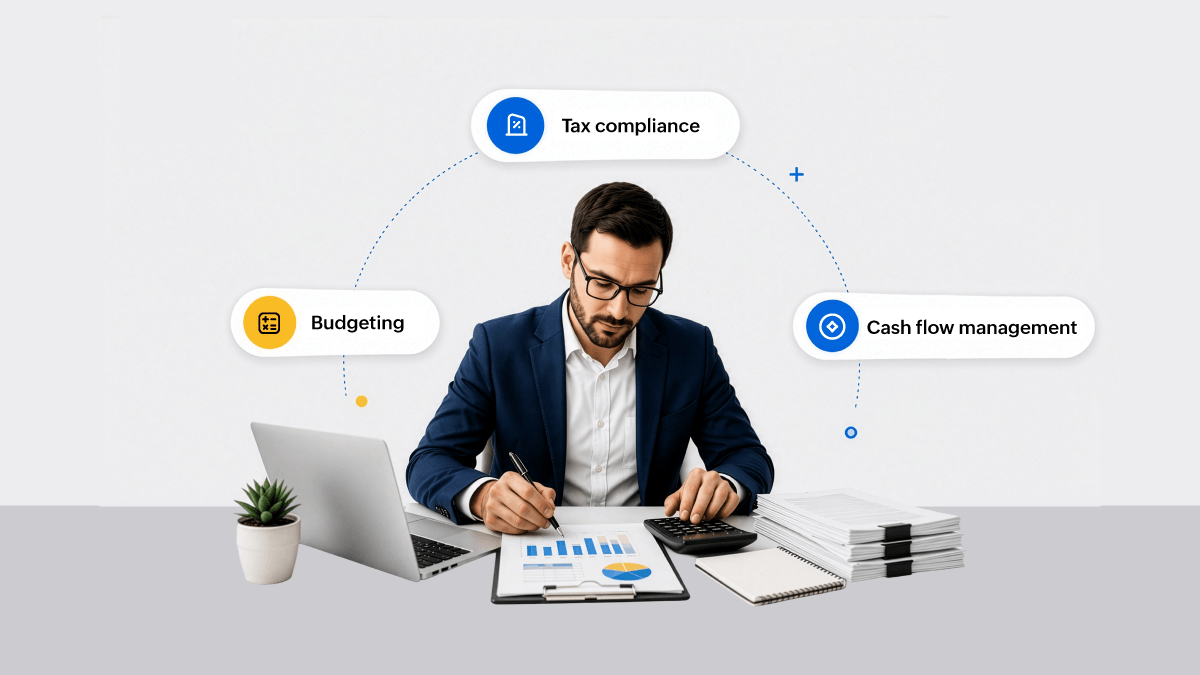
As a new small business owner, chances are you are either balancing your books based off tutorial videos or taking tips from fellow small business owners on how to maintain your books. This pressure is at an all-time high right before the tax season.
What if we told you that you can save hours of headaches, avoid costly errors and penalties, and stay compliant? An accountant with the right expertise can help you with this. Accountants can go beyond compliance and help your business grow.
This article will go through who an accountant is and what they do, the type of accountants, how new small businesses like yours can benefit from them, and when small business owners should hire an accountant.
Who are accountants?
Accountants are finance professionals who help maintain financial records and analyse financial data. They also ensure records are accurate and the business remains compliant, and also file taxes. For the recent MTD for Income Tax mandate in the UK, accountants can help small businesses in maintaining digital records, submitting quarterly updates, and filing tax returns to HMRC.
Apart from this, they may also provide advisory services on efficiency, cost optimisation, financial forecasting, risk management, and software implementation. They can work with companies, individuals, non-profits, governments, or run an independent practice.
Type of accountants
An accountant's duties may vary and it is important to know their expertise to ensure they are the right fit for your small business.
Management accountants can prepare financial data to help with analysing, identifying, budgeting, and forecasting. They use the data for short- and long-term strategy planning and cost optimisation to drive decision-making levels to assure growth.
Tax accountants support navigating the complex tax landscape to ensure compliance and support for tax returns. They will be the link between your new business and HMRC, represent your company when disputes arise, and provide strategic advice on tax planning.
Financial accountants work to maintain the financial transactions of your business by preparing financial statements such as cash flow statements and balance sheets. They also ensure accurate reporting in accordance with guidelines such as IFRS or UK GAAP. They can also assist with audits with external entities and HMRC.
Public accountants work with an auditing or accounting firm and provide services to multiple clients, such as, bookkeeping, auditing, tax, and advisory.
Independent accountants are similar to public accountants but the key difference is that they run their own accounting practice.
In-house accountants are employed within the financial department of a company and use internally available data to support strategic decisions, tax, and compliance.
This is not the complete list of accountant types but the above list can serve as a guide for new small businesses before hiring an accountant. As a new small business, you can avail services from a public accountant or an independent accountant, and opt for an accountant with specialisation as the business grows.
How to choose an accountant?
Before you get an accountant on onboard, it is important you have someone who is qualified. Check if they have qualifications as listed below issued by respective institutions.
ACA (Associate Chartered Accountant) by ICAEW
CA (Chartered Accountant) by ICAS
ACCA (Associate Chartered Certified Accountant) by ACCA
CGMA (Chartered Global Management Accountant) by CIMA
It is essential to choose an accountant who has experience working with clients from your industry so they can understand your business model.
Make sure you discuss pricing to ensure your transparency from the start to end. This allows to discuss the services you can avail from an accountant for your small business.
How can accountants help small businesses?
An accountant doesn't just have to be the person you contact right before the tax season to file your tax returns; they can be a strategic driver of your business and find ways to save costs and grow revenue.
Accountants can add value to small businesses and support in the following areas.
Tax and compliance
As a new small business owner, you would reach out to accountants on a ad-hoc basis to submit your tax returns. An accountant will help you understand your tax obligations based on regulations set by the government and ensure your business stays compliant all through the year.
They can help clean up books, assure your numbers are accurate for audits, and make sure your business complies with legislative changes such as MTD for Income Tax where HMRC mandates digital record maintenance, quarterly submissions, and annual tax returns. They are experts in tax regulations and can also help legally lower your tax obligations.
Strategic decisions
As mentioned earlier, you are playing multiple roles as a small business owner. A good accountant can support you with business growth by setting financial KPIs that fit your business model. Tracking KPIs can help you establish long- and short-term goals. They can then help you implement key changes when your business deviates from the KPIs. They can also help you understand if your business can withstand expansion based on the past data combined with forecasts.
Your vision combined with the accountant's advice can also help you price your goods and services, and seek funding for new business ideas.
Cash flow management
Regardless of the business size, cash flow is crucial. It is important as a small business owner you understand it and not just focus on making profits. Good cash flow can help reduce payment cycles, manage stock, pay employees, allocate budget, and build cash reserves. A good accountant can support you with managing income and expenses to prevent running out of cash when it is much needed. They can help identify which part of the income needs to be used for repaying suppliers or loans and when it should be reinvested. Reinvesting your income while you haven't paid your employees could impact operations. An accountant can help you plan them based on periods of revenue growth and costs in your business.
Loan applications
With the help of an accountant, your clean books can support your application loans. Airtight books and a captivating story tied with presentable financial data can offer financial clarity. Accountants also work on projections to back up your vision for the business and its growth. This builds credibility and instils confidence with the loan agent.
Accounting software
An accountant's role has evolved over the years and they are now equipped to recommend and implement technology that can help you save time and money. On the other hand, small businesses can also benefit when their books are on cloud-based accounting solution to get real-time visibility into their cash flow.
Accountants can onboard clients onto an HMRC-recognised cloud-based accounting software, like Zoho Books, to run all your financial operations and oversee your books from time to time. They can also help with the following:
Set up AR/AP workflows based on your business model.
Manage recurring invoices and automate payments.
Reconcile bank feeds faster by connecting to a bank.
Set up KPIs and dashboards with insightful reports.
The support with technology does not just end here. As your business grows, accountants today are well-equipped to implement integrated solutions to ensure your business data flows seamlessly across different operational teams.
When is the right time to hire an accountant?
Businesses avoid hiring accountants due to the costs involved but when done from the start it saves a lot of sleepless nights correcting expensive mistakes. You can hire an accountant when:
Your tax obligations get complex as you scale up.
You're looking to hire employees.
You wish to apply for loans.
You are spending too much time navigating tax regulations.
Hiring an accountant from the start saves a lot of trouble and expensive mistakes. With clean books and all records in order, your accountant can go beyond and provide advisory services.
Running a small business is a lot of weight on your shoulders and choosing the right accountant from the start can save time and energy. An accountant can go beyond just number crunching and be a trusted business advisor you can rely on. The combination of the right tech stack and accounting partner always works the best.