

- HOME
- Accounting trends & insights
- Cash flow management tips for growing businesses in South Africa
Cash flow management tips for growing businesses in South Africa
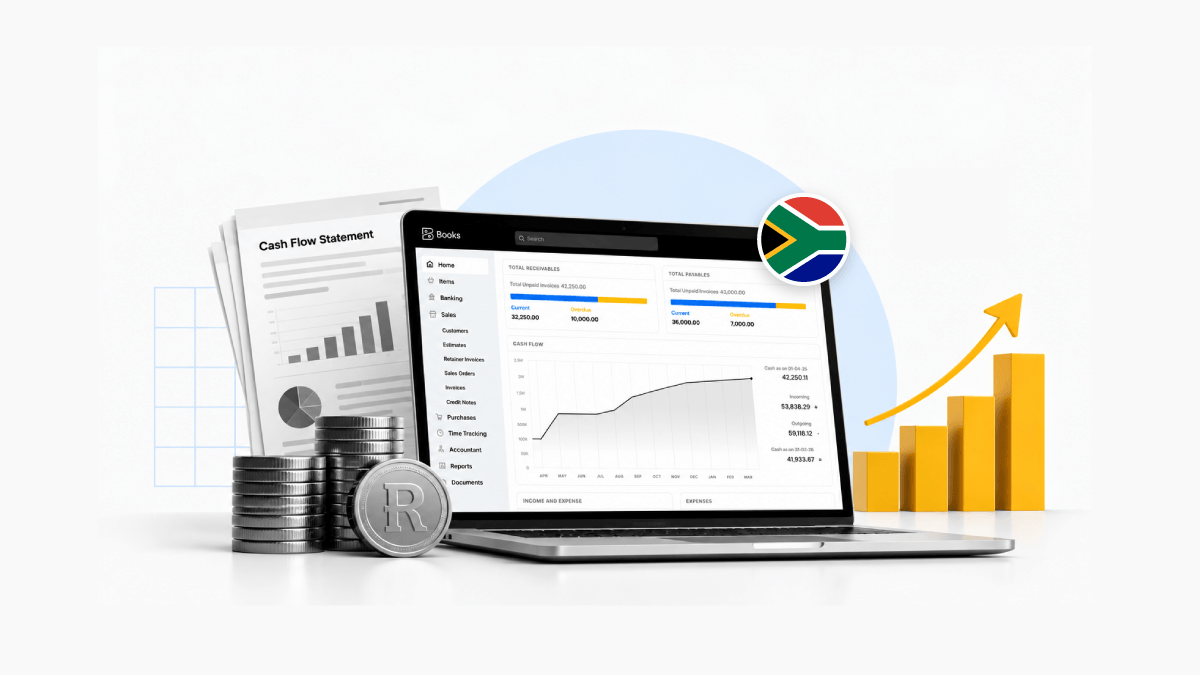
Growing a business is exciting. More customers, bigger orders, and higher revenue are all signs that things are moving in the right direction. But growth also creates a hidden challenge: More money moving through the business doesn't necessarily mean more cash in the bank.
You may need to buy stock before you sell it, hire employees before the additional revenue comes in, or pay suppliers while you're still waiting for customers to settle their invoices. Add operating expenses and tax obligations to the mix, and even a profitable business can find itself short of cash. That's why cash flow management is essential for growing small businesses in South Africa.
This article will look at practical ways to manage cash flow, avoid common cash shortages, and build a stronger financial foundation for growth.
What is cash flow management?
Cash flow management is the process of tracking, forecasting, and controlling the money coming into and going out of your business.
Cash coming in can include:
Customer payments
Cash sales
Recurring income
Loans or other financing
Investment into the business
Cash going out can include:
Supplier payments
Salaries and wages
Rent and utilities
Inventory purchases
Loan repayments
Tax payments
Software, marketing, and other operating expenses
The goal isn't simply to have more money coming in than going out over the course of a year. It's also to make sure cash is available when your business needs it. That timing matters.
Imagine your business invoices customers for R150,000 this month but only collects R80,000. Meanwhile, R110,000 in salaries, suppliers, rent, and other expenses must be paid. Your sales may look healthy on paper, but you still have a R30,000 cash gap to manage.
That's a difference between revenue earned and cash actually available. This is one of the most important concepts for a growing business to understand.
Why is cash flow important for small businesses in South Africa?
South African businesses operate in an environment where payment delays, changing operating costs, tax obligations, borrowing costs, and economic uncertainty can all put pressure on working capital.
Late customer payments are particularly important. When an invoice remains unpaid, the business has technically made a sale but it doesn't yet have that cash available to pay its own expenses.
The issue is significant enough that South Africa has a 30-day payment framework for government suppliers, while Parliament has continued to raise concerns about delayed payments and their effect on SME cash flow.
For a growing business, good cash flow management helps you:
Pay employees and suppliers on time.
Meet tax obligations without scrambling for funds.
Maintain enough working capital for day-to-day operations.
Invest in inventory, equipment, and people.
Prepare for slower sales periods.
Reduce dependence on emergency borrowing.
Make growth decisions with greater confidence.
In short, profitability tells you whether your business model is working; cash flow tells you whether the business can keep operating while it grows.
10 cash flow management tips for growing South African businesses
1. Build a cash flow forecast
If you only look at your bank balance, you're looking at where your business is today. A cash flow forecast helps you look ahead.
Estimate how much cash you expect to receive and how much you expect to spend over the next few weeks and months. Depending on your business, a rolling 13-week forecast can be particularly useful for short-term planning.
Your forecast could include:
Expected inflows
Customer invoice payments
Cash and card sales
Recurring customer payments
Other expected income
Expected outflows
Salaries
Supplier payments
Inventory
Rent
Utilities
Loan repayments
VAT and other taxes
Insurance
Marketing
Planned capital expenditure
Update your forecast regularly using actual figures. For example, if you expect a major customer payment of R100,000 on the 15th but the customer's usual payment pattern suggests it may only arrive at month's end, forecast the realistic date, not the ideal one. A conservative forecast gives you more time to prepare for potential cash gaps.
2. Invoice customers as soon as possible
Every unnecessary delay in sending an invoice can become an unnecessary delay in getting paid.
If work is completed on the 15th, but the invoice isn't sent until the end of the month, you've effectively extended your customer's payment period before their official payment terms have even begun.
Create a consistent invoicing process:
Confirm the work or delivery is complete.
Generate the invoice promptly.
Clearly state the due date and payment terms.
Include the correct banking and payment information.
Send the invoice to the right person or department.
Follow up before and after the due date when necessary.
For larger projects, consider whether milestone billing or deposits make sense instead of waiting until the entire project is complete before invoicing. The sooner an accurate invoice reaches your customer, the sooner your payment cycle can begin.
3. Make your payment terms clear
"Payment due soon" isn't a payment term; be specific. For example, payment due within 14 days of invoice date.
Clear terms reduce ambiguity and make follow-ups easier. Before extending longer payment terms to a new customer, consider how those terms affect your working capital. If your suppliers expect payment within 15 days while your customers pay you after 60 days, your business needs enough cash to fund the 45-day gap.
As your business grows, review payment terms rather than automatically offering every customer the same arrangement.
4. Stay on top of your accounts receivable
Revenue sitting in unpaid invoices can't pay today's bills.
Make accounts receivable management part of your regular financial routine rather than something you deal with only when cash gets tight.
Review outstanding invoices every week and group them by age. For example:
Not yet due
1–30 days overdue
31–60 days overdue
61–90 days overdue
More than 90 days overdue
This is commonly known as an accounts receivable ageing report. Pay particular attention to large invoices and customers whose payment behaviour is changing. A customer who normally pays within 20 days but suddenly starts paying after 50 days may deserve attention even if the invoices eventually get paid. The objective isn't aggressive debt collection; it's early visibility and consistent follow-up.
5. Don't treat VAT as available cash
If your business is VAT-registered, remember that VAT collected from customers isn't simply additional business income. South Africa's standard VAT rate is currently 15%. From 1 April 2026, the compulsory VAT registration threshold increased to R2.3 million in taxable supplies over a consecutive 12-month period, while voluntary registration may be available from R120,000, subject to the applicable requirements.
VAT vendors generally need to calculate output tax, deduct allowable input tax, submit VAT201 returns for their applicable tax periods, and pay the resulting amount to SARS. A practical approach is to keep your expected VAT liability visible in your cash flow forecast rather than mentally counting the entire bank balance as spendable cash.
For example, receiving R115,000 from a standard-rated sale doesn't mean the full R115,000 represents revenue available for operating expenses. The VAT component needs to be accounted for, subject to any allowable input tax deductions.
Planning for VAT throughout the reporting period can help prevent an unpleasant cash squeeze when the payment becomes due.
6. Plan ahead for provisional tax
Tax obligations can become significant cash outflows, especially if you haven't planned for them.
Provisional tax allows qualifying taxpayers to pay income tax in advance based on estimated taxable income rather than facing one large liability after assessment. SARS generally requires at least two provisional payments during the year, with an optional third payment available in certain circumstances.
For taxpayers following a March–February assessment year, the first payment generally falls at the end of August and the second at the end of February. Instead of waiting for a tax deadline to determine whether sufficient cash is available, estimate your upcoming liabilities and include them in your cash flow forecast.
Consider maintaining a separate tax reserve so money earmarked for SARS isn't accidentally absorbed by everyday business spending. For advice about your business's specific tax obligations, consult a qualified South African tax practitioner or refer to the latest SARS guidance.
7. Manage inventory carefully
Inventory ties up cash.
Imagine a retailer purchases R200,000 worth of stock. Until that stock is sold and customers pay, a substantial portion of the business's cash remains locked in inventory. Too little stock can mean lost sales. Too much stock can create cash flow problems.
Monitor:
Fast-moving products
Slow-moving inventory
Reorder levels
Seasonal demand
Supplier lead times
Gross margins
Stock that's becoming obsolete
The objective isn't necessarily to hold the least inventory possible. It's to hold the right amount of inventory for the demand you realistically expect.
If a product sits on a shelf for six months while supplier invoices must be paid within 30 days, you're effectively financing that inventory for several months. Growing businesses should, therefore, treat inventory management as a cash flow decision, not only an operational one.
8. Negotiate supplier terms strategically
Cash flow isn't only about getting customers to pay faster. It's also about managing when your own payments leave the business.
Suppose customers typically pay you within 30 days, but your supplier requires payment within seven days. You're funding most of that gap yourself.
Where appropriate, speak to suppliers about:
Longer payment terms
Volume-based pricing
Scheduled payments
Deposits with the balance payable later
Consolidating orders
Early-payment discounts when you have surplus cash
Good supplier relationships matter here. Paying suppliers reliably and communicating early when circumstances change can put your business in a stronger position when negotiating future terms.
9. Maintain a cash buffer
Forecasts help you prepare for expected events. A cash buffer helps you handle the unexpected ones.
Equipment can fail. A major customer can pay late. Sales can slow unexpectedly. Input costs can rise. An urgent repair may be unavoidable. Instead of assuming everything will go according to plan, gradually build a cash reserve.
There isn't one ideal cash buffer for every business. A consultancy with predictable recurring income may need a different reserve from a retailer carrying significant inventory or a construction company working on long payment cycles.
Start by understanding your essential monthly operating expenses.
Then ask: If revenue suddenly slowed, how long could the business continue meeting its essential obligations using available cash? That answer gives you a useful starting point for setting a reserve target.
10. Watch a few cash flow metrics consistently
You don't need dozens of financial metrics to understand your cash position. Start with a few that help you answer practical questions.
Operating cash flow: Is the core business generating cash from normal operations?
Accounts receivable ageing: How much customer money is outstanding, and how long has it been unpaid?
Accounts payable: How much does the business owe suppliers, and when is it due?
Cash conversion cycle: How long does it take the business to turn money spent on inventory and operations back into cash collected from customers?
Cash runway: Based on available cash and current spending, how long could the business continue operating if inflows slowed significantly?
Tracking these figures over time is often more valuable than looking at them once.
A deteriorating trend can give you an early warning before a cash shortage reaches your bank account.
Common cash flow mistakes growing businesses should avoid
Growth can sometimes hide weak financial habits because increasing sales temporarily compensate for them. Watch out for these common mistakes.
Confusing profit with cash: A profitable month doesn't necessarily mean customers have paid you yet.
Growing too quickly without enough working capital: Winning a large contract may require additional staff, inventory, or materials long before the customer pays.
Ignoring overdue invoices: The longer invoices remain unpaid, the harder they can become to collect.
Spending tax money: VAT and other upcoming tax liabilities should be planned for rather than treated as surplus cash.
Buying too much inventory: Stock that isn't moving is cash that isn't available elsewhere.
Making major purchases based only on today's bank balance: Look at upcoming commitments before deciding how much cash is genuinely available.
Not updating forecasts: A forecast created six months ago is unlikely to reflect what's happening in your business today.
What should you do if your business has a cash flow shortage?
First, don't wait until the bank balance reaches zero. If your forecast shows a potential shortfall, identify:
How large is the expected cash gap?
When will it happen?
How long will it last?
What is causing it?
The solution depends on the cause.
➤ If customers are paying slowly, focus on receivables and payment terms.
➤ If excess inventory is absorbing cash, review purchasing and stock levels.
➤ If expenses have grown faster than revenue, identify which costs can be reduced or delayed without damaging the business.
If the gap is temporary and the underlying business remains healthy, financing may be worth considering—but understand the repayment schedule and total cost before borrowing.
The earlier you identify the problem, the more options you'll usually have.
Make cash flow visibility part of your everyday business
Healthy cash flow doesn't happen simply because sales are growing. It comes from knowing what's coming in, what's going out, what's overdue, and what's coming next. For South African small businesses, that means staying disciplined about invoicing, receivables, expenses, inventory, supplier payments, VAT, provisional tax, and forecasting. You don't need to predict every rand perfectly. You just need enough visibility to spot a potential cash gap while you still have time to do something about it.
As your business grows, accounting software can make that visibility easier to maintain. Zoho Books, for example, brings invoicing, receivables, payables, banking, expenses, and financial reports into one system, helping businesses get a clearer picture of the money moving through their operations. The software is only part of the equation, though. Good cash flow ultimately comes down to good financial habits: forecast regularly, collect promptly, spend deliberately, and plan ahead.
That's what turns growing revenue into sustainable growth.
Frequently asked questions
What is the best way for a small business to manage cash flow?
Start with three habits: maintain an up-to-date cash flow forecast, invoice customers promptly, and review outstanding receivables regularly. Then plan major expenses and tax payments before they become due.
How often should a small business review its cash flow?
For a growing business, reviewing cash flow at least weekly can provide useful visibility. Businesses with tight working capital, high transaction volumes, or unpredictable payments may benefit from checking it more frequently.
Why can a profitable business still have cash flow problems?
Profit records income and expenses according to accounting principles, while cash flow tracks when money actually enters and leaves the business.
A company can therefore record a profitable sale today while waiting several weeks for the customer to pay. During that period, salaries, suppliers, rent, and taxes may still need to be paid.
How can a business improve cash flow quickly?
Depending on the underlying problem, businesses can consider invoicing outstanding work immediately, following up on overdue payments, reducing unnecessary expenditure, slowing non-essential inventory purchases, renegotiating supplier terms, or postponing discretionary capital expenditure.
Longer-term improvement usually requires better forecasting and working-capital management rather than a single quick fix.
How much cash should a small business keep in reserve?
There is no universal figure. The right reserve depends on your fixed costs, revenue predictability, payment cycles, inventory requirements, debt commitments, and industry.
A useful starting point is to calculate your essential monthly operating expenses and decide how many months of those expenses you want your reserve to cover.