

- HOME
- Ecommerce trends
- How AI-powered product recommendations are transforming ecommerce
How AI-powered product recommendations are transforming ecommerce
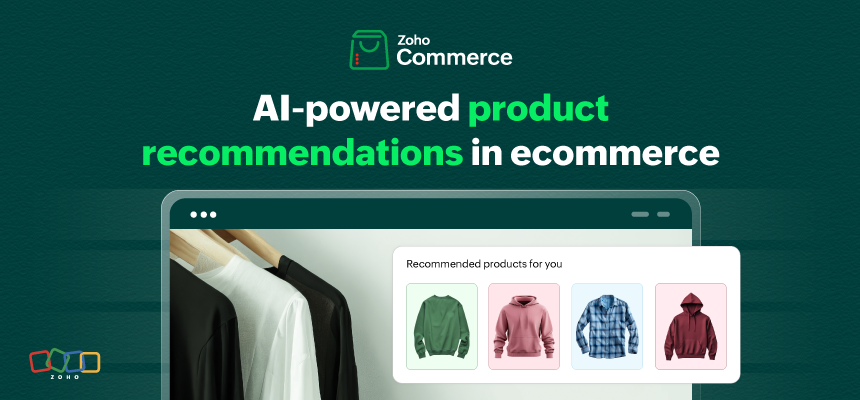
Have you ever visited an online store, and it suddenly displayed your favorite product on the front page without you searching for it? Isn't it magical? But it isn't.
This is the work of Artificial intelligence (AI) product recommendation systems. These systems use machine learning to collect and examine customer data to deliver personalized product suggestions. Recent statistics reveal that 71% of ecommerce stores with product recommendations.
This article dives deep and explores how an AI-powered product recommendation system works, the different techniques involved in it, its importance, and the best practices to implement them.
Key takeaways:
AI product recommendation systems use machine learning to analyze customer behavior and suggest relevant products.
Common techniques include collaborative filtering, content-based filtering, and hybrid models.
These systems help businesses improve personalization, increase conversions, and boost average order value through cross-selling and upselling.
Implementation involves collecting data, training a model, integrating it with the ecommerce platform, and optimizing performance.
Tools like Zia in Zoho Commerce help automate AI-powered recommendations for online stores.
What is an AI-powered product recommendation system?
AI-powered product recommendation systems use machine learning to study algorithms in user behavior, such as:
Clicks
Browser history
Purchasing behavior
Wish lists
Abandoned cart
Searches
Most-viewed products
Previous purchases
Recently viewed items
Shopping carts
By processing large volumes of data, these systems learn a customer’s preferences, what they like and dislike, and use those insights to suggest personalized products that match their needs, creating highly relevant shopping experiences.
AI-powered product recommendations are an advanced automated version of manual recommendation systems where the product suggestions are selected and arranged by humans rather than being generated automatically by algorithms.
Aspect | AI-powered product recommendation systems | Manual recommendation systems |
How they work | Automatically suggests products using machine learning algorithms. | Selected manually by store owners or marketers. |
Data usage | Analyze large volumes of behavioral data like clicks, searches, purchases, and browsing history. | Usually based on human judgment, product knowledge, or simple sales trends. |
Scalability | Easily scales across thousands of products and customers. | Difficult to scale as the catalog or customer base grows. |
Effort required | Minimal manual effort after setup. | Requires continuous manual work and monitoring. |
Use cases | Personalized product suggestions, dynamic homepage content, cross-selling and upselling. | Featured products, seasonal collections, curated product lists. |
How does an AI-powered product recommendation system work?
Understanding customer behavior
Every click, search, or scroll matters. Whether it is a customer who spends extra time looking at a specific product or adds something to their cart and abandons it later, AI captures these signals. These collected signals then create a detailed map of preferences, habits, and intent to produce a customer profile.
Processing data in real time
This data is then securely stored in cloud databases where it is combined and analyzed. For instance, if a shopper starts browsing for hiking gear, the system immediately shifts to prioritize showcasing related items like backpacks, boots, or water bottles. Speed is the essence here, responding to intent while it’s still fresh.
Predicting what customers might want next
AI then uses patterns from similar customers to predict what a new user might want. If users who bought yoga mats also loved foam rollers, the system quickly suggests them. It's like an algorithm’s gut instinct except the fact that they are powered by millions of data points and numbers.
Learning and adapting
AI never sleeps, and it never stops learning. Every interaction updates the system, refining its suggestions to be more accurate over time. If a customer frequently skips clothing suggestions but clicks on gadgets, the AI starts showing tech-related recommendations moving forward.
Delivering personalized experiences
The AI system then packages everything into visually appealing, hyper-relevant recommendations. Whether it’s a “Top Picks for You” section or a “People Also Viewed” list, the end goal is to provide great customer experiences and make shopping feel effortless and enjoyable.
Types of ecommerce recommendation techniques
1. Collaborative filtering
Ever noticed how Spotify’s “Discover Weekly” playlist just resonates with your taste? Collaborative filtering makes this magic happen by analyzing the behavior of the user. If users who loved Product A also loved Product B, the system knows to recommend both.
2. Content-based filtering
Imagine you want to buy sustainable skincare. Content-based filtering focuses on product components such as organic ingredients and eco-friendly packaging and suggests items with comparable attributes.
3. Hybrid filtering
Platforms like Netflix and Amazon take it a step further with hybrid filtering, combining collaborative and content-based techniques. Through this technique, their recommendations are so precise that you’ll feel they’ve cracked the code to your mind.
Why do AI product recommendations matter?
In today's ecommerce climate, customer expectations are at an all-time high. AI product recommendations are the best way ecommerce businesses can make buyers feel seen, understood, and valued.
Here's why AI recommendations hold more importance than ever.
Crafting personalized customer experiences: Buyers today want brands to anticipate their requirements. A study reveals 76% of customers get frustrated when they do not get tailored online shopping experiences.
Driving better conversions: The effectiveness of a well-timed recommendation is undeniable. A well-timed recommendation pop-up has the potential to convince hesitant buyers to close the sale by minimizing decision fatigue.
Maximizing order value: AI recommendations uses strategic upselling and cross-selling to increase average order value. Statistics say that users that engage with product recommendations have 26% higher average order value.
Making every product discoverable: Hidden gems in your inventory shouldn’t stay hidden. Product recommendation systems ensures that even niche products find their way to the right audience.
Case study
Netflix uses a hybrid recommendation architecture combining collaborative filtering, content-based filtering, and deep neural networks. The system analyzes behavioral signals such as what users watch, rewatch, skip, and even how long they hover over thumbnails to build detailed preference profiles.
As a result, their personalized recommendations perform 3 to 4 times better and helps Netflix save more than $1 billion each year by reducing customer churn.
How to implement it an AI-powered product recommendation system?
Here is a simple step-by-step overview.
Step 1: Collect and organize customer data
The first step is gathering relevant user behavior data to help the system understand customer preferences and shopping patterns. The data analyzed comes under three categories:
Contextual data | Example in an ecommerce store |
User data | Browsing history, products clicked, items added to cart, past purchases, wishlists, and search queries. |
Product data | Product category, price, brand, color, size, tags, descriptions, and product ratings. |
Contextual data | Device used (mobile or desktop), location, time of day, season, current promotions, first source. |
Step 2: Choose a recommendation technique
You can choose between different AI techniques can be used depending on your goals:
Collaborative filtering: Best for discovering new products.
Content-based filtering: Best for recommending similar products.
Hybrid models: Best for highly personalized recommendations at scale.
Step 3: Train the machine learning model
After collecting user and product data, the next step is to train a machine learning model so it can recognize patterns in customer behavior and predict which products to recommend.
Step 4: Integrate the recommendation engine with your ecommerce platform
Once the recommendation model is ready, the next step is to connect it to your ecommerce platform. This can be done through APIs or in-built ecommerce tools and embedding recommendation widgets on pages and mapping where they should appear.
Step 5: Display personalized recommendations
Once integrated, the system starts generating real-time personalized recommendations for each user based on their activity and preferences.
Step 6: Monitor and optimize performance
Finally, track key performance metrics such as:
Click-through rate (CTR)
Conversion rate
Average order value (AOV)
Revenue generated from recommendations
Use these insights to fine-tune your machine-learning algorithms and improve recommendation quality.
Best practices for implementing AI recommendations
Maintain a seamless omnichannel experience
Customers bounce between devices and platforms like mobile apps and websites. Ensure your recommendations follow them seamlessly.
For example, if a customer saves a product on your website, it should appear in their mobile app recommendations too. Consistency builds trust and creates convenience.
Optimize for mobile-first shopping
With mobile commerce dominating, your recommendations must be swipe-friendly and visually engaging on smaller screens.
Think of bite-sized, scrollable suggestions personalized for on-the-go buyers. Design matters and poor UI can make even the smartest recommendations feel clunky.
Balance personalization with privacy
Customers love personalization but hate feeling spied on. Be transparent about how data is used and prioritize opt-in consent. Build trust by showing how AI enhances their experience rather than intruding on it.
Enhance product recommendations with Zoho Commerce through Zia
Zoho Commerce offers a powerful product recommendation through its AI-powered bot, Zia. Zia understands buyers by analyzing their activities and behavioral patterns in your store and helps you deliver hyper-relevant product recommendations.
Whether it’s suggesting products to existing buyers or predicting what new visitors are likely to purchase, Zia keeps your store ahead of the curve. With Zoho Commerce, you get a complete ecommerce platform where intelligent tools like Zia work together to help you drive sales, build loyalty, and create unforgettable shopping experiences.
Conclusion
Personalization in ecommerce is no longer a good-to-have; it's the must-to-have to stand out in a crowd. From discovering the right products to buy to a gentle nudge towards the customer's next purchase, AI is reimagining ecommerce. Tools like Zia are in place to let businesses lead from the front while offering memorable, impactful, and irresistible experiences.
Frequently Asked Questions
1. Where do product recommendations appear in ecommerce platforms?
In ecommerce platforms, product recommendations are made to appear in several strategic places to influence shoppers throughout their buying journey. Here are the most common locations:
1. Homepage: Online stores display personalized recommendations like “Recommended for you” or “Trending products.”
2. Product pages: When a customer views a product, recommendations like “Similar products,” “Customers also bought,” or “You may also like” appear.
3. Cart page: Recommendations appear as “Frequently bought together” or “Complete the look" to encourage cross-selling.
4. Checkout page: Some platforms display small product suggestions during checkout, such as last-minute add-ons or low-cost complementary items.
5. Post-purchase pages: After completing an order, ecommerce sites suggest "Related products" or "Repeat purchases" on the order confirmation page.
2. Who should use AI-powered product recommendation systems
AI-powered recommendation systems are most useful for ecommerce businesses with large product catalogs and significant customer data. Stores that receive consistent traffic and have repeat customers can benefit the most because the system can analyze user behavior and generate accurate personalized suggestions.
They are especially useful for businesses that want to:
Improve product discovery
Increase average order value through cross-selling and upselling
Deliver personalized shopping experiences
Manage large inventories
3. When not to use AI-powered product recommendation systems
AI-powered recommendations may not be necessary for very small stores or new businesses with limited data. Machine learning models need sufficient user interactions to generate meaningful suggestions.
In such cases, manual recommendations like featured products, bestsellers, or curated collections may work better. For example, a new ecommerce store with only 10 to 20 products and very few visitors may not see much value from AI recommendations until it gathers more data.
