What is CPaaS? Communications Platform as a Service Explained
- Published : September 23, 2026
- Last Updated : October 7, 2026
- 170 Views
- 6 Min Read

Every business communicates with its customers at different points in a customer journey through order updates, OTPs, appointment reminders, and more. How that communication gets delivered has changed dramatically. A decade ago, embedding a messaging channel into your product meant months of engineering work, carrier negotiations, and ongoing maintenance. Today, a developer can send their first SMS or WhatsApp message within minutes of signing up for a platform.
That shift is CPaaS (Communication Platform as a Service). This guide explains what it is, how it works, what businesses use it for, and how to choose the right platform.
The problem CPaaS solves
Before CPaaS, businesses that wanted to communicate across multiple channels faced a fragmentation problem. Email lived with one vendor. SMS required a separate gateway. WhatsApp meant a different provider, a different API, and a different compliance process. Each integration was its own project, and maintaining them was an ongoing engineering burden.
The result was slow deployments, inconsistent delivery quality, and no unified view of how customers were actually receiving and responding to messages. CPaaS was built to solve exactly this. It consolidates channels, infrastructure, and reporting into a single programmable platform.
So, what is CPaaS, and what does it do?
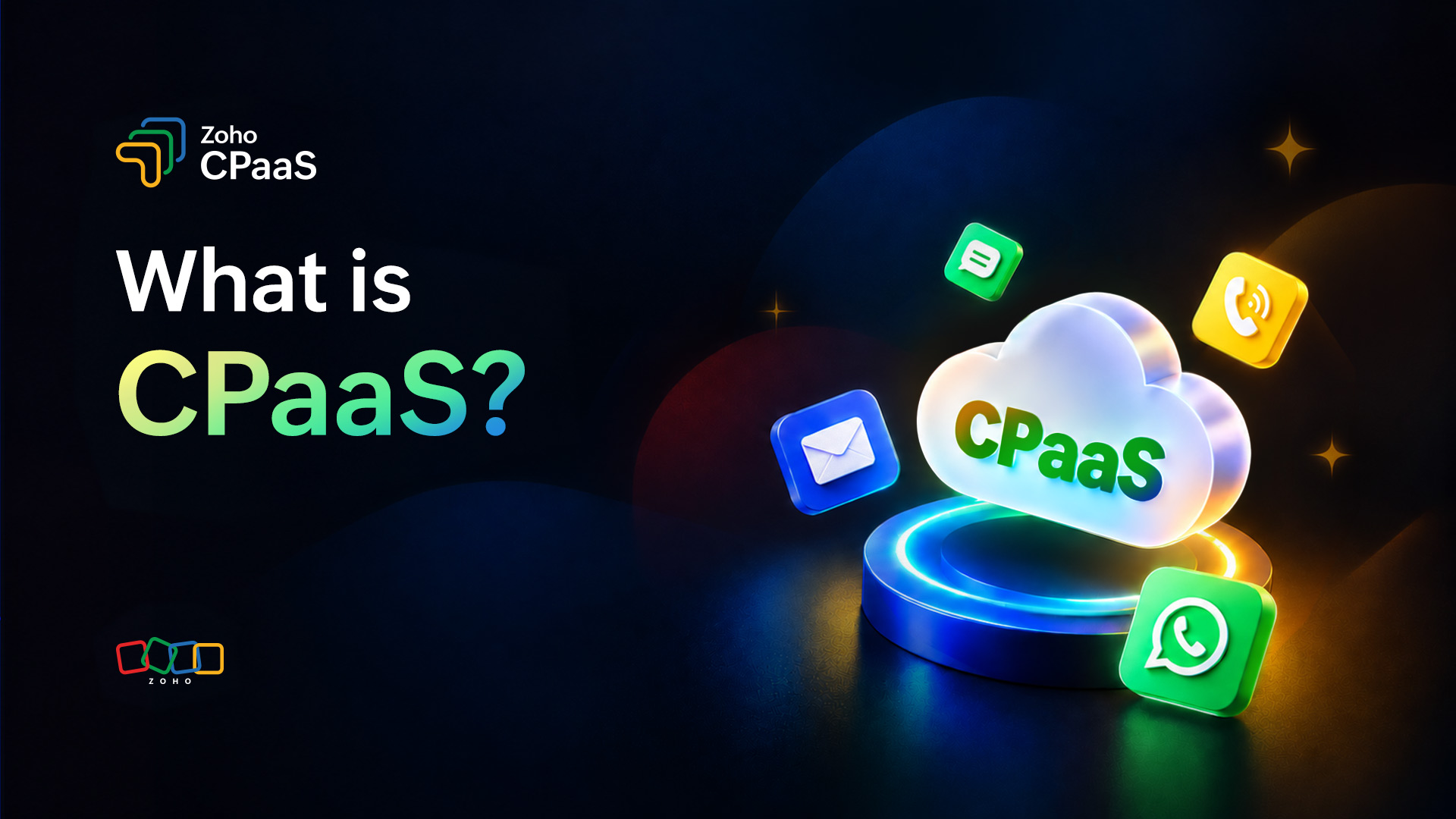
CPaaS is a cloud-based platform that delivers communication channels like email, SMS, WhatsApp, voice, and others, as programmable APIs. Businesses use those APIs to embed messaging directly into their applications, workflows, and systems, without building or managing the underlying infrastructure themselves.
The “as a service” part matters. Like other cloud services, CPaaS handles the infrastructure layer like carrier relationships, delivery routing, compliance frameworks, and uptime, so businesses can focus on the experience they’re building, not the pipes underneath it.
CPaaS vs. UCaaS vs. CCaaS
CPaaS is often confused with UCaaS (Unified Communication as a Service) which is team communication tools like video and messaging, and CCaaS (Contact Center as a Service) which is contact center infrastructure for inbound support. All three are cloud-based communications categories, but they serve entirely different functions and different users. For a full breakdown of how they compare and when each applies, see our [CPaaS vs. UCaaS vs. CCaaS] article.
How CPaaS works
At its core, CPaaS sits between your application and the carrier or channel network. When your system triggers a communication event like a purchase confirmation, a login OTP, or a delivery alert, it makes an API call to the CPaaS platform. The platform handles everything after that, including routing the message through the right carrier or channel, tracking delivery status, logging events, and returning webhooks so your system knows what happened.
The key components that make this work:
APIs and SDKs: The interface between your application and the platform, typically REST APIs with SDKs in major languages.
Communication channels: Email, SMS, WhatsApp, Voice, each with its own API or unified under a single one depending on the platform.
Webhooks and event triggers: Real-time callbacks that notify your system of delivery events, failures, or user responses.
Delivery infrastructure: Carrier routing, redundancy, and send-time optimization that affect whether messages actually reach recipients.
Analytics and reporting: Delivery rates, open rates, response rates, and channel-level performance data.
Use cases of CPaaS
CPaaS isn’t a single use case, it’s an infrastructure that different teams use for different communication needs. Here are the most common applications, along with why CPaaS handles them better than point solutions.
Transactional notifications
Order confirmations, shipping updates, payment receipts, and account alerts are triggered by system events and need reliable, fast delivery. Email and SMS are the primary channels. CPaaS platforms built for transactional traffic prioritize deliverability and throughput at scale.
Authentication and security
OTPs and two-factor authentication codes are latency-sensitive. A code that takes 45 seconds to arrive causes drop-off. CPaaS platforms with direct carrier relationships and intelligent routing keep delivery fast and consistent.
Marketing and promotional campaigns
Multi-channel campaigns that combine email, WhatsApp, and SMS see better reach than single-channel sends. CPaaS allows orchestration across channels from a single platform, with consistent reporting across all of them.
Appointment and scheduling communications
Reminders, confirmations, and rescheduling prompts are common in healthcare, logistics, and service businesses. Automating these via CPaaS reduces no-shows and support volume.
Customer support flows
Ticket updates, chatbot handoffs, and resolution confirmations via WhatsApp or SMS reduce email volume and friction for customers. CPaaS enables these flows without building a separate integration for each channel.
Operational and internal alerts
System downtime notifications, escalation alerts, and shift reminders are high-value CPaaS use cases that often go overlooked. SMS and voice are more reliable than email for time-critical internal communication.
Who CPaaS is for
CPaaS is relevant to any business that communicates with customers at volume. This holds true for most businesses.
In practice, the heaviest adopters are e-commerce platforms, fintech companies, healthcare providers, logistics businesses, and SaaS companies with transactional communication needs. But CPaaS isn’t exclusively for enterprises. Platforms with usage-based pricing and no-code configuration tools have brought the technology within reach of smaller teams too.
The developer vs. business-user dimension also matters. API-first CPaaS platforms require engineering resources to integrate and maintain. Others offer low-code or no-code interfaces that let marketing and operations teams configure and launch communication flows without writing code. The right choice depends on your team’s makeup and how much customization you need.
How to pick the right CPaaS platform
Choosing a CPaaS platform is a longer-term decision than most software purchases because migration costs are real, and deep integrations are hard to reverse. Evaluate carefully across these dimensions.
Channel coverage
Start with what you need today, then assess what you’re likely to add in the next 12 to 18 months. A platform that handles email well but requires a separate vendor for WhatsApp creates exactly the fragmentation CPaaS is supposed to solve.
Deliverability and routing reliability
This is the most important technical factor and the hardest to evaluate from a pricing page. Look for uptime SLAs, ask about carrier relationships, and test delivery rates during a trial and not just at low volumes.
API and developer experience
Documentation quality, SDK availability, sandbox environments, and time-to-first-send are reliable signals of how well-engineered a platform is. A poorly documented API will cost your team time long after the initial integration.
Compliance and data residency
Requirements vary by industry and region. GDPR, HIPAA, SOC 2, and local data residency regulations all affect which platforms you can legally use. Confirm compliance posture before shortlisting, not after.
Pricing model
Per-message, per-channel, volume tiers, and flat subscriptions each have different cost profiles at different send volumes. Model out costs at your actual usage levels to pick the right provider for your business.
Scalability
Check if the platform handle traffic spikes without degraded delivery and what the rate limits are per channel. These questions matter most during peak periods like product launches, sale events, or incidents that trigger mass notifications.
Vendor support
Dedicated onboarding, SLA-backed technical support, and pre-built integrations with your CRM, helpdesk, or e-commerce platform reduce time-to-value and lower your risk during the integration phase.
Always pilot before committing
Most platforms offer sandbox or trial access. Use it to test real integration complexity. The gap between “works in sandbox” and “works in production at scale” is where platforms differentiate.
Common misconceptions about CPaaS
"CPaaS is only for large enterprises."
Usage-based pricing and no-code configuration have made CPaaS accessible to businesses of all sizes. You don’t need a large engineering team or a large send volume to get value from a CPaaS platform.
"It’s too complex to implement."
The complexity depends on the platform and the integration. For straightforward use cases like transactional SMS and email notifications, integration can be completed in hours, not months. Low-code options reduce that further.
"We already have email. That’s enough."
Email alone misses customers who don’t open email reliably, who need real-time alerts, or who prefer messaging channels. Channel diversification through CPaaS is how businesses reach customers where they actually are.
"It’s just another messaging API."
A single-channel messaging API is a component. CPaaS is a platform that adds multi-channel orchestration, compliance infrastructure, delivery analytics, and scalability that a standalone API doesn’t provide.
Why should you choose Zoho CPaaS?
If you’re evaluating CPaaS platforms, Zoho CPaaS is built for businesses that need reliable, multi-channel customer communication without managing multiple vendor relationships.
It delivers email, SMS, WhatsApp, and voice through purpose-built APIs. Each channel is designed for the specific requirements of that medium, with shared compliance infrastructure, unified analytics, and a single vendor relationship across all of them. For teams already in the Zoho ecosystem, it integrates naturally with existing workflows. For teams that aren’t, it stands on its own as a transactional communications platform.
Zoho CPaaS is built on the same deliverability foundation as ZeptoMail—Zoho’s transactional email service—and extends that reliability to every channel your customers use.
The bottom line
CPaaS removes the infrastructure burden of customer communication and turns it into a programmable service your application can call. The question for most businesses isn’t whether to communicate with customers, it’s whether to build that capability across multiple vendors, or through a single platform designed for it.
For businesses that want multi-channel communication that scales, stays compliant, and doesn’t require rebuilding every time a new channel becomes important, CPaaS is the answer.