- HOME
- Know Your Tech
- AI efficiency in custom software development
AI efficiency in custom software development
- Last Updated : November 30, 2025
- 463 Views
- 7 Min Read
You need software that fits how your business actually works. But here's what usually happens: You explain your requirements to a development team, wait a few months, and get an application that's close but not quite right.
You request changes, wait another month, and by then your processes have already evolved. The cycle repeats, and you're stuck paying for software that still doesn't match your workflows.
Highlights
AI-driven low-code platforms enable non-technical users to create custom applications quickly, reducing development time and simplifying the process.
Self-healing systems use AI to automatically detect and fix issues in real-time, improving software reliability and minimizing downtime.
Quantum computing enhances AI efficiency by processing large data sets at high speeds, leading to smarter predictions and faster application performance.
AI in software development automates tasks, optimizes resources, and improves decision-making, helping businesses innovate faster and scale more efficiently.
But what if you could build applications yourself when you need them? What if updating your software was as simple as describing what changed, and you could see it working the same day? That’s where the efficiency of AI comes in.
Find out the top benefits of AI in custom software development, which technologies power it, and what to consider when you face common implementation challenges.
What is AI efficiency in custom software development?
AI efficiency in custom software development refers to the integration of artificial intelligence technologies, such as machine learning, natural language processing, and automation, throughout the software development lifecycle. These tools streamline the development process by automating repetitive tasks, improving decision-making, and enhancing code quality, all while reducing costs and development time.
The increasing adoption of AI is evident in the growth of the custom software development market, projected to expand from USD 53.02 billion in 2025 to approximately USD 334.49 billion by 2034, at a CAGR of 22.71%.
7 key benefits of AI efficiency in custom software development
Most businesses lose weeks waiting for custom software that still doesn't fit their needs perfectly. But with AI, instead of managing development projects for months, you can build, test, and launch applications while your requirements are still fresh.
Here's what you get with AI-powered custom software development:
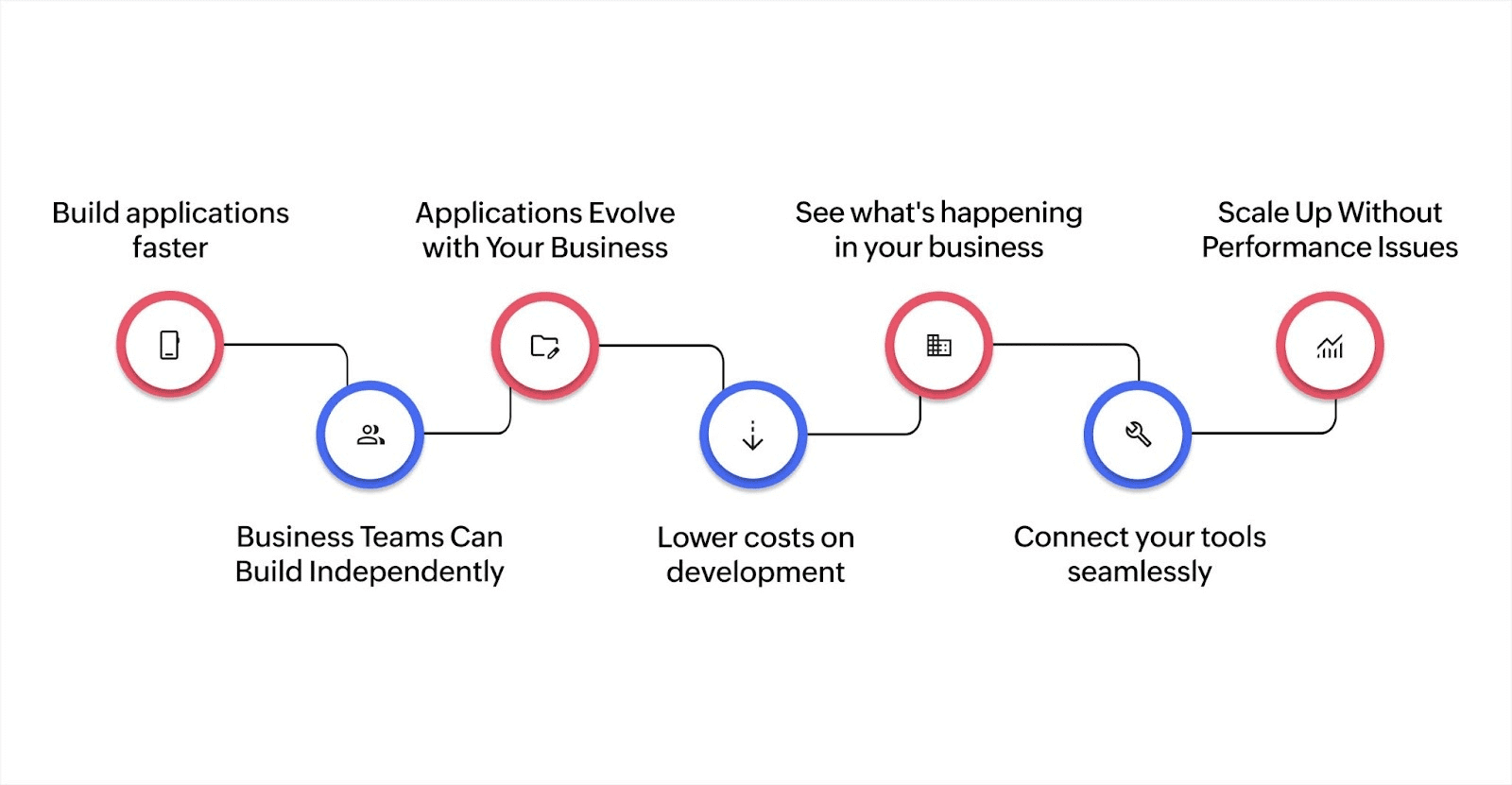
Build applications faster: AI handles the setup work like creating forms, setting up data fields, and connecting workflows, so you can launch working applications in a fraction of the usual time.
Business teams can build without waiting on IT: Non-technical users can create and modify applications themselves using simple drag-and-drop tools and plain language inputs, reducing your backlog of IT requests.
Applications adapt as your business changes: When you need to add new fields, modify workflows, or change approval processes, you can make updates quickly without rebuilding from scratch.
Lower costs on development and maintenance: You spend less on hiring specialized developers and maintaining complex codebases since AI-powered platforms automate much of the technical work.
See what's happening in your business right now: Built-in analytics show you real-time data across operations, so you can spot problems and opportunities faster than waiting for reports.
Connect your tools without custom integrations: Pre-built connections to payment systems, accounting software, and other business tools work out of the box, saving weeks of integration work.
Scale up without performance problems: Applications automatically handle more users and data as you grow, without requiring you to manage servers or optimize databases manually..
Top 4 AI technologies powering custom software development
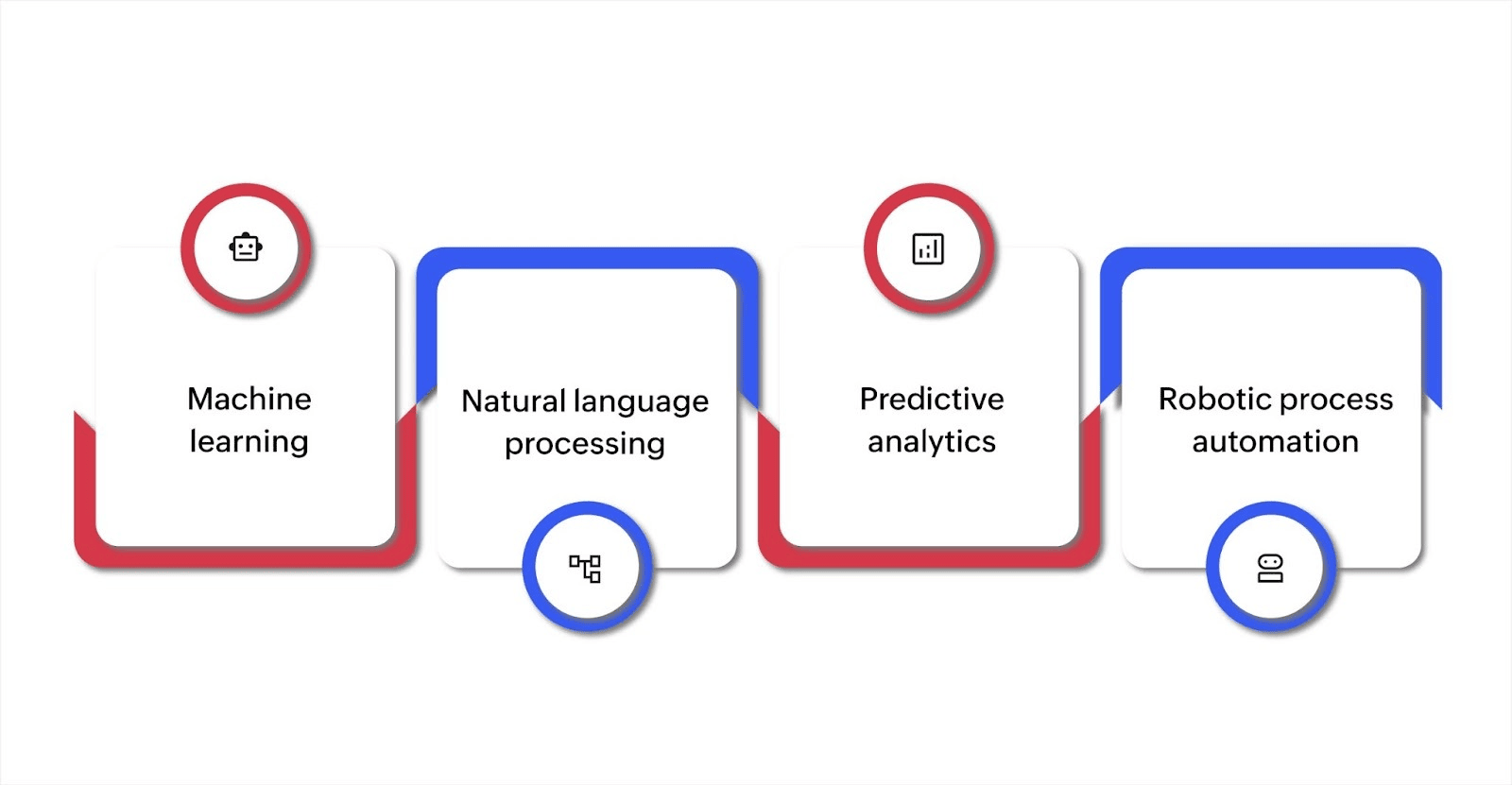
Machine learning (ML)
Machine learning (ML) helps custom software systems learn from data, improving prediction accuracy and automating decision-making. ML algorithms analyze large datasets to identify patterns and make data-driven decisions, allowing software to adapt and respond to changing business needs.
How ML supports custom software development:
Prediction accuracy: By analyzing past data, ML models can predict future outcomes, helping businesses make quicker, informed decisions.
Continuous optimization: As the system processes more data, it becomes better at predicting trends, improving its performance over time.
Automated decision-making: ML allows software to make complex decisions automatically, reducing reliance on human input and increasing consistency across operations.
Natural language processing (NLP)
Natural language processing (NLP) allows software systems to understand and generate human language. With NLP, businesses can automate communication, data analysis, and content creation, all of which help improve operational efficiency.
How NLP integrates into custom software:
Automation of communication: NLP enables systems to automatically respond to customer inquiries through chatbots or virtual assistants, reducing the need for human intervention.
Document processing: NLP can read and extract information from invoices, contracts, and forms automatically, turning unstructured text into organized data you can use.
Data analysis: It helps analyze large volumes of text-based data such as customer feedback or social media posts, allowing businesses to extract key insights quickly.
Predictive analytics
Predictive analytics uses AI to forecast future trends, helping businesses anticipate challenges and plan accordingly. This technology uses historical data to provide valuable insights into potential outcomes, allowing for better decision-making and resource allocation.
How predictive analytics benefits software development:
Forecasting trends: Predictive models provide insights into future trends, helping businesses stay ahead of the curve and avoid delays.
Optimized resource allocation: By predicting potential problems, businesses can allocate resources more effectively, ensuring smooth project execution.
Risk assessment: Predictive analytics evaluates project risks by analyzing similar past projects, showing you which areas need extra attention or contingency planning.
Robotic process automation (RPA)
Robotic process automation (RPA) automates repetitive tasks, such as data entry, form filling, and processing, reducing the time and effort required for manual operations. This increases efficiency and allows employees to focus on tasks that require human judgment.
How RPA drives efficiency in custom software:
Rule-based task automation: RPA excels at tasks that follow specific rules and patterns, like moving data between systems, filling forms, or processing transactions according to defined criteria.
24/7 operation without breaks: RPA bots work continuously without fatigue, processing tasks overnight and on weekends when human workers are unavailable.
Error reduction: RPA follows defined rules consistently, reducing mistakes that happen with manual data entry and processing.
Challenges of implementing AI efficiency in custom software development

AI has the potential to enhance custom software development processes by automating repetitive tasks and improving workflows. However, its implementation comes with challenges that you need to solve for successful implementation.
Data quality and integration
AI depends on high-quality, accurate data. Inaccurate or incomplete data can lead to poor predictions and results. Integrating data from various sources, particularly legacy systems, can complicate development. Ensuring clean, well-structured data is vital for AI efficiency.
Key considerations
Ensure data accuracy and completeness
Address integration issues with legacy systems
Upfront costs
AI tools and technologies require significant investment in infrastructure, software, and training, which can be prohibitive for small and medium-sized businesses. Evaluating the potential return on investment (ROI) is essential before AI adoption.
Key considerations
Significant initial investment required
Evaluate the ROI against upfront costs
Future of AI efficiency in custom software development
The future of AI in custom software development presents transformative opportunities. As AI technologies continue to evolve, they are becoming integral to how applications are built, maintained, and optimized. Here are some key developments shaping the future:
Self-healing systems
Self-healing systems are AI-powered solutions that autonomously detect and fix issues in software. This reduces downtime and the need for manual intervention. Benefits include:
Error detection: AI monitors system performance and identifies potential issues.
Automatic fixes: AI applies solutions in real time, keeping systems running smoothly.
Improved reliability: Faster recovery from issues leads to more stable software.
Self-healing systems ensure your software operates consistently without constant maintenance.
Quantum computing in AI
Quantum computing will significantly boost AI efficiency in software development. With its ability to process vast amounts of data at high speeds, quantum computing can enhance AI algorithms, offering:
Increased computational power: AI can handle larger datasets and perform complex calculations faster.
Smarter predictions: Quantum computing enables more accurate models and better decision-making.
Faster performance: AI-powered applications will run more efficiently with quantum computing.
This technology will allow businesses to build smarter, faster applications, tackling complex challenges in custom software development.
How AI efficiency is transforming custom software development
Building custom software used to mean hiring developers, managing long projects, and paying high costs. AI efficiency has changed this by automating the technical work that traditionally required specialized skills.
AI-powered low-code platforms like Zoho Creator use AI efficiency to let you build applications by describing what you need in plain language. The platform handles form creation, workflow setup, and data structure automatically.
Curious about how AI can reshape your software development process? With Zoho Creator, you can use AI to create custom applications that evolve with your business. Start building today.
FAQ
How does AI help businesses build better custom software?
AI helps you build applications that work better by suggesting optimal data structures, workflows, and integrations based on common business patterns. It monitors how your applications perform and recommends improvements, so your software continues to meet your needs as usage grows.
Can AI-driven software development tools reduce the need for a large IT team?
Yes, AI-powered low-code platforms let business users build and modify applications themselves, which reduces dependency on IT teams for routine requests. Your IT team can focus on complex integrations and security while business users handle day-to-day application changes and updates.
How can AI improve resource allocation in custom software development?
AI can analyze the development process to identify inefficiencies and recommend better allocation of resources. By automating routine tasks and optimizing team efforts, businesses can allocate resources more effectively, ensuring faster development with minimal waste.
Will AI change the role of software developers in the future?
While AI will automate many tasks, software developers will still play a crucial role in designing, implementing, and overseeing AI-driven solutions. Developers will focus more on high-level tasks, such as strategic planning, while AI handles repetitive setup and configuration tasks.
 Bharathi Monika Venkatesan
Bharathi Monika Venkatesan is a content writer at Zoho Creator. Outside of work, she enjoys exploring history, reading short novels, and cherishing moments of personal introspection.