- HOME
- Know Your Tech
- AI agents: How they work, types, and benefits for businesses
AI agents: How they work, types, and benefits for businesses
- Last Updated : August 4, 2026
- 182 Views
- 11 Min Read
Ask a chatbot a question, and it gives you an answer straight away. But ask an AI agent to handle a task, and it figures out the steps, picks the right tools, and gets it done on its own, without waiting for step-by-step instructions.
Highlights
- AI agents are autonomous software systems that plan, reason, and execute tasks independently, going well beyond simple chatbot responses.
- The five main types of AI agents range from simple reflex agents to advanced learning agents that improve over time.
- Businesses use AI agents for customer support, workflow automation, data analysis, and decision-making across departments.
- Key components include a foundation model, planning module, memory, and tool access that let agents handle complex, multi-step tasks.
- Choosing the right platform depends on factors like ease of setup, integration support, security controls, and multi-device access.
According to a recent PwC survey, 79% of senior executives reported that in their organizations, they are already putting AI agents to work. Companies across different industries are adopting AI agents to increase their productivity and build more efficient automated workflows.
This blog post explains what AI agents are, how they work, and where they add the most value. You'll also learn about the main types and what you should look for before selecting an AI agent platform.
What are AI agents?
An AI agent is a software system that can independently plan, reason, and take action to achieve a specific goal. Unlike a chatbot that waits for your prompt and gives a single response, an agent breaks down a complex task into steps, selects the right tools, and executes each step on its own.
For instance, imagine you ask an AI agent to "process this week's expense reports." The agent would pull the reports from your finance app, validate each entry against company policy, flag exceptions, route approvals to the right managers, and send confirmation emails. You gave one instruction. The agent handled everything else.
How are AI agents different from chatbots?
Chatbots and AI agents both use language models, but they serve very different purposes. For instance, a chatbot is reactive. You type a question, and it replies. The conversation ends there unless you ask another question. It can't take action outside the chat window.
An AI agent, on the other hand, is proactive. It receives a goal, creates a plan, and works through it step by step. It can interact with external systems, make decisions based on context, and learn from previous outcomes. Here's how they compare side by side:
| Factor | Chatbot | AI agent |
|---|---|---|
| Interaction | Responds to individual prompts | Works toward a defined goal |
| Autonomy | Needs constant input | Operates independently after receiving a goal |
| Tool use | Limited to text generation | Can use APIs, databases, apps, and web tools |
| Memory | Typically session-based | Retains context across tasks and sessions |
| Decision-making | Follows scripted or trained responses | Reasons, plans, and adapts based on context |
| Output | Text responses | Actions, decisions, and completed tasks |
A chatbot answers your question. An AI agent does the work.
How do AI agents work?
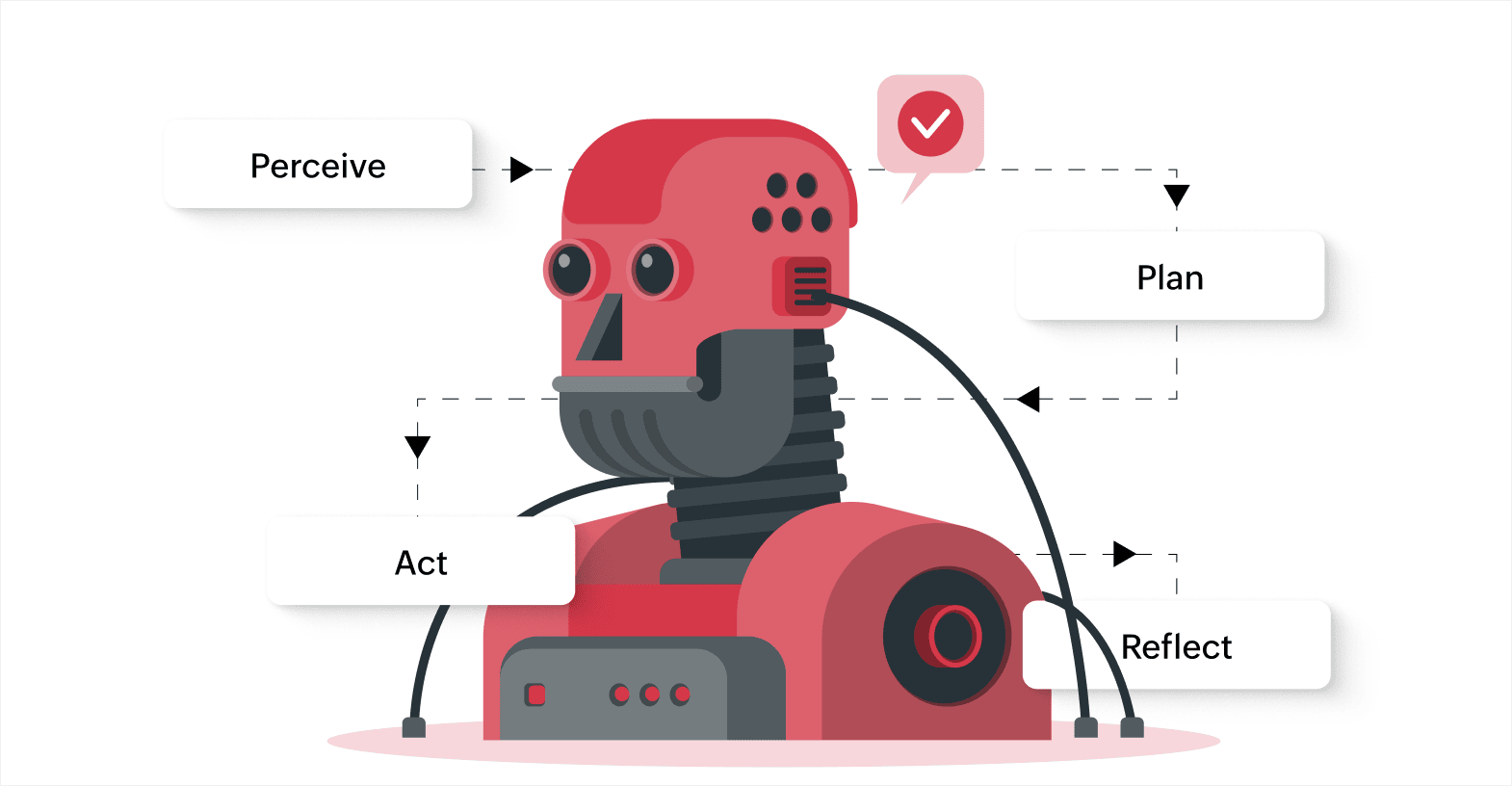
AI agents follow a repeating cycle that allows them to handle complex tasks without manual intervention at every step. This cycle has four stages.
1. Perceive
The agent takes in information from its environment. This could be a user prompt, data from a connected app, a triggered event, or a change in a database. It gathers the context it needs to understand the current situation and what's being asked.
2. Plan
Based on its goal, the agent breaks the task into smaller sub-tasks. It decides which steps to take, in what order, and which tools to use for each one. For example, if the goal is to onboard a new employee, the agent might plan steps for creating accounts, assigning training modules, and notifying the manager.
3. Act
The agent executes its plan. It calls APIs, updates records, sends messages, runs queries, and interacts with connected systems. Each action moves it closer to completing the goal. If one step requires output from another, the agent handles that dependency automatically.
4. Reflect
After acting, the agent reviews the results. Did the action succeed? Was the output correct? If something didn't go as expected, the agent adjusts its approach and tries again. This reflection loop is what separates agents from basic automation workflows that simply stop when they hit an error.
This perceive-plan-act-reflect cycle runs continuously until the agent completes its goal or determines it needs human input. The ability to self-correct and adapt makes agents effective for tasks that aren't fully predictable.
Key components of an AI agent
Every AI agent, regardless of its complexity, is built on a set of core components that work together. Understanding these helps you evaluate what an agent can actually do.
- Foundation model: The large language model (LLM) that gives the agent its reasoning and language abilities. This is the brain that interprets instructions, generates responses, and drives decision-making.
- Planning module: The logic that breaks a high-level goal into a sequence of actionable steps. A strong planning module handles dependencies, prioritizes tasks, and adjusts when conditions change.
- Memory: The ability to store and retrieve information across interactions. Short-term memory holds context within a task. Long-term memory retains knowledge from past tasks, helping the agent improve over time.
- Tool access: The connections to external systems, APIs, databases, and applications that let the agent take real action. Without tools, an agent can only think. With tools, it can do.
- Learning and reflection: The feedback loop that lets the agent evaluate its own output, identify errors, and refine its approach. This is what makes agents adaptive rather than rigid.
These components work in layers. The foundation model provides intelligence. Planning and memory add structure. Tool access enables action, while reflection ensures quality. As AI automation in app development advances, these components are becoming easier to configure and deploy.
Types of AI agents
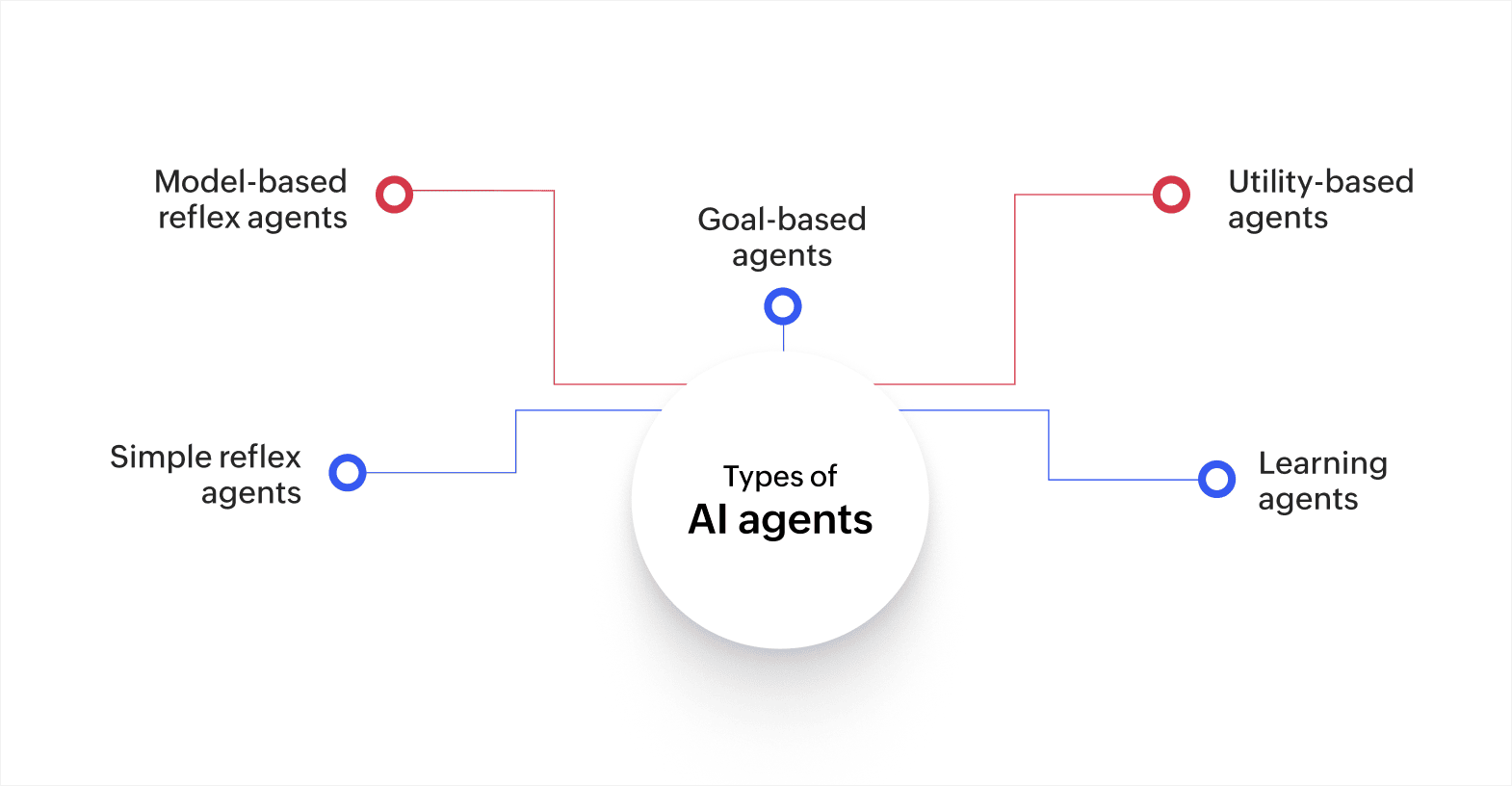
AI agents vary widely, ranging from simple systems that react to predefined conditions to advanced agents that learn and improve independently. Some of the main types include:
1. Simple reflex agents
These agents respond to specific inputs with predefined actions. They don't consider history or future consequences. For instance, a thermostat that turns on heating when the temperature drops below a set point is a simple reflex agent. In business, this could be a rule that sends an alert when inventory falls below a threshold.
2. Model-based reflex agents
These agents maintain an internal model of how the world works. They track changes over time and use that context to make better decisions than simple reflex agents. For example, a model-based agent monitoring server health might notice a pattern of increasing load and preemptively scale resources before a crash happens.
3. Goal-based agents
Goal-based agents go beyond reacting to current conditions. They evaluate different possible actions and choose the one most likely to achieve a specific goal. For example, a delivery routing agent might evaluate traffic patterns, weather data, and driver availability to find the fastest route for each package.
4. Utility-based agents
These agents don't just aim for a goal. They evaluate how well different outcomes serve the overall objective. A utility-based agent handling customer portal tickets might prioritize high-value accounts, route complex issues to senior agents, and resolve simple queries automatically, all while maximizing overall satisfaction scores.
5. Learning agents
Learning agents improve their performance over time based on feedback and past experiences. They adapt to new situations without needing explicit reprogramming. For instance, a hiring agent that reviews resumes might learn to weigh certain skills more heavily based on which past candidates succeeded in the role.
Most business applications today involve goal-based, utility-based, or learning agents, since real-world tasks require reasoning, prioritization, and adaptation.
Where businesses use AI agents today
AI agents are showing up across departments and industries. Here are the most common applications where they deliver measurable value.
Customer service and support
AI agents handle incoming queries, classify ticket urgency, pull relevant customer history, and either resolve the issue or route it to the right team member. A well-designed customer service workflow powered by AI agents reduces response times and frees up human agents for complex conversations.
Sales and lead management
Agents can score incoming leads based on behavior, demographics, and engagement history. They assign high-priority leads to the right reps, trigger follow-up sequences, and update your customer relationship management (CRM) system, all without manual input.
HR and employee onboarding
From generating offer letters to setting up accounts, assigning training, and scheduling orientation sessions, AI agents handle the repetitive steps that slow down onboarding. They ensure nothing gets missed and every new hire has a consistent experience.
Finance and expense management
AI agents validate expense reports against policies, flag anomalies, route approvals, and update accounting systems. For example, an agent could check whether a submitted travel expense exceeds the daily limit and automatically request documentation before approving.
IT operations and incident response
When a system alert fires, an AI agent can assess the severity, check related logs, escalate to the right team, and even execute initial troubleshooting steps. This cuts response time from minutes to seconds.
Marketing campaign management
Agents can monitor campaign performance in real time, adjust ad spend based on defined rules, generate reports and dashboards, and suggest optimizations based on what's working. They keep campaigns on track without constant human monitoring.
In every situation, AI agents handle multi-step tasks that span systems and teams. They take over the coordination work that would otherwise require a person to manage manually.
Benefits of AI agents for businesses
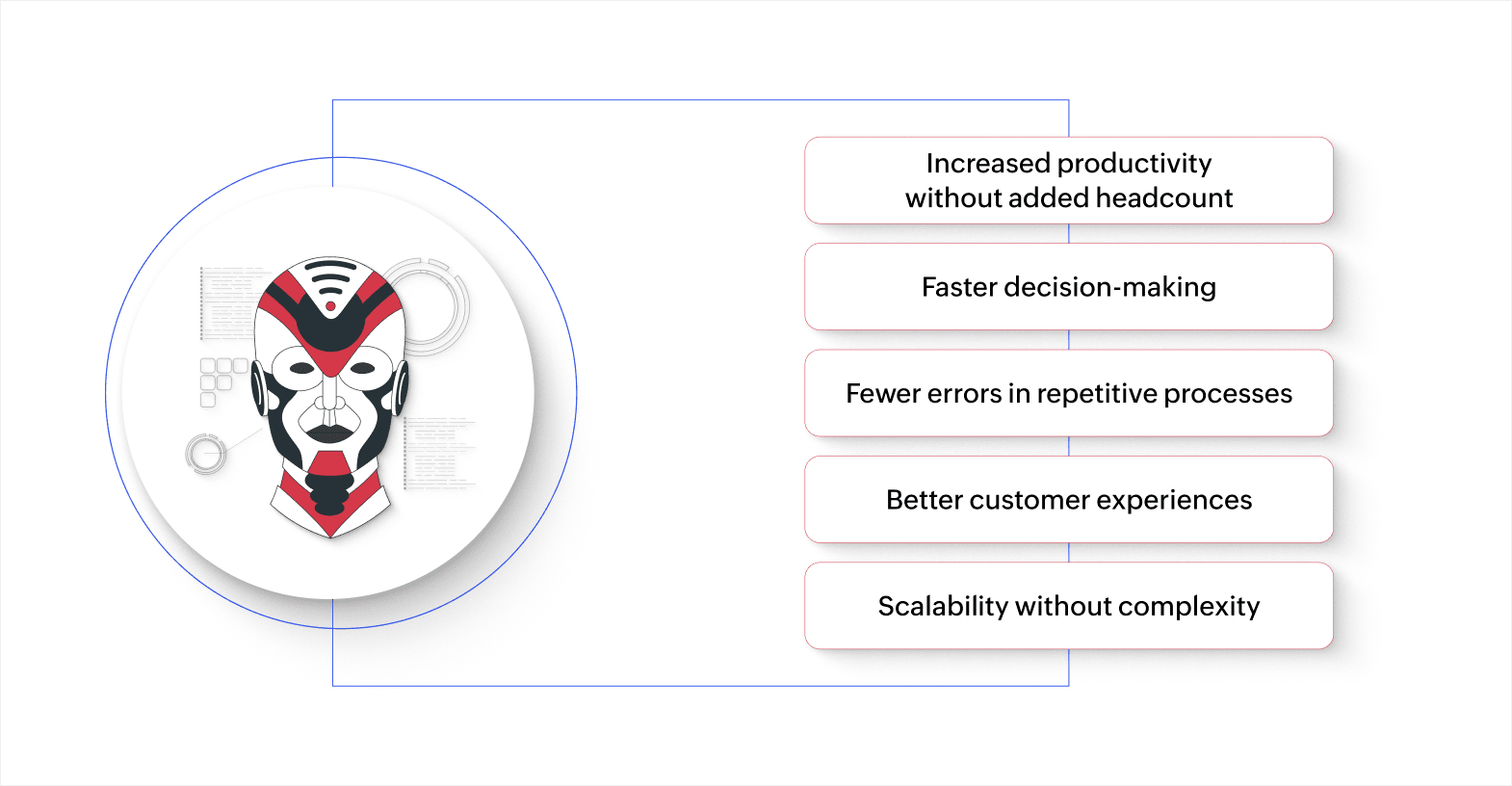
The advantages of AI agents go beyond simple time savings. Here's what they bring to the table in practical terms.
Increased productivity without added headcount
AI agents handle repetitive, multi-step tasks that previously required dedicated staff. Your team stays the same size, but their time shifts from coordination work to strategic work. A finance team spending hours on expense validation can focus on forecasting instead.
Faster decision-making
Agents process data, analyze patterns, and surface recommendations faster than any manual review. When a supply chain agent detects a potential shortage, it can flag the issue, suggest alternative suppliers, and prepare a purchase order, all before a human would notice the trend.
Fewer errors in repetitive processes
Manual data entry, approvals, and routing are prone to mistakes, especially at scale. AI agents follow consistent logic every time. They validate inputs, check for exceptions, and apply rules uniformly across hundreds or thousands of transactions.
Better customer experiences
Faster responses, accurate routing, and personalized interactions add up to happier customers. An agent that remembers a customer's history and preferences can resolve issues more quickly than a generic support flow.
Scalability without complexity
As your business grows, AI agents scale with it. They handle increasing volumes without proportional increases in cost or staff. A company processing 100 orders a day can scale to 10,000 without rethinking its workflow architecture.
These benefits add up quickly, especially when agents handle tasks across departments.
Challenges and risks to consider when using AI agents
AI agents are powerful, but they also come with considerations that deserve attention before deployment.
Data privacy and security
AI agents often need access to sensitive business data to do their jobs. Customer records, financial data, and internal communications can all be part of an agent's workflow. Clear access controls, encryption, audit trails, and strong data security practices are essential.
Feedback loops and hallucinations
An agent that reflects on its own output can sometimes reinforce incorrect conclusions. If the initial data or reasoning was flawed, the reflection step may not catch it. This is why human review checkpoints matter, especially for high-stakes decisions.
Over-reliance on automation
Agents work best as collaborators, not replacements. Teams that hand off critical decisions entirely to AI agents risk losing visibility into how those decisions are made. Maintain clear escalation paths and regular oversight.
Goal misalignment
If an agent's goal is poorly defined, it may take actions that technically achieve the goal but produce unintended consequences. For instance, an agent told to "minimize support ticket volume" might start closing tickets prematurely rather than resolving them properly.
Integration complexity
Agents are only as effective as their access to tools and data. If your systems don't share data well or lack accessible APIs, the agent's ability to act is limited. Integration readiness is a prerequisite for any successful AI agent deployment.
Having clear goals, proper guardrails, and a plan for human oversight ensures effective AI agents adoption and implementation.
What to look for in an AI agent platform
Choosing the right platform shapes how efficiently your team can build, deploy, and manage AI agents. Here are the factors that matter most to consider when choosing the right AI agent platform:
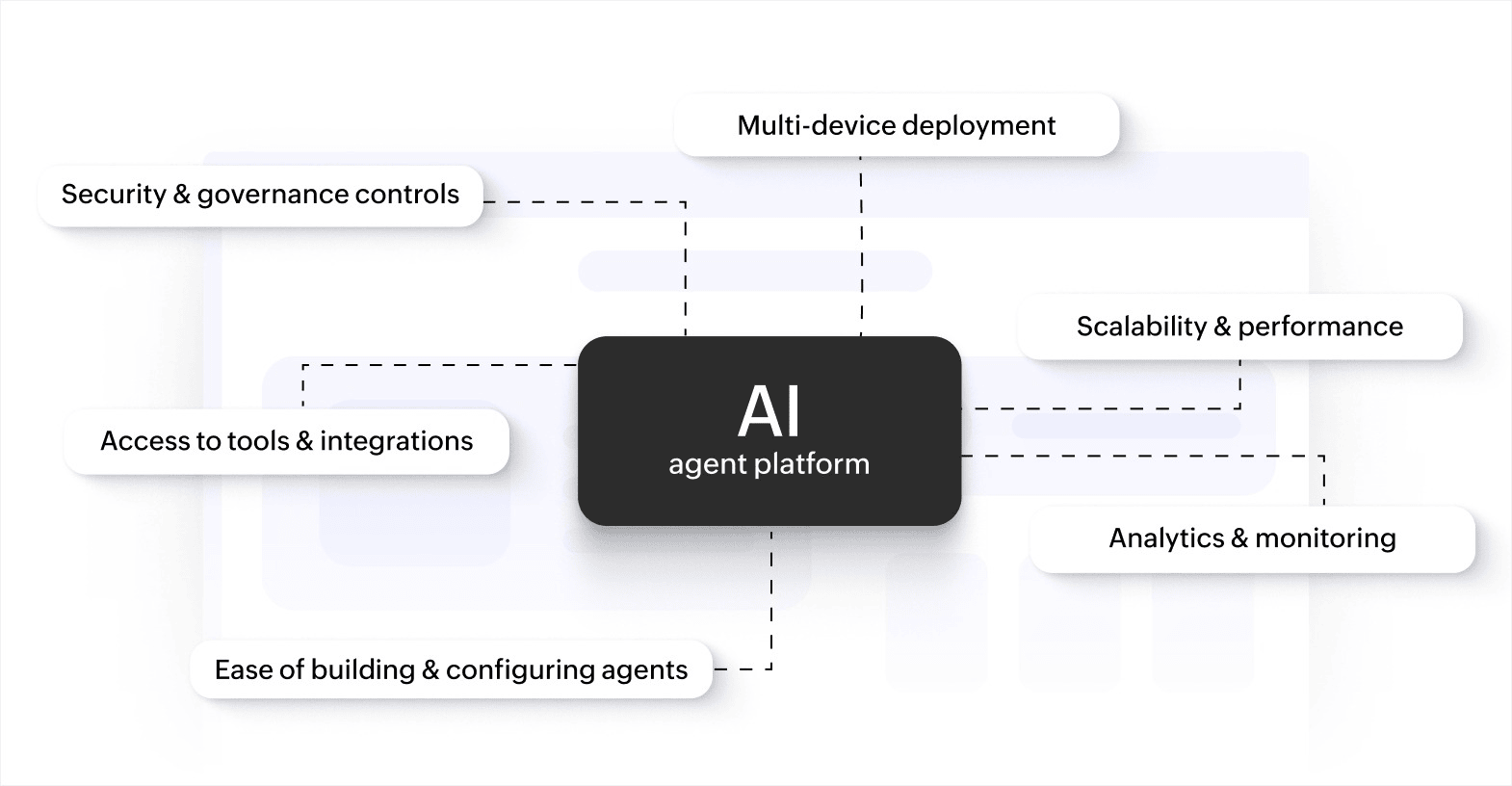
Ease of building and configuring agents
The platform should let you define agent behavior using natural language instructions, not just code. Look for visual builders, drag-and-drop interfaces, and pre-configured templates that reduce the time from idea to working agent.
Access to tools and integrations
Your agents need to interact with the systems your business already uses. Check for ready-made connectors, API support, and the ability to build custom connections. The more tools an agent can access, the more useful it becomes.
Security and governance controls
Role-based access, audit logs, data encryption, and compliance certifications are non-negotiable. You need to know who built each agent, what data it accesses, and what actions it takes.
Multi-device deployment
Your teams don't all work from the same device or location. The platform should support web, mobile, and tablet access for both building and using agents. Native mobile apps make agents accessible to field teams and remote workers.
Scalability and performance
As you add more agents and increase usage, the platform needs to keep up. Look for auto-scaling infrastructure, usage monitoring, and the ability to manage large numbers of agents without performance drops.
Analytics and monitoring
You need visibility into how your agents perform. Track success rates, task completion times, error frequencies, and user interactions. This data helps you refine agents and measure return on investment.
The platform you choose should reduce the technical barrier to entry while giving experienced teams the flexibility to build complex, multi-step agents.
Build and deploy AI agents with Zoho Creator
Setting up AI agents typically requires deep technical expertise, dedicated engineering resources, and months of development. For businesses that want to move faster without building from scratch, a platform that simplifies the process makes a real difference.
Zoho Creator is an AI-powered low-code application development platform that lets you build AI agents customized to your business needs. You start by defining what the agent should do using natural language instructions, then configure the functions it needs to carry out those tasks.
The platform's AI agent builder lets you set up your agents within the same environment where you build your apps. Your agents can analyze data, route tasks, send notifications, update records, and interact with connected tools.
Sign up for free today and see how quickly you can bring intelligent automation to your workflows.
FAQ
1. What is the difference between AI and an AI agent?
AI is a broad field that includes any system designed to perform tasks that typically require human intelligence. An AI agent is a specific type of AI that can autonomously plan, reason, and take action to complete goals.
2. Can AI agents work with existing business software?
Yes, most AI agent platforms support integrations with popular business tools through APIs and ready-made connectors. The agent connects to your existing systems and acts on data across them.
3. Do you need coding skills to build an AI agent?
Not always. Low-code platforms let you define agent behavior using natural language and visual tools. Technical skills help with advanced customizations, but basic agents can be built without writing complex code.
4. How do AI agents learn and improve over time?
Learning agents use feedback from past actions to refine their decision-making. They track which approaches produced the best results and adjust their behavior accordingly for future tasks.
5. Are AI agents safe to use with important business data?
They can be, with the right safeguards. Look for platforms that offer data encryption, role-based access controls, audit logs, and compliance with standards like service organization control 2 (SOC 2) and general data protection regulation (GDPR).
 Bharathi Monika Venkatesan
Bharathi Monika Venkatesan is a content writer at Zoho Creator. Outside of work, she enjoys exploring history, reading short novels, and cherishing moments of personal introspection.