

- HOME
- Business travel
- Managing Unused Flight Credits: Maximizing ROI in Corporate Travel
Managing Unused Flight Credits: Maximizing ROI in Corporate Travel
Flight cancellations and itinerary changes are an unavoidable part of business travel. Meetings get postponed, projects change direction, employees fall sick, and travel plans shift at short notice. According to the 2024 GBTA analysis, highlights that 54% of travel buyers flag unused tickets as a major operational pain point. For frequent business travelers and travel administrators, reclaiming this value represents a significant opportunity to reduce effective travel spend without cutting travel programs.
The challenge is not just about making employees use their credits. It's about creating enough visibility, accountability, and planning discipline to ensure credits are identified, tracked, and used before they expire, without compromising business travel policies. A structured approach to flight-credit management can help organizations reduce avoidable airfare expenditure.
What Are Unused Flight Credits?
An unused flight credit is a monetary value provided by an airline when a previously purchased flight is cancelled, changed, or otherwise qualifies for credit instead of a cash refund. The credit can typically be applied toward a future eligible flight, subject to the airline's terms, validity period, fare conditions, and other restrictions.
For businesses, these credits represent travel spend that has already been committed but has not yet been fully utilized. Unlike a simple refund, the value remains tied to future travel and may have conditions around who can use it, when it can be used, and which flights or fares are eligible.
How Do Businesses Get Unused Flight Credits?
Unused flight credits generally received when a booked business trip does not take place as originally planned. Common situations include:
Flight cancellations: An employee may need to cancel a trip because a client meeting is postponed, a project timeline changes, or when business priorities shift. Depending on the fare and airline rules, the cancelled ticket may result in a flight credit.
Changes to business travel plans: A traveler may change an itinerary, destination, or travel date. The difference in fare or the value of the original ticket may be retained as a credit that can be used for future travel.
Airline schedule changes: Airlines may change or cancel scheduled flights. Depending on the circumstances and applicable airline policies, this can result in a travel credit or other form of compensation.
Non-refundable or restricted fares: Some corporate fares may not qualify for a cash refund when cancelled but may instead retain some or all of their value as a credit for future travel.
Unused or partially used tickets: A ticket may be changed or cancelled after only part of its value has been used, leaving a residual amount that can potentially be applied to another eligible booking.
Disrupted or postponed business trips: Unexpected changes such as project delays, client rescheduling, internal meetings being moved, or changes in business priorities can leave previously booked travel unused.
The exact value, validity period, eligibility, and redemption conditions vary by airline, fare type, booking channel, and the circumstances of the cancellation or change. This makes it important for enterprises to capture the details of each credit rather than treating every credit as interchangeable.
More importantly, the creation of a flight credit is only the beginning of the management challenge. Once a credit is issued, organizations need to know its value, who it is associated with, when it expires, what restrictions apply, and how it can be used for legitimate future business travel. Without that visibility, a credit that represents recoverable travel spend can easily become stranded and eventually expire.
That is why managing unused flight credits requires more than simply keeping a record of cancelled tickets. It requires a structured process for capturing, tracking, assigning, monitoring, and ultimately redeeming the value before it is lost.
Why unused flight credits are a corporate travel problem
An unused flight credit may appear to be a relatively small amount when viewed individually. But across an enterprise, hundreds of unused credits can represent a substantial pool of recoverable travel spend.
Listing down some of the problems that companies potentially face.
Credit Fragmentation
In large enterprises, credits can be scattered internally across employees, departments, and business units, with bookings spread across multiple airlines, channels, and travel agencies.
Scattered credit ownership: Credits are often tied to individual travelers rather than managed as an enterprise-wide asset.
Multiple booking channels: Credits may originate from airlines, online booking tools, travel agencies, or direct bookings.
Limited visibility: Travel teams may lack a consolidated view of outstanding credits and their values.
Different airline rules: Expiration dates, transferability, and redemption conditions can vary by airline.
Duplicate spending: Employees may purchase new tickets while eligible credits remain unused.
Difficult reconciliation: Partial redemption can leave small balances that are easily overlooked.
Expiry risk: Without centralized monitoring, credits approaching expiry can go unnoticed.
Unclear ownership model
One of the biggest challenges with flight credits is ambiguity around ownership. When a flight is canceled, the credit is often issued in the traveler's name. But it would be paid by the company, and the booking may have been made by the travel admin, the TMC, or the corporate travel platform. This can create ambiguity around who should monitor, act on, and ultimately redeem the credit.
In large enterprises, where employees frequently change roles, teams, locations, or travel requirements, this problem becomes more pronounced.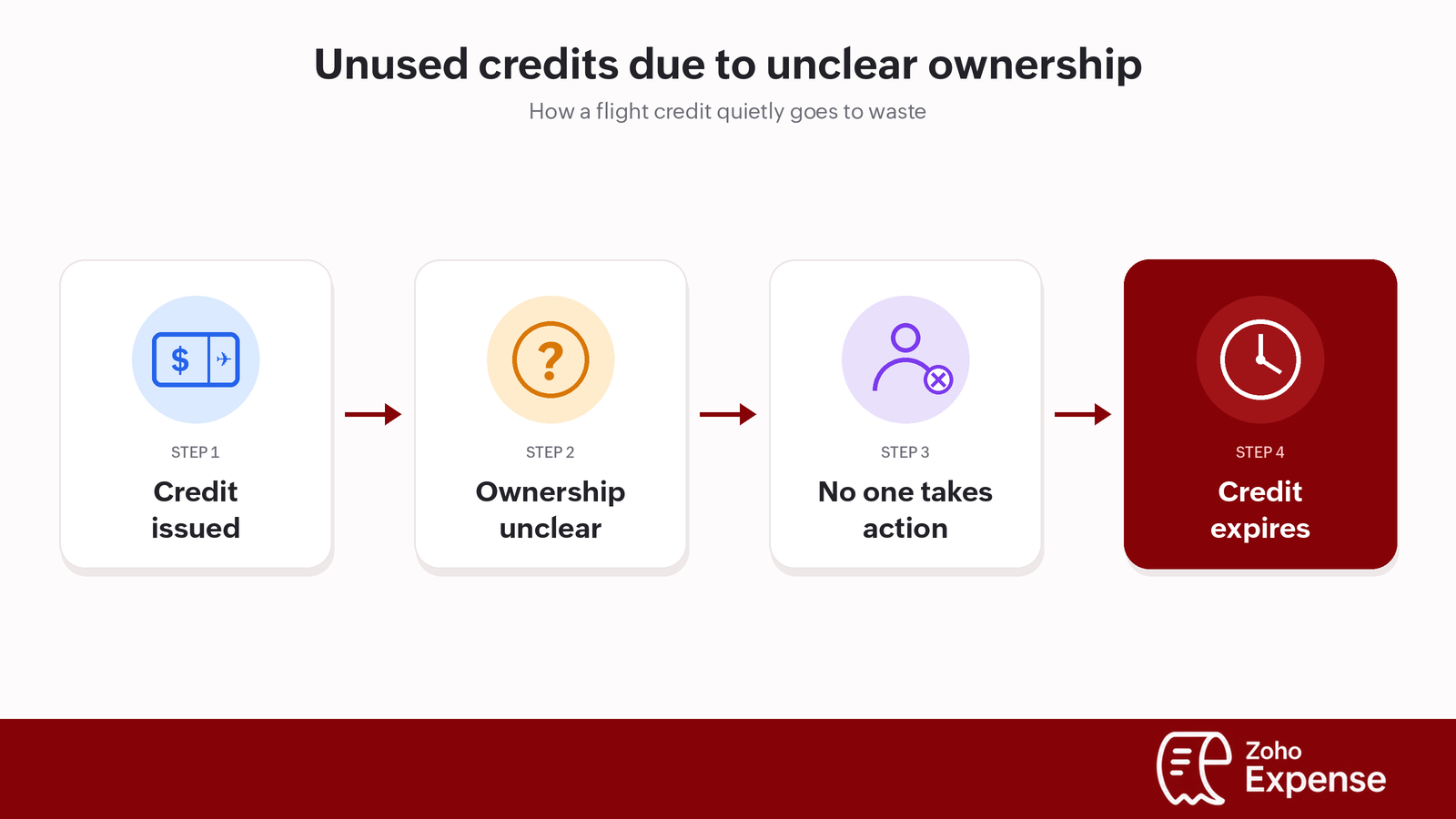
Expiry Risk and Poor Visibility
One of the biggest challenges for companies is knowing which credits are approaching expiry. Flight credits have different expiration dates, airline-specific conditions, and redemption restrictions. When these details are spread across booking confirmations, emails, travel agency records, or individual employee accounts, it becomes difficult for travel teams to maintain a complete and timely action to redeem them.
Best Practices for Travel Admins
Travel admins need to recover the unused flight-credit value. But managing credits effectively requires more than maintaining on spreadsheets and emails. Travel administrators need to establish process that captures credits when they are created, keeps them visible throughout their lifecycle, and ensures that action is taken before they expire.
Create a centralized credit repository
Capture every credit as soon as it is issued. Centralized information gives travel teams a complete picture of outstanding travel value.
Establish clear accountability
A clear ownership model should define responsibilities throughout the credit lifecycle. 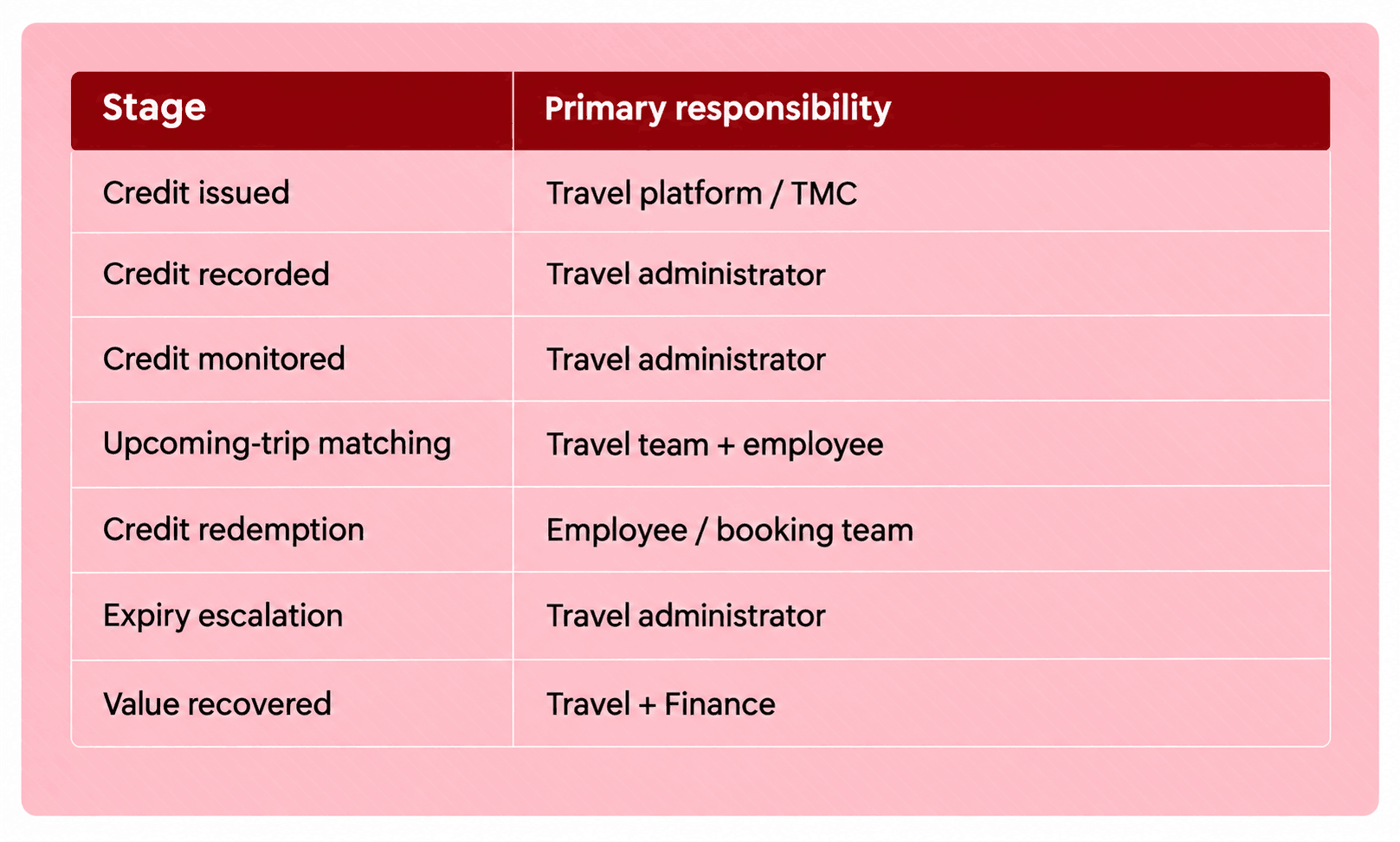
Use technology to reduce manual tracking
At enterprise scale, managing hundreds of credits via spreadsheets and email can be inefficient. A connected travel platform can help organizations capture booking information, monitor credits, send expiry notifications, and connect available credits with future travel.
The goal is not simply to automate administration. It is to create visibility across the entire travel lifecycle.
Tips for business travelers
Before purchasing a new business flight, check whether you have an eligible airline credit.
Don't ignore cancellation confirmations
When a business trip is canceled or changed, pay attention to the confirmation provided by the airline or booking platform.
Respond to expiry notifications: Employees need to travel admin. If they receive a notification about a credit approaching expiry, check whether you have an upcoming business travel that can legitimately use it.
Inform the travel team about changes: If your itinerary changes, notify the relevant travel team or use the approved booking channel. This helps ensure that new credits are captured and tracked rather than disappearing into individual booking records.
Plan upcoming travel with existing credits in mind: Business travel is often planned much in advance. If you know that you have an upcoming travel, check whether an existing credit can be used for that trip.
Turning Stranded Credits Into Strategic Travel Value
The most effective approach is to think of flight credits as part of the corporate travel lifecycle, rather than as isolated airline vouchers. A flight credit should not be viewed simply as the leftover value from a canceled booking. It is travel spend that the organization has already committed and can potentially recover. From an organizational standpoint, managing travel credits is effectively part of a broader corporate travel strategy.
Technology can bring these pieces together by connecting travel booking, traveler information, credit tracking, and expense data. With Zoho Expense, bring corporate travel booking, expense management, and corporate cards under a single roof. The connected system can help reduce avoidable leakage, strengthen accountability, and give travel and finance teams better information for managing corporate travel spend.
Frequently Asked Questions
Companies should maintain a centralized record containing the credit amount, traveler, airline, issue date, expiration date, restrictions, and redemption status. Automated alerts can then flag credits at 90, 60, and 30 days before expiration, allowing travel teams to take action before the value is lost.
Travel administrators can track unused flight credits through a centralized travel management system or structured credit register. The system should provide visibility into outstanding balances, travelers, airlines, expiration dates, and redemption status, making it easier to identify credits that require immediate attention.
 Neil Varshiney
A focussed marketer and seasoned Fintech writer helping finance professionals and business owners to find and help them evaluate the right tech stack to run their operations effectively.