

- HOME
- Business travel
- How to Build a Corporate Travel Program That Saves Money
How to Build a Corporate Travel Program That Saves Money
Business travel is one of the biggest controllable expenses for most companies, and one of the least controlled. When employees book on their own, through different sites, at different times and at different prices, no one has a clear picture of what the company spends or why. A well-built corporate travel program fixes that. This guide covers what a managed travel program is, how it saves money, how to negotiate better rates, and which software features matter.
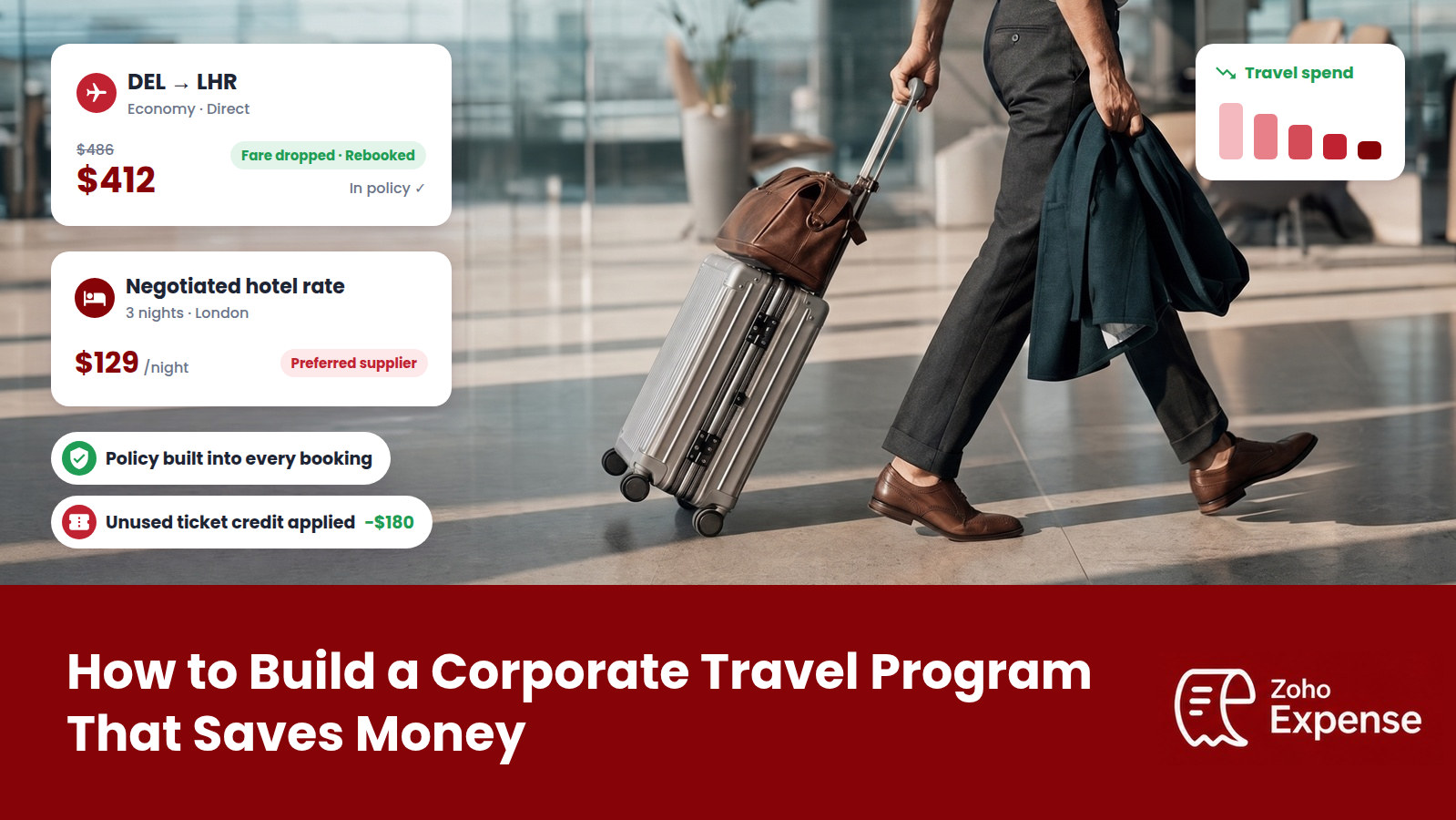
What is a managed travel program?
A managed travel program is a structured way of planning, booking, approving, and tracking business trips. Instead of employees booking wherever they like and claiming reimbursement later, travel goes through defined channels and follows a written policy. It can be run through travel and expense management software, supported by a travel management company (TMC) or an internal team that handles bookings.
Most managed programs have five parts:
- A travel policy covering cabin class, hotel caps, advance-booking windows, and approvals
- A booking channel (an online booking tool, a TMC, or both) that employees must use
- Supplier agreements with preferred airlines, hotels, and car providers
- Approval workflows that catch expensive trips before they are booked
- Reporting and analytics that show where the money goes
Many companies still lack this. A Business Travel News Europe report found that two-thirds of global business travel spend remains unmanaged.
Why your organisation needs one, and the benefits
Cost control. Policies are applied when the booking is made, not after the money is spent, so overspending is prevented rather than reviewed later.
Better rates. Consolidated bookings give you volume to negotiate with, which individual employees never have.
Visibility. Finance sees spend by team, route, supplier, and trip type, in near real time.
Duty of care. If a flight is cancelled or an incident occurs, you know who is where and can help them quickly.
Less admin. Bookings flow into expense reports automatically, so there is less manual reconciliation and fewer receipts to chase.
Better traveller experience. Employees get a single place to book, human support when plans change, and no need to pay out of pocket and wait for reimbursement.
How a managed travel program saves money
Savings come from four sources: price (negotiated and pre-negotiated rates), behaviour (booking earlier, choosing in-policy options), waste (unused tickets, unclaimed credits, missed fare drops), and process (less time spent on approvals, bookings, and reconciliation).
Managed travel controls costs by enforcing policy at booking, negotiating volume discounts with suppliers, and giving real-time visibility that helps curb unused tickets and hotel rooms. The Association of Corporate Travel Executives (ACTE) has reported that effective use of business travel services can cut travel expenses by up to 30%. Your own savings will depend on how much you spend, how much.
Different ways to save money in a managed travel program
Set a clear, reasonable travel policy. Define cabin class by flight length, nightly hotel caps by city tier, and rules for rental cars and ground transport. If the policy is unrealistic, people will book around it.
Require advance booking. Last-minute fares are usually the most expensive. A 14-day (domestic) or 21-day (international) advance-purchase rule is a common starting point. Allow exceptions with approval.
Make the approved channel the easiest one.GBTA data shows 35% of travel buyers name booking outside required channels as their biggest compliance challenge. If the booking tool is easy and has good inventory, leakage falls.
Use pre-trip approvals. Ask whether the trip is necessary before asking how much it costs. Some trips can be a video call.
Consolidate suppliers. Concentrating spend with a few airlines and hotel chains gives you leverage. Track how much of your spend goes to preferred suppliers.
Recover unused value. Cancelled or changed tickets often leave airline credits that expire unnoticed. Tracking and reusing them saves real money.
Re-shop after booking. Fares change. If the price drops after you ticket, rebooking at the lower fare saves money without changing the trip.
Reward smart choices. One approach is to let employees keep a portion of the savings when they book below the policy cap. Rewards encourage employees to look for cheaper options instead of the first one.
Watch ancillary fees. Baggage, seat selection, and change fees add up. Cover them in your policy, and check whether your negotiated fares include them.
Review the data quarterly. Look at the most expensive routes, hotels with the highest rates, and teams with the most out-of-policy bookings. Then adjust the policy and your supplier deals.
How to negotiate better rates for flights and hotels
For flights
Lead with your data. Airlines respond to numbers: annual spend, top routes, and how much of it you can shift to them.
Ask for what suits your routes. This might be corporate discounts on specific routes, flexible change and cancellation terms, lounge access, or waived fees rather than a headline discount.
Negotiate with a shortlist. Give volume to two or three airlines and make them compete for it.
Ask for flexibility. Business travel changes often, so lower change fees and credit validity can be worth more than a small fare discount.
Revisit annually. Rates and route networks change. Track your actual volume against commitments.
Use your booking platform's inventory. Your tool may already offer direct airline connections and pre-negotiated fares, which can be a baseline to beat.
For hotels
Concentrate on your top cities. Negotiate hard where you have the most room nights, instead of chasing a discount in every city.
Ask for the full package. Room rate, breakfast, Wi-Fi, late checkout, and a flexible cancellation window all have value.
Seek "last room availability" and seasonal blackout rules. A discounted rate is less useful if it is unavailable during your busiest travel weeks.
Compare against market rates. Check your negotiated rate against what the public and online travel agency rates are. A "corporate rate" is not always cheaper.
Give something in return. Commit to volume, a longer contract term, or an easier payment schedule.
What to do before you go into a negotiation
Preparation decides the outcome more than negotiating skill does.
Get your data in one place. Pull 12 months of bookings: spend by airline, route, hotel, and city.
Find your leverage. Identify which suppliers and routes hold the most volume, and where you can realistically shift traffic.
Know your current position. What are you paying now, what is your average booking window, and how much are you losing to change fees and unused tickets?
Fix your policy first. Suppliers give better rates to buyers who can deliver the volume they promise. That requires compliance.
Benchmark the market. Compare your fares and room rates against public prices and industry figures.
Set your priorities. Decide which terms matter most (price, flexibility, service) and what you would trade.
Bring alternatives. If you have a credible second option, you negotiate from a stronger position.
Plan how to track results. Agree on how the deal will be measured after signing.
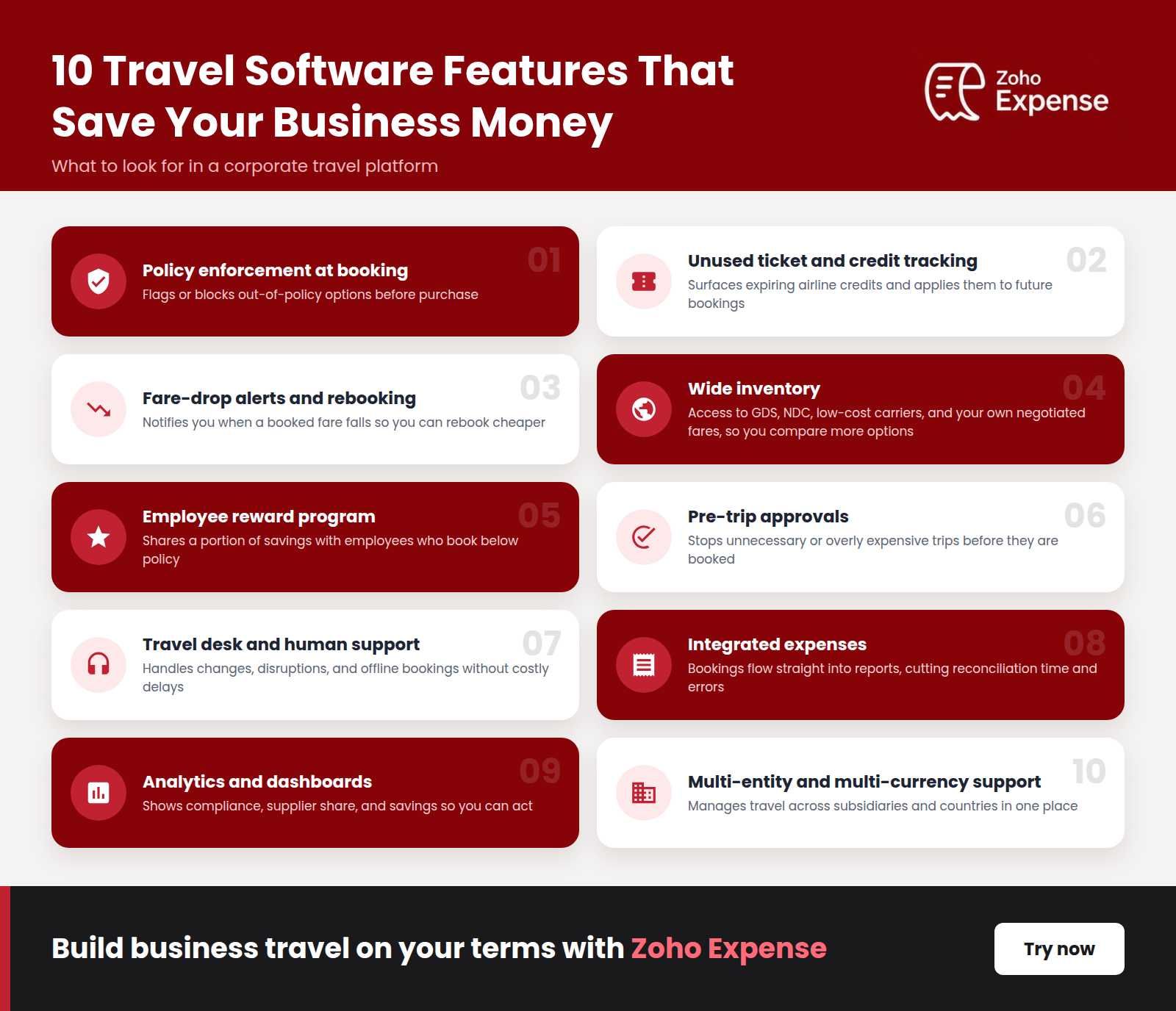
Features to look for in travel software that saves money
Metrics for a strong travel program
There is no single "best" metric, because company size, routes, and travel frequency vary widely. But well-run programs tend to track the same metrics:
Booking-channel compliance. Industry sources commonly cite 90–95% booking-channel compliance for best-in-class managed programs. Treat this as a directional target, since figures vary by source and definition.
Preferred-supplier share. How much spend goes to contracted airlines and hotels.
Average advance-purchase days. A rising number usually means falling costs.
Exception-approval rate. Too many exceptions suggest the policy or the tool needs fixing.
Savings per trip. The gap between the fare paid and the published or highest available fare.
A practical example: A food manufacturing company raised online booking adoption from roughly 70% to 86% within a year using regular nudges, targeted communication to high-leakage teams, and ongoing policy refinements based on live data, and reported over USD 529,000 in savings. This is a vendor-reported case, but it shows the pattern that works: measure, nudge, and adjust regularly instead of relying on a one-off crackdown.
The common traits of strong programs are a policy people can follow, a booking tool they want to use, supplier deals backed by real volume, and data reviewed regularly.
How Zoho Expense Business Travel helps you save money
Zoho Expense combines booking, policy control, and expense management in one platform, so the savings levers above sit in the same system.
Book and track in one place. Employees can book flights, hotels, and ground transportation online, and each booking is captured in expense reports automatically, giving finance real-time visibility.
Wide inventory and your own deals. Zoho Expense offers pre-negotiated global inventory from GDSs, direct NDC integrations, low-cost carriers, and your own direct connections.
Policy built into booking. Non-compliant flights are flagged so employees see policy issues at the time of booking.
Unused ticket credits. Zoho Expense tracks available airline credits and surfaces them during future bookings, so travellers can apply them without searching old emails.
Rebooking at lower fares. You receive automatic alerts when your ticket fares drop, and you can rebook at the lower rate.
Support and travel desk. Travellers get 24/7 access to experienced travel agents rather than bots. For offline bookings, requests go for manager pre-approval and then to the travel desk, which completes the booking.
Multi-entity, multi-country control. Zoho Expense supports enterprises managing travel and expenses across subsidiaries, multiple currencies, global tax compliance, and regional policies.
Sustainability insights. The platform tracks carbon footprint to help employees make more sustainable travel choices.
Together, these features cover the main cost drivers: booking outside policy, expired credits, missed fare drops, and manual reconciliation.

Conclusion
A travel program that saves money is built in a clear order: write a policy people can follow, route bookings through one easy channel, negotiate with data, recover unused value, and review results regularly. The right software makes each step easier, and the savings come from consistency more than from any single tactic.
 Satheesh KP
Satheesh heads global product marketing at Zoho Expense & Spend , a part of Zoho's Finance Suite. He has 17+ years of industry experience across multiple industries and regions. His areas of interest include technological advancements in finance, travel and expense management, spend management, and more.