

- HOME
- Expense Management
- Multi-Entity Expense Management: Complete Guide to Managing Employee Expenses Across Entities and Countries
Multi-Entity Expense Management: Complete Guide to Managing Employee Expenses Across Entities and Countries
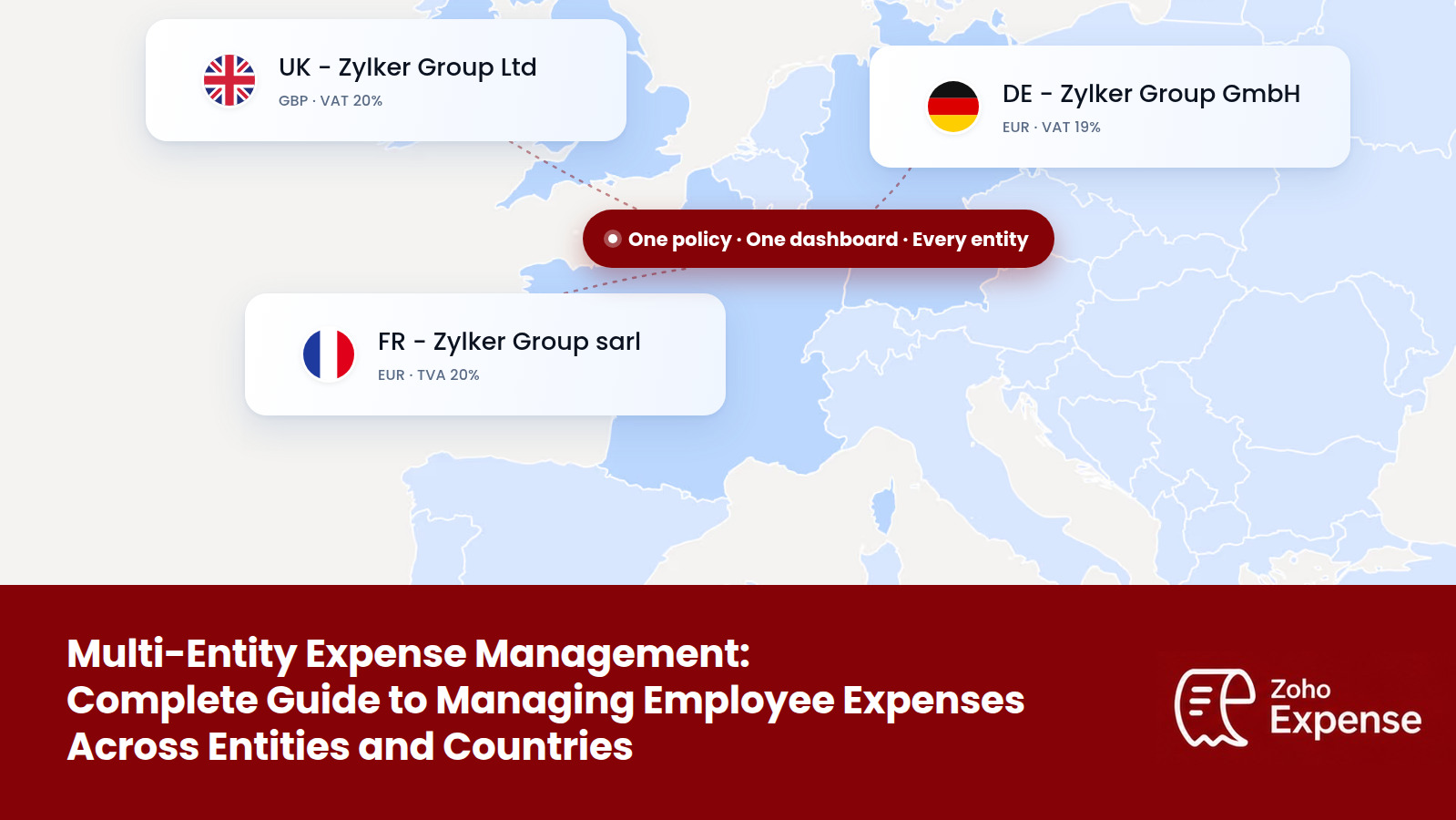
What is multi-entity expense management?
Multi-entity expense management is the process of managing, controlling, approving, reimbursing, accounting for, and reporting employee expenses across multiple legal entities, subsidiaries, branches, or business units.Unlike a single-entity expense process, multi-entity expense management must account for differences in:
- Expense policies
- Currencies
- Tax regulations
- Accounting structures
- Approval workflows
- Reimbursement rules
- Cost centers
- Projects
- Compliance requirements
- Reporting requirements
For example, a company operating entities in the US, UK, India, UAE, and Singapore may need to process expenses in USD, GBP, INR, AED, and SGD while applying different tax and reimbursement rules to each entity.The objective is not to make every entity operate identically.Instead, effective multi-entity expense management provides centralized visibility while preserving local control.
Who needs multi-entity expense management?
Any organization with multiple legal entities or geographically distributed operations can benefit from a multi-entity expense management system.It is particularly relevant for:
- Multinational corporations
- Companies with international subsidiaries
- Conglomerates and holding companies
- Businesses operating across multiple tax jurisdiction
- Organizations expanding into new countries
- Companies that have grown through mergers and acquisitions
- Organizations with multiple branches or regional entities
- Businesses with employees who regularly travel internationally
- Companies managing multiple accounting books
Even organizations operating in a single country may require multi-entity expense management if different subsidiaries have separate tax registrations, accounting structures, budgets, or approval hierarchies.
Why is multi-entity expense management challenging?
Managing expenses becomes more complicated with every additional entity and geography.
Different expense policies
Expense limits and rules can vary by country, entity, department, employee type, or expense category.
A hotel allowance that is acceptable for one entity may exceed the limit for another.
Multiple currencies
Employees can incur expenses in foreign currencies while their entity operates using a different functional currency.Finance may also need to report consolidated expenses in yet another currency.
A multi-currency expense management system should therefore retain the original transaction amount while providing accurate converted values for accounting and reporting.
Different approval workflows
Approval requirements may vary depending on the entity, amount, department, cost center, project, or expense category.A single global approval workflow may not work for every subsidiary.
Different accounting structures
Each legal entity may maintain its own chart of accounts, tax codes, cost centers, projects, or accounting system.
The expense management process must preserve these distinctions even when corporate finance wants a consolidated view.
Tax compliance in multi-entity expense management
Tax compliance is one of the biggest challenges of managing employee expenses across multiple entities and countries.
An expense is not simply an amount that needs to be reimbursed. It may also contain VAT, GST, sales tax, or other indirect taxes that need to be identified, recorded, and potentially reclaimed.
Tax treatment can depend on:
- The country where the expense occurred
- The entity that incurred the expense
- The supplier's tax registration
- The employee's location
- The type of expense
- Whether the expense is business-related
- Whether the transaction is domestic or cross-border
- Whether the entity is eligible to recover the tax
For example, organizations operating across different GST registrations may need to associate expenses with the appropriate location and tax registration. Similarly, businesses operating across VAT jurisdictions need to capture relevant VAT information for accounting and tax reporting.
What happens when tax compliance is managed manually?
Finance teams may have to manually:
- Verify tax information on receipts
- Identify applicable tax rates
- Validate tax registration information
- Determine the appropriate entity
- Separate taxable and non-taxable amounts
- Identify recoverable taxes
- Map taxes to accounting codes
- Maintain supporting documentation
Prepare information for tax reporting
This increases the workload for finance teams and creates opportunities for incorrect tax treatment or missed tax-recovery opportunities.A tax-aware expense management system can make tax information part of the expense process instead of treating it as a separate finance activity.
Download free guide on global taxation on business travel & expenses here.
Taxation and business travel expenses: A global guide for multi-entity businesses 2026
How to manage expenses across multiple entities
A successful multi-entity expense management strategy combines global standardization with local flexibility.
1. Establish a global expense framework
Create common standards for:
- Expense categories
- Receipt requirements
- Approval principles
- Employee expense processes
- Audit requirements
- Reporting dimensions
2. Define entity-specific requirements
Each entity should have clearly defined:
- Functional currency
- Reimbursement currency
- Expense limits
- Tax requirements
- Approval hierarchy
- Cost centers
- Projects
- Accounting codes
- Local compliance requirements
3. Automate policy enforcement
Configure expense policies based on entity, geography, category, employee group, or amount.
Instead of finance manually reviewing every expense for compliance, the system can flag exceptions automatically.
4. Automate approvals
Expenses should automatically route to the right approvers based on predefined rules.
This reduces delays and prevents reports from being sent to the wrong manager or finance team.
5. Integrate expenses with accounting
Approved expenses should flow into accounting or ERP systems with the appropriate entity, account, tax code, cost center, project, and currency information.
6. Consolidate reporting
Corporate finance should have a consolidated view of organizational spending while retaining the ability to drill down to individual entities, countries, departments, employees, categories, and transactions.
How does multi-entity expense management software help?
A multi-entity expense management software solution provides a centralized platform for managing employee expenses while allowing individual entities to maintain their own financial and compliance requirements.
It can help organizations:
Centralize expense management
Manage expenses for multiple entities from one platform instead of maintaining disconnected systems and spreadsheets.
Automate expense policies
Apply different expense rules based on entity, country, employee, category, or amount.
Simplify multi-currency expenses
Capture expenses in the original transaction currency and provide converted values for reimbursement, accounting, and reporting.
Automate approvals
Route expenses based on entity, department, amount, project, cost center, or other business rules.
Improve tax management
Capture relevant tax information and support entity- and geography-specific tax requirements.
Improve accounting accuracy
Map expenses to the correct accounting dimensions before they reach the accounting system.
Provide consolidated visibility
Give corporate finance a group-wide view while allowing entity finance teams to focus on their own expenses.
Strengthen audit controls
Maintain digital receipts, approval histories, policy checks, and expense activity in one place.
Features to look for in multi-entity expense management software
If your organization operates across multiple entities and geographies, look for these capabilities.
1. Multi-entity support
The platform should support multiple legal entities within a centralized environment while maintaining entity-level controls.
2. Multi-currency expense management
Look for transaction currency support, exchange-rate conversion, and visibility into original and converted amounts.
3. Entity-specific expense policies
The ability to configure different policies for different entities, countries, departments, or employee groups is essential.
4. Flexible approval workflows
Approval workflows should support rules based on entity, amount, employee, department, expense category, project, and cost center.
5. Tax and compliance management
The system should support relevant local tax requirements and provide the information needed for accounting, reporting, and audits.
6. Entity-level access controls
Users should only have access to the entities and information relevant to their roles.
7. Accounting and ERP integrations
The platform should integrate with accounting and ERP systems and support entity-specific accounting dimensions.
8. Consolidated reporting
Finance leaders should be able to view spending across the organization and drill down into entity-level data.
9. Corporate card integration
Corporate card transactions should flow into the expense management process for reconciliation and accounting.
10. Audit and fraud controls
Look for capabilities such as duplicate detection, policy violation alerts, audit trails, receipt management, and suspicious expense identification.
11. Mobile expense management
Employees should be able to capture receipts, create expenses, submit reports, and complete workflows from anywhere.
12. Scalability
The platform should make it easy to add new entities, countries, currencies, employees, and accounting integrations as the organization grows.
Why Zoho Expense for multi-entity expense management?
For organizations managing employee expenses across multiple entities and geographies, Zoho Expense provides a centralized platform for managing expenses while supporting entity-specific policies, tax requirements, currencies, approvals, and accounting workflows.
Zoho Expense brings together:
- Multi-entity expense management
- Multi-currency expense tracking
- Entity- and region-specific policies
- Tax and compliance management
- GST and VAT capabilities
- Flexible approval workflows
- Corporate card management
- Receipt capture
- Expense report automation
- Audit controls
- Accounting and ERP integrations
- Consolidated reporting
This allows organizations to standardize their overall expense management framework without forcing every entity to follow exactly the same financial rules.For example, different entities can maintain their own policies and accounting requirements while corporate finance gets consolidated visibility into organizational spending.
Zoho Expense also supports tax configuration and tax-related expense information, helping organizations incorporate tax requirements into their expense workflows rather than handling them entirely as a separate manual process.
The result is a model that combines global visibility with local financial control.

Multi-Entity Expense Management Checklist
Managing multiple entities requires more than simply adding subsidiaries to an expense platform.
Before selecting a multi-entity expense management solution, ask:
Entity management
☐ Can we manage multiple legal entities from one platform?
☐ Can each entity have its own policies and configurations?
☐ Can we add new entities as the organization grows?
Global expense management
☐ Does the platform support multiple currencies?
☐ Can employees submit expenses from different countries?
☐ Does it retain the original transaction currency?
Policy and approvals
☐ Can policies differ by entity and geography?
☐ Can approval workflows vary by entity?
☐ Can approvals be based on amount, department, project, or cost center?
Tax and compliance
☐ Can the platform handle different tax requirements?
☐ Can we capture relevant VAT/GST information?
☐ Can tax information flow into accounting?
☐ Does the system maintain a complete audit trail?
Accounting
☐ Can expenses be mapped to entity-specific accounting dimensions?
☐ Does the platform integrate with our ERP/accounting systems?
☐ Can corporate finance consolidate expenses across entities?
Visibility and control
☐ Can we drill down from global reports to individual transactions?
☐ Can access be restricted by entity and role?
☐ Does the system provide duplicate and policy-violation detection?
Employee experience
☐ Can employees submit expenses from mobile devices?
☐ Can receipts be captured digitally?
☐ Can corporate card transactions be automatically imported?
If the answer to these questions is yes, your organization is better positioned to manage employee expenses across entities without sacrificing local control or global visibility.
Conclusion: Manage every entity. Control every expense.
As organizations become more global, expense management needs to evolve beyond spreadsheets, email approvals, and disconnected finance systems.
The goal isn't simply to process expense reports faster. It is to create an expense management framework that can accommodate multiple entities, currencies, tax jurisdictions, policies, approval structures, and accounting systems without creating additional complexity for employees or finance teams.
Zoho Expense brings these capabilities together in one platform, helping organizations manage employee expenses across entities and geographies while maintaining the visibility, control, compliance, and automation required by modern finance teams.
From receipt capture and policy enforcement to tax management, approvals, corporate cards, accounting, and consolidated reporting, Zoho Expense provides a unified approach to multi-entity expense management at scale.
Frequently Asked Questions
1. What is multi-entity expense management?
Multi-entity expense management is the process of managing employee and business expenses across multiple legal entities, subsidiaries, branches, or business units while maintaining entity-specific policies, currencies, taxes, approvals, accounting, and compliance requirements.
2. Why do businesses need multi-entity expense management?
Businesses need multi-entity expense management when they operate multiple subsidiaries or entities with different financial, tax, accounting, or operational requirements. It helps centralize visibility while allowing each entity to maintain appropriate local controls.
3. What is multi-entity expense management software?
Multi-entity expense management software is a platform that allows organizations to manage expenses for multiple legal entities from a centralized system. It typically supports entity-specific policies, approval workflows, currencies, taxes, accounting integrations, and consolidated reporting.
4. How does multi-entity expense management handle different currencies?
A multi-currency expense management system allows employees to record expenses in the currency in which the transaction occurred while converting the amount into the appropriate reimbursement, functional, or reporting currency using configured exchange rates.
5. How does multi-entity expense management help with tax compliance?
It helps organizations capture and manage tax information associated with employee expenses, apply appropriate tax configurations, maintain supporting documentation, and transfer relevant tax information to accounting and reporting systems.
6. Can different entities have different expense policies?
Yes. A multi-entity expense management system should allow organizations to configure different expense limits, receipt requirements, categories, approval rules, and other policies for different entities, countries, or employee groups.
7. Can multi-entity expense software integrate with accounting systems?
Yes. Modern expense management platforms can integrate with accounting and ERP systems and transfer approved expense information with relevant entity, account, tax, cost center, project, and currency information.
8. What features should I look for in multi-entity expense management software?
Key features include multi-entity support, multi-currency processing, entity-specific policies, flexible approval workflows, tax management, accounting integrations, consolidated reporting, corporate card integration, audit trails, duplicate detection, and mobile expense management.
9. How does multi-entity expense management improve financial visibility?
It allows corporate finance teams to view spending across multiple entities from a centralized platform while retaining the ability to drill down into countries, subsidiaries, departments, employees, categories, and individual transactions.
10. Can Zoho Expense manage expenses across multiple entities and countries?
Yes. Zoho Expense is designed to support organizations managing expenses across multiple entities, currencies, tax requirements, policies, approval workflows, and accounting environments, providing centralized expense visibility while supporting localized financial requirements.
 Satheesh KP
Satheesh heads global product marketing at Zoho Expense & Spend , a part of Zoho's Finance Suite. He has 17+ years of industry experience across multiple industries and regions. His areas of interest include technological advancements in finance, travel and expense management, spend management, and more.