- HOME
- Corporate Cards
- Corporate cards: What they are, how they work, and how businesses use them.
Corporate cards: What they are, how they work, and how businesses use them.
Most companies reach a point where reimbursement stops working: an account manager fronts $3,200 for a client trip and waits three weeks, or six subscriptions sit on a personal card with nobody in finance tracking the renewals. Corporate cards move that spending onto payment cards the company owns and can monitor close to real time. They give businesses greater visibility and control over employee spending, but they are not right for every business and create their own work around policy enforcement, expense management, and reconciliation.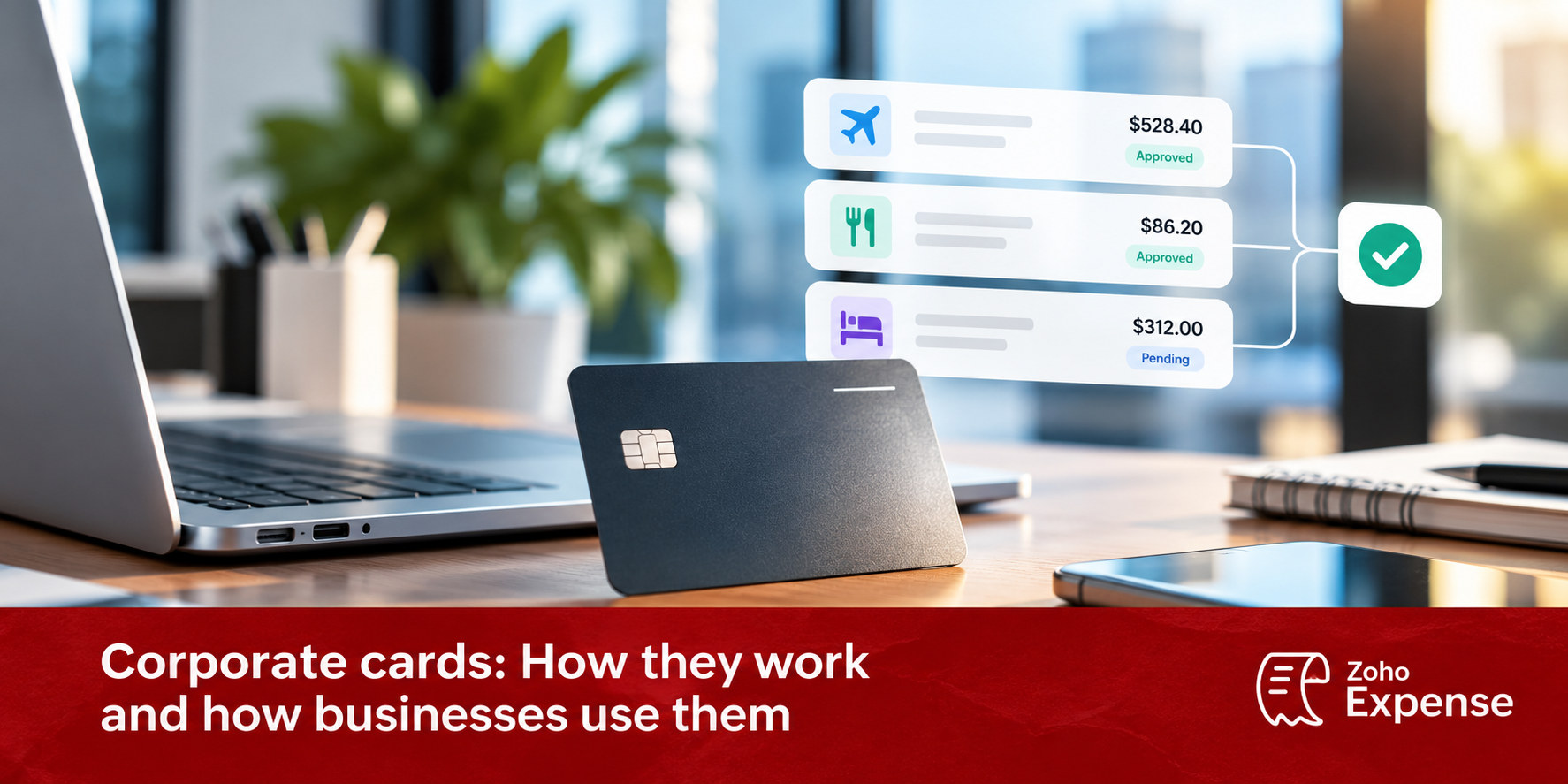
What is a corporate card?
A corporate card is a payment card issued in a company's name to employees so they can pay for approved business expenses directly. The card account belongs to the company, not the employee. Responsibility for paying the issuer is determined by the liability model in the card agreement and most commonly sits with the company.
The distinguishing feature of a corporate card is not the card itself, but the ownership and control behind it: a central company account, individual cards issued under it, and a transaction feed that finance can monitor without waiting for employees to file expense claims.
For example, a sales manager holds a corporate card with a $5,000 monthly limit and a rule that transactions above $500 need approval. She books a flight and a hotel, photographs the folio, her manager approves the expense, the expense is coded to travel, and the company settles with the issuer at the end of the cycle. She does not have to spend her own money and then wait for reimbursement.
Corporate cards typically go to people who commit company money away from an approval desk: executives, sales teams, consultants, field technicians, procurement teams, and department heads who own subscriptions or vendor spend. Usually, a minority of employees need cards rather than the entire workforce.
How does a corporate card work?
- The company opens a corporate card program. The issuer assesses the business and may consider financials, credit history, trading history, and in some cases a deposit or guarantee. The company agrees to a liability model, spending controls, and payment terms.
- Cards are assigned to named employees, with per-card limits and, where the program supports it, merchant, category, and transaction restrictions.
- An employee pays for an approved business expense using the corporate card.
- The transaction is captured in the card feed. When that feed is connected to an expense management system, the transaction can reach finance within a day or faster through direct feeds.
- The receipt and business context are attached, usually by taking a photo from a phone or capturing the receipt through the company's expense system.
- Policy checks run and a reviewer approves, with exceptions routed to finance for review.
- The transaction is reconciled and coded to a general ledger account, cost center, tax treatment, and other required accounting fields.
- The company pays the issuer on the statement date, in full or as a revolving balance depending on the card type and payment terms.
The order varies by card program and workflow. Some corporate card programs generate expense reports automatically on the statement date; prepaid programs reverse the payment step because the company funds the card balance before employees spend.
Types of corporate cards
Type | How it works | Best for |
Corporate credit card | Revolving credit line at the company level; balances can be carried, with interest. | Payment flexibility when the business needs to carry a balance. |
Corporate charge card | Balance is generally due in full each cycle. It may have no fixed preset limit, although issuers can apply dynamic controls and decline transactions. | Businesses that can settle the balance in full each month. |
Purchasing card (P-card) | Procurement-focused, often with tighter merchant and transaction controls. Some programs support Level 2 and Level 3 data with product, quantity, and tax details. | Low-value purchases and procurement transactions that are not worth processing through a traditional invoice workflow. |
Virtual card | A digital card number with no physical plastic, often scoped by vendor, project, employee, amount, or expiry date. | Subscriptions, vendor payments, and employees who make occasional purchases. |
Single-use virtual card | A virtual card generated for one transaction, often locked to a specific amount and merchant before being closed. | One-off vendor, contractor, or other controlled payments. |
Physical card | A plastic or metal card used for in-person and online purchases. Mobile wallets cover many card-present cases, while the physical card remains useful where a wallet is not accepted. | Fuel, taxis, restaurants, hotels, travel, and other in-person business expenses. |
Fleet or fuel card | A card restricted to fuel and vehicle services, often with additional vehicle, driver, or odometer data. | Fuel and other vehicle-related spending. |
Some providers also issue prepaid corporate cards that draw from a funded balance rather than a credit line. Zoho, for example, offers the Zoho Prepaid Mastercard in its US edition, with company-set spending limits and merchant restrictions.
Corporate card vs business credit card
The terms corporate card and business credit card are used inconsistently by issuers. The table below describes typical market patterns rather than strict technical definitions. No single row is a defining characteristic, and the cardholder agreement is the authoritative source for a specific card program.
Factor | Corporate card | Business credit card |
Typical user | Established organizations with multiple employee cardholders. | Smaller and owner-managed businesses. |
Underwriting | Generally assessed against the business and its financial profile. | May also rely heavily on the owner's personal credit. |
Personal guarantee | May or may not be required; larger corporate programs are more likely to waive it. | More often required, depending on the issuer and business profile. |
Liability | Set by the agreement. Corporate liability is common, but individual and joint and several liability models also exist. | Set by the agreement; the owner or guarantor is commonly liable. |
Controls | Often more granular: per-card and per-transaction limits, merchant category restrictions, department rules, and other program-level controls. Varies by issuer. | Typically lighter, often centered around per-user limits and account-level controls. |
Employee cards | Usually central to the product, with cards issued, managed, and closed as part of routine administration. | Often provided as authorized users rather than centrally managed employee cards. |
Reporting | Often detailed transaction feeds designed for expense management and accounting or ERP integration. | More often focused on statement-level reporting. |
Worth noting: some corporate programs place liability on the employee for their own charges, with the company reimbursing them afterwards, which is closer to a personal-card workflow than the corporate label suggests. Fintech issuers have also blurred the line by offering corporate-style spending controls and expense management features to smaller businesses.
Corporate card vs personal card
Where a corporate card program exists, employees should generally use it rather than a personal card for approved business spending. A personal card puts the employee's own money at risk, gives finance limited visibility until a claim is filed, and does not provide the same company-imposed spending controls. Corporate card transactions also reach finance closer to the transaction date, helping spending land in the correct accounting period rather than appearing weeks later through an expense claim.
Reimbursement is still a legitimate model, and most companies run both. The problem is using reimbursement by default for spending that is frequent, large, recurring, or better controlled through a company-issued card.
Benefits and limitations
What a corporate card program gives you. Corporate cards make business spending visible by department, employee, merchant, and transaction without requiring finance to assemble information from individual expense claims. Spending controls can apply before money leaves the business rather than only rejecting a claim after the employee has paid. Reconciliation becomes more about validation than manual data entry because each card transaction already carries information such as merchant, amount, date, and card identity. Employees stop financing the business with their own money, which matters most in travel-heavy and field-based roles. Recurring spending on dedicated or virtual cards is also easier to attribute, audit, monitor, and cancel.
What it costs you. A corporate card lowers the friction of spending, which is both the point and the risk, so spending limits, policies, monitoring, and review processes need to be in place from day one. Personal and grey-area charges need a clearly stated procedure. Fees can apply, including annual, per-card, foreign transaction, and late payment fees. Credit cards can carry interest, while charge cards generally require full monthly settlement. Someone has to own the card program, and reconciliation remains mandatory. Adoption can be uneven, and spending that stays on personal cards remains outside the visibility the business paid for. Protection against unauthorized transactions varies by issuer and agreement, and commercial cards should not be assumed to carry the statutory protections that apply to consumer cards. Not everyone needs a physical card; an employee who spends twice a year may be better served by a virtual or single-use card.
How companies control corporate card spending
Controls sit at the card level, the transaction level, and in the review process:
- Spending limits per card, per billing cycle, and per single transaction.
- Merchant category code (MCC) restrictions, along with merchant allow-lists or block-lists on procurement cards.
- Velocity and time rules, such as transaction counts or cards that are active only during a specific project or period.
- Department and role-level profiles, so a new employee can inherit a standard card configuration.
- Approval workflows, before the purchase or after the transaction and before it is accounted for, depending on the card program.
- Virtual and single-use cards, which control spending by design rather than relying only on policy.
- Automated policy checks for spending limits, missing information, restricted categories, duplicates, and other exceptions.
- Receipt thresholds, enforced through the expense workflow rather than by the card itself.
- Real-time visibility and instant card freeze, where supported by the issuer.
No issuer supports every control on this list. Card controls vary by provider, card type, country, and program, so capability is worth evaluating before choosing a corporate card program. A policy you cannot enforce in the system is a policy enforced by email.
Managing and reconciling corporate card expenses
Corporate card expense management takes a transaction from authorization to a correctly coded general ledger entry with supporting documentation attached. The typical corporate card expense process is: transaction, receipt capture, categorization, policy validation, approval, reconciliation, accounting, and reporting.
Reconciliation means confirming that four records agree: the card transaction as reported by the issuer, the expense record, the receipt or invoice, and the accounting entry. If they disagree, the business can end up with unsupported or incorrectly classified accounting and tax records, or a transaction nobody can explain. Auditors often focus on exactly these gaps.
The recurring problems include missing receipts, timing differences between authorization and settlement, amount mismatches caused by tips and currency conversion, unassigned charges on shared cards, duplicate claims, miscoded transactions caused by misleading merchant categories, and refunds that land in a later billing cycle.
Automation can handle transactions that meet matching criteria, typically based on details such as date, amount, and merchant, and send the rest to a review queue. Zoho Expense connects to corporate card feeds, imports transactions automatically, matches them to receipts captured from a phone, applies category and policy rules, flags discrepancies, and can sync approved expenses with connected accounting systems. Feed type, supported card networks, country availability, and integrations vary, so businesses should confirm the specifics for their card program and Zoho Expense edition.
For the month-end process in detail, see the guide to corporate card reconciliation.

What to put in a corporate card policy
Keep a corporate card policy short enough that employees read it and specific enough that it settles common spending questions. Cover who is eligible and who approves a card; permitted and prohibited expenses; spending limits by role and how to request an increase; restricted merchants; receipt thresholds and the missing-receipt procedure; how accidental personal charges are declared and repaid; what must be documented for meals and entertainment, which depends on local tax and recordkeeping rules; how to report lost or compromised cards; approval requirements; card cancellation when an employee changes roles or leaves the company; consequences of misuse; and a review cadence for cardholders, dormant cards, and spending limits.
Two habits matter more than the document itself: require the receipt at the point of sale, with a prompt when the transaction posts, and reconcile continuously rather than waiting until month end. A queue reviewed twice a week can take minutes; the same queue left until month end can take a day.
Are corporate cards right for your business?
Corporate cards tend to pay off when spending is frequent, spread across several employees, and difficult to route efficiently through accounts payable: regular business travel, employees frequently paying out of pocket, subscriptions scattered across personal cards, or finance teams unable to answer “what did we spend last month, by department?” without a manual exercise.
Reimbursement may still be better when only the owners spend, expenses are infrequent and low value, most spending already runs through invoices, or nobody has the capacity to own the reconciliation work. Many companies use a hybrid approach: physical cards for the employees who spend constantly, virtual cards for recurring vendors, and reimbursement for everyone else. Small businesses can use corporate-style cards too; the deciding factor is the ability to manage the card and expense process, not company size.
If the decision comes down to the operational work, test that part first. Whether card feeds, receipts, policy checks, expense approvals, and accounting sit in one workflow is what determines whether a corporate card program saves time or simply relocates the administrative work. Trial Zoho Expense against your actual card feed and expense policy rather than a demo dataset.

Frequently Asked Questions
A corporate card is a payment card issued in a company's name for employees to use for approved business expenses. The company owns the account and typically sets spending limits, merchant restrictions, and other controls.
Usually the company pays the card issuer under a corporate liability model. Some programs use individual liability, where the employee pays the issuer and is reimbursed, or joint and several liability. The card agreement defines which liability model applies.
Not always. Some corporate cards are credit cards with a revolving balance and interest, some are charge cards that are due in full each cycle, and some are prepaid cards that draw from funds the company has loaded.
No. Corporate cards are intended for approved business expenses, not personal spending. A card will physically process a personal purchase if it is allowed by the issuer, which is why the company's policy should explain how an accidental personal charge is declared and repaid.
The employee should report the lost card immediately to the card administrator and issuer so the card can be frozen or cancelled. Protection against unauthorized transactions depends on the issuer and card agreement; commercial cards do not automatically carry the statutory protections that apply to consumer cards.
In common practice, corporate cards are more often issued to established companies with multiple employee cardholders, assessed against the business, and configured with employee-level controls and detailed reporting. A personal guarantee is also less often required for larger corporate programs. Business credit cards are more common among smaller businesses, more often involve a personal guarantee, and may offer lighter controls. These are market patterns, not strict definitions.
Each transaction on the issuer's statement is matched to an expense record, supporting receipt, and accounting entry. Discrepancies such as missing receipts, amount differences, timing differences, or duplicate claims are investigated and resolved before the accounting period closes.
They can be, particularly when several employees spend independently, travel regularly, or manage recurring vendor expenses. Smaller businesses may find it harder to qualify or may be asked for a personal guarantee; prepaid and virtual cards can be alternatives. The deciding factor is the business's ability to manage the card, expense, and reconciliation process, not simply its company size.