

- HOME
- Business spend management
- Direct vs. indirect spend in procurement: Key differences explained
Direct vs. indirect spend in procurement: Key differences explained
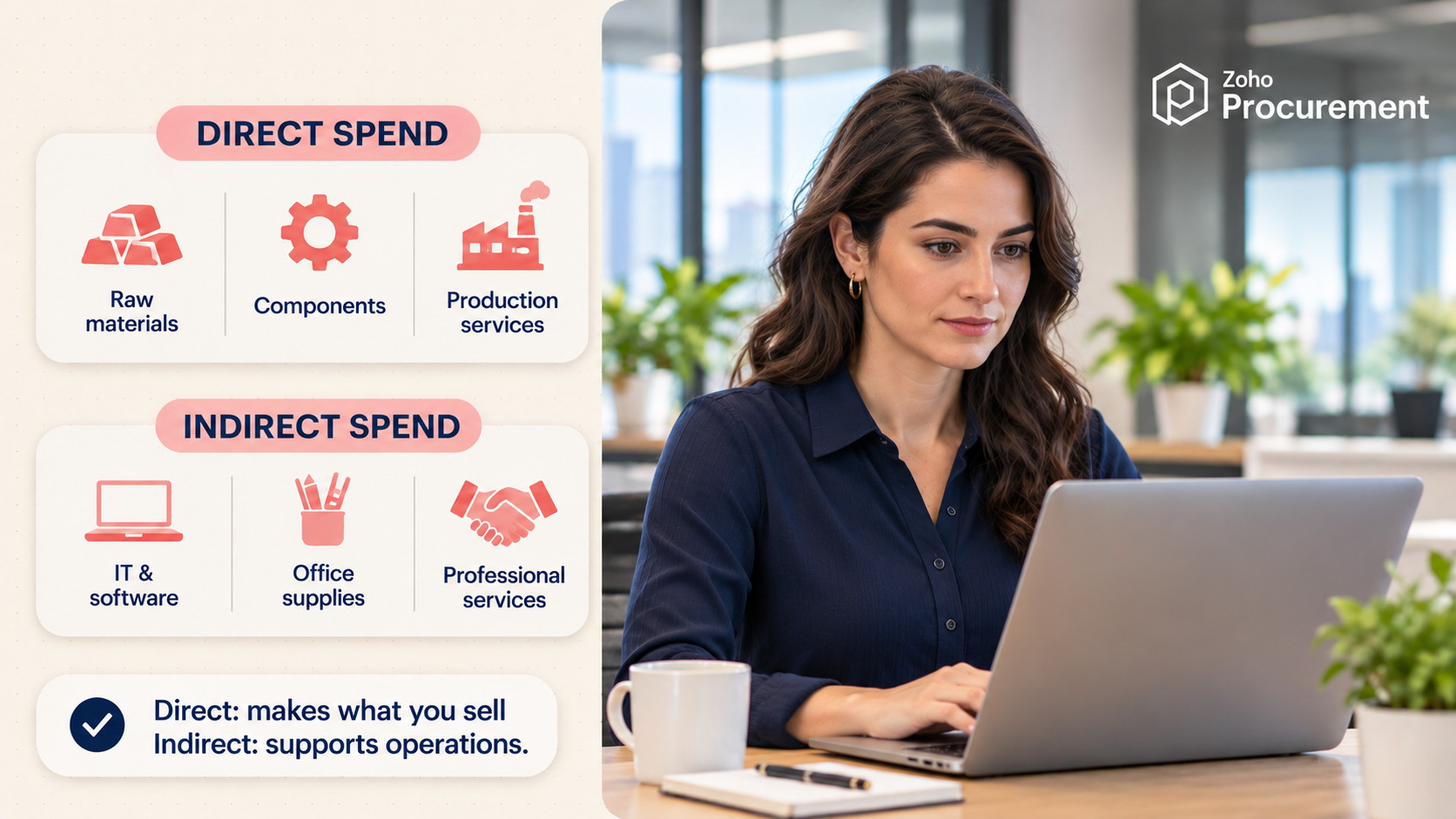
Every business makes purchases to keep its operations running. A manufacturing company buys raw materials to make its products, while its HR team purchases recruitment services and its IT team pays for software subscriptions.
Although all these purchases contribute to the business, they serve different purposes. Procurement teams classify them as direct spend and indirect spend.
Understanding the difference between direct and indirect spend helps businesses track expenses, manage suppliers, control purchasing, and identify opportunities to reduce costs. More importantly, it helps procurement teams apply the right purchasing approach to each category.
Let's look at what these two types of spend mean, how they differ, and how businesses can manage them effectively.
What is direct spend?
Direct spend refers to the money a business spends on goods and services that directly contribute to the products it manufactures or the services it delivers to customers.
Simply put, these are purchases a business needs to produce and sell what it offers.
For example, a furniture manufacturer needs wood, screws, fabric, and other materials to make chairs. It may also hire an external manufacturer to assemble certain components. These purchases contribute directly to making the finished product, so they fall under direct spend.
Common direct spend categories include:
Raw materials: Steel, wood, plastic, chemicals, and other materials used in production.
Components and parts: Electronic components, mechanical parts, and other items incorporated into finished products.
Production services: Contract manufacturing, assembly, and other services required to produce goods.
Product packaging: Boxes, labels, and other packaging materials used to prepare products for sale.
For manufacturers, changes in raw material prices or supplier costs can directly affect production expenses and profit margins. That's why procurement teams pay close attention to supplier pricing, material availability, product quality, and delivery schedules.
What is indirect spend?
Indirect spend refers to the money a business spends on goods and services that support its everyday operations but don't directly become part of the products or services it sells.
Think about the same furniture manufacturer. Apart from purchasing wood and other production materials, it also needs office computers, accounting software, electricity, cleaning services, employee travel, and marketing services.
These purchases help the company operate, but they don't become part of the finished furniture. They're classified as indirect spend.
Common indirect spend categories include:
IT and software: Computers, software subscriptions, cloud services, cybersecurity tools, and IT support.
Office supplies and equipment: Stationery, printers, furniture, and other workplace supplies.
Marketing and advertising: Digital advertising, event management, creative services, and public relations.
Facilities and maintenance: Office rent, electricity, cleaning, repairs, and building maintenance.
Professional services: Legal services, consulting, accounting, and external agencies.
Travel and employee expenses: Flights, accommodation, transportation, and business travel.
HR and recruitment: Recruitment agencies, employee training, and other workforce-related services.
Direct vs. indirect spend: Key differences
Both direct and indirect spend are necessary for a business to operate. However, they differ in their purpose, purchasing patterns, financial impact, and management requirements.
Here's a comparison:
Dimension | Direct spend | Indirect spend |
Purpose | Used to produce goods or deliver services to customers | Supports everyday business operations |
Purchases | Raw materials, components, and production services | Software, office supplies, marketing, and facilities |
Demand | Driven by production requirements and customer demand | Driven by departmental needs and business activities |
Budgeting | Often planned around production forecasts | Often distributed across departments |
Purchasing | Usually handled through structured procurement processes | Can involve multiple departments and individual requesters |
Supplier relationships | Often involves long-term relationships with critical suppliers | Involves a broader supplier base, including both transactional and strategic suppliers |
Main challenges | Material shortages, supplier delays, and price fluctuations | Uncontrolled purchases, duplicate spending, and limited visibility |
Key performance measures | Product quality, delivery performance, and cost per unit | Policy compliance, purchasing efficiency, and departmental spending |
The main difference is that direct spend is connected to what a business sells, whereas indirect spend supports the activities that allow the business to function.
This distinction also explains why procurement teams shouldn't manage both categories in exactly the same way.
Examples of direct and indirect spend across industries
The classification of a purchase depends on the nature of the business and how it uses the goods or services.
A purchase that qualifies as direct spend for one company might be indirect spend for another.
Industry | Direct spend | Indirect spend |
Manufacturing | Raw materials, components, and production services | Office supplies, software, and factory maintenance |
SaaS | Cloud infrastructure supporting the customer-facing product and third-party services used to deliver it | Office rent, internal IT equipment, and employee travel |
Restaurant | Food ingredients and packaging for customer orders | Kitchen maintenance, cleaning services, and office software |
Healthcare | Medical supplies and materials used in patient care | Administrative software, cleaning services, and employee training |
Consider cloud hosting as an example. For a SaaS company, cloud infrastructure that powers its customer-facing application may be classified as direct spend because it's essential to delivering the service. For a manufacturing company using cloud services for internal email and administrative tasks, the same purchase would generally be indirect spend.
The important thing is to classify spending based on how it contributes to the business, not simply the type of product or service being purchased.
Why is it important to differentiate between direct and indirect spend?
Classifying purchases correctly helps procurement and finance teams understand where their money goes and how it affects business performance.
Here are four reasons why the distinction matters.
1. Better cost control
Direct and indirect spend offer different opportunities for cost savings.
For direct spend, businesses can negotiate better raw material prices, compare suppliers, improve production planning, and reduce material wastage.
For indirect spend, the focus is often on identifying duplicate purchases, consolidating suppliers, reviewing unused software subscriptions, and negotiating better contracts.
For example, a company may discover that three departments are paying separately for similar software subscriptions. Bringing those purchases under one agreement could reduce costs and simplify supplier management.
2. Improved supplier risk management
A supplier disruption can affect different parts of a business in different ways.
If a manufacturer doesn't receive an essential raw material, production may stop and customer orders could be delayed. This makes supplier reliability particularly important in direct procurement.
With indirect procurement, a delayed office supply order may have little operational impact. However, a disruption involving a critical cloud service or cybersecurity provider could affect the entire organization.
Understanding the importance of each supplier helps procurement teams decide where to focus their supplier reviews, contingency planning, and risk management efforts.
3. Greater visibility into business spending
Direct purchases are often connected to production plans and established supplier relationships. Indirect purchases, however, can originate from multiple departments, locations, and budgets.
For example, the marketing team might purchase event services while the HR team independently engages an external training provider. Without centralized spending information, procurement may not know how much the organization is spending across these categories.
Classifying purchases and maintaining a common record of them helps procurement identify spending patterns, overlapping suppliers, and opportunities to negotiate better terms.
4. Better purchasing compliance
When employees purchase goods and services without following established procurement policies, businesses can lose control over their spending.
This is particularly common with indirect purchases because employees across departments may independently approach suppliers.
A standardized purchase request and approval process helps ensure purchases are reviewed before money is committed. It also makes it easier to verify whether employees are buying from approved suppliers and staying within their budgets.
How should businesses manage direct and indirect spend?
Since these categories have different purchasing requirements, procurement teams need approaches that suit each one.
1. Supplier relationship management
Direct procurement often involves suppliers that are essential to production. Building reliable, long-term relationships helps businesses maintain material availability, consistent quality, and predictable delivery schedules.
Indirect procurement may involve a larger number of suppliers across different categories. Procurement teams can improve efficiency by identifying preferred suppliers, consolidating similar purchases, and negotiating suitable contracts.
However, not every indirect supplier is low priority. For example, cybersecurity providers and critical software vendors may require the same level of attention as strategic direct suppliers.
2. Purchase requests and approvals
Direct purchases are often planned in advance based on production requirements and expected demand.
Indirect purchases are less predictable because different departments raise requests whenever they need goods or services.
A standardized purchase request process helps bring these purchases under control. Employees can submit their requirements, while procurement and finance teams review the purpose, estimated cost, supplier, and available budget before approving them.
This reduces unauthorized purchases and gives the business better visibility into upcoming expenses.
3. Forecasting and inventory management
Direct procurement requires careful planning to ensure the right materials are available when production needs them.
For example, an automobile manufacturer needs to ensure that its steel, tyres, electronic components, and other materials arrive according to its production schedule. A shortage of even one critical component can delay the entire manufacturing process.
Indirect procurement also benefits from planning, but the requirements are different. Businesses need to understand how frequently they purchase items such as office supplies, IT equipment, and maintenance materials to avoid unnecessary purchases or shortages.
4. Performance measurement
Procurement teams should track different performance measures for each category.
For direct spend, useful metrics include:
Supplier on-time delivery rate.
Material cost per unit.
Product quality and defect rate.
Inventory turnover.
For indirect spend, useful metrics include:
Spending by department and category.
Purchase order processing time.
Purchasing policy compliance.
Cost savings from supplier consolidation.
Spending with preferred suppliers.
These measures help procurement teams understand whether they're controlling costs, maintaining supplier performance, and following purchasing policies.
5. Using procurement software
Managing purchases through spreadsheets, email conversations, and disconnected systems makes it difficult to maintain visibility across departments.
Procurement software helps businesses bring purchasing activities into a structured process.
For example, employees can raise purchase requests, managers can review and approve them, and procurement teams can convert approved requests into purchase orders. Supplier records, purchase receipts, and invoices can also be managed as part of the same purchasing process.
A connected system makes it easier to track purchases from the initial request through order and payment, helping procurement and finance teams maintain better control over business spending.
Manage every purchase with better visibility
Direct and indirect spend contribute to different parts of a business, but both deserve attention from procurement teams.
While direct procurement focuses on maintaining production and supplier reliability, indirect procurement requires greater visibility into purchases happening across departments.
The goal isn't to manage both categories identically. It's to establish the right purchasing processes, supplier relationships, and spending controls for each.
With a structured procurement process, businesses can make informed purchasing decisions, reduce unnecessary expenses, and maintain better control over their spending.
Zoho Procurement helps businesses manage purchasing activities through a connected process, from purchase requests and approvals to purchase orders, supplier management, and accounts payable. This gives procurement teams better visibility and control over their purchasing activities.