- HOME
- All Products
- Collaboration
- Team silos explained: Why departments stop sharing information and how to fix it
Team silos explained: Why departments stop sharing information and how to fix it
- Published : September 29, 2026
- Last Updated : October 1, 2026
- 66 Views
- 7 Min Read
Marketing is planning around a Friday launch. Product moved it to Tuesday. Support has promised customers something else entirely. Everyone has been working, everyone has notes, and nobody is using the same date.
That’s how a team silo usually announces itself: not with a locked filing cabinet, but with two departments producing perfectly reasonable work from different versions of reality. The easy response is to tell people to communicate more. The useful response is to find out why the right information failed to cross the boundary in the first place.
What a team silo actually is
A team silo forms when information that another department needs can’t cross into its work reliably. The information may be sitting in plain sight and still be useless to the next team. Nobody told them it changed. They found three versions and can’t identify the current one. Or the only person who can explain it is on vacation.
This distinction matters because departmental boundaries aren’t automatically a problem. Finance shouldn’t publish individual payroll records to the company. A security team needs tight control over incident details. Specialists also need room to work without narrating every move to a crowd.
The trouble starts when a legitimate boundary blocks information needed for a legitimate decision. A protected payroll file is sensible. Hiding the approved headcount figure and its owner is not.
The symptoms tend to be mundane: repeated questions, contradictory numbers, decisions reopened after someone finds an old email, and handoffs that stall while everybody waits for the person who “knows how this works.” Atlassian’s recent work-visibility research, published in November 2025, reported that roughly half of knowledge workers said teams at their company tend to work on the same things unknowingly. Information can be open and searchable while the work it affects remains invisible to the next team.
Why departments stop sharing information
The usual diagnosis is poor communication. That describes the result, not the cause.
Start with incentives. A department is often measured on its own output, even when its choices create work elsewhere. Sales may be rewarded for closing a deal, while implementation absorbs promises that never made it into the handoff. Marketing can hit a campaign deadline by using an old product date, then leave support to explain the mismatch. Each team looks efficient on its own dashboard.
Ownership complicates matters. Knowledge can carry status, credit, or a measure of job security. Sharing an unfinished idea may mean losing control of it. Documenting a specialist process can feel like making yourself replaceable. Whether that fear is justified hardly matters if it changes what people share.
Evidence for this goes beyond office folklore. In 2025, researchers interviewed 106 people in two UK policing organizations about the conditions behind knowledge hiding. Some held back ideas because they feared someone else would take the credit. Perceived unfairness weakened trust, turning the choice to share into a personal risk calculation. This was a sector-specific qualitative study, so it can’t tell us how widespread the behavior is elsewhere. It does explain why another shared folder won’t settle a problem rooted in credit or trust.
Then there is the handoff itself. Most teams have habits, but fewer have an explicit agreement about what must travel with the work. A request arrives without its purpose. A decision appears without its rationale. A deadline changes, yet nobody names the departments affected by it. The fix is to structure communication around the work: specify which event triggers an update, who sends it, and which teams need it.
Tools make every weakness louder. Scattered systems create version confusion and hide history. A shared platform can reduce that friction, but it can’t decide what matters, repair an unfair target, or make someone feel safe admitting that a plan is off course.
Find the broken boundary, not the “bad team”
Blame is a tempting shortcut. But it tells you nothing about where the handoff failed.
Pick a workflow that gives people trouble every week. Sales to implementation is a good candidate; so is a customer issue moving from support to product. Trace one real item from the initial request to the final decision. Write down who handed it over, who received it, what decision was expected, and who decided the job was done.
Now mark the points where people wait, reinterpret a request, chase an owner, or reconstruct a decision from chat messages. The useful question is quite narrow: What must the receiving team know or decide that it can’t reliably know or decide today?
That question separates failures that look similar from a distance. Information that exists but can’t be found has a discoverability problem. Two teams may use “ready” to mean different things. A record can be visible but abandoned because no one owns the update. Restricted access is another case: decide whether the restriction is needed, then give the receiving team an approved summary or a clear request path.
Capability can disappear at the same boundary. The receiving department may know what must happen but have no clear view of who is qualified to do it, review it, or cover an absence. A competency matrix can make role-based capabilities visible across departments, helping a manager spot a handoff that rests on one specialist or has no qualified backup. It doesn’t prove proficiency, though. That still requires current evidence of the person’s work.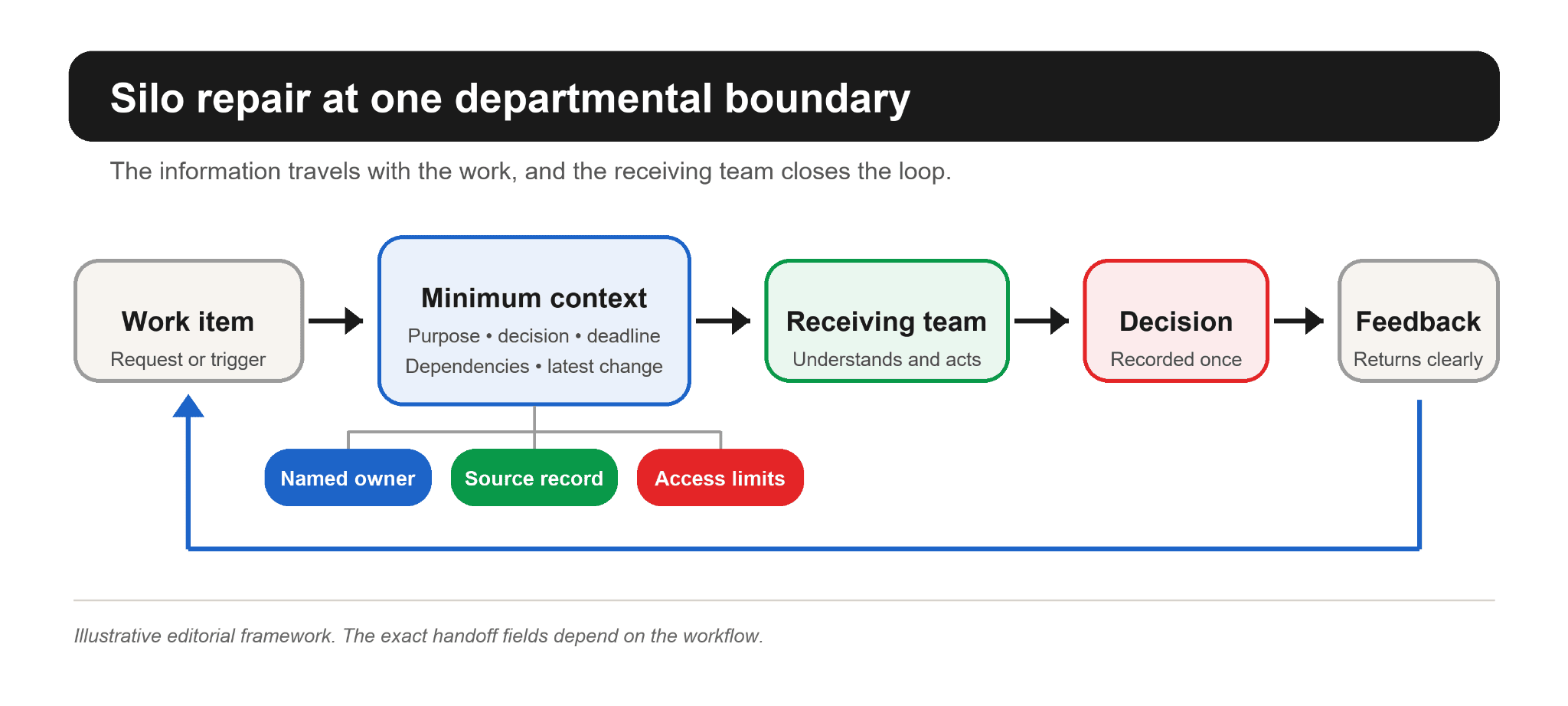
Make useful information travel with the work
Once you find the faulty boundary, resist the urge to share everything. A document dump is still a silo; it simply has more visitors.
The most useful fix is a minimum handoff packet. Keep it small. It needs enough context for the next team to act: the purpose, current owner, decision required, deadline, dependencies, and any change since the last update. If that list starts growing into a project archive, stop.
Keep the packet with the work itself. If a campaign brief is the controlling record, it should carry the approved launch date, audience, asset owner, legal dependencies, and the decisions that changed the plan. A separate message can alert another team to an important change, but it shouldn’t become the only place where that change is recorded.
Decision records needn’t become miniature board minutes. Note the decision, date, owner, short rationale, and affected teams. This is enough to stop an old option from returning three weeks later as if nobody discussed it.
Shared definitions matter, too. “Ready,” “qualified lead,” and “urgent” sound clear until two departments compare notes. Write down what the status requires, who can apply it, and which record controls the current value.
That last point is the practical value of a single source of truth. It’s an authoritative record, not necessarily one application that swallows every other tool. Other systems may display or notify people about the information. They should not create rival versions with no visible owner.
Change the incentives around sharing
A clean handoff template won’t survive if the organization rewards people for ignoring it.
Managers need to look past local throughput. A sales team that closes deals quickly while passing vague commitments downstream isn’t producing a clean result. A product team that ships on time but tells support about breaking changes at the last minute has moved its delay onto someone else’s queue.
Review the cross-team outcome as well as the department’s output. Check whether the receiving team had enough context to act, how often it reopened a decision or returned the work, and which questions kept appearing. Those are better clues than a general plea for transparency.
Credit matters just as much. Name the people who wrote the instructions, clarified the definition, or documented the awkward exception that saved everyone an hour. If employees believe sharing an idea means surrendering authorship, a knowledge base will fill with safe, bland material while the useful thinking stays in private messages.
Leaders set the risk level. They can ask teams to record changed decisions and then document their own reversals with the same care. They can also make it safe to say, “This date no longer works,” before another department builds a week of work around it.
Some information should stay restricted. Collaboration doesn’t cancel privacy rules or role-based access. Give people what they need for the decision they own, then provide a clear request path for anything protected.
Try the repair on one handoff
Company-wide silo programs tend to produce company-wide meetings. Pick one boundary instead.
1. Choose a recurring handoff with a visible cost, such as repeated questions, a delayed decision, or work that regularly comes back.
2. Ask both teams what they need, what they currently receive, and what must remain restricted. The answers won’t be identical, which is the point.
3. Agree on the minimum handoff packet and name an owner on each side. One prepares the record; the other confirms that it’s usable.
4. Put the record somewhere both teams already work, then define the event that triggers an update. A changed deadline shouldn’t depend on someone remembering to mention it at Thursday’s meeting.
5. Run the new handoff for four weeks. Review search time, repeated questions, reopened decisions, and avoidable rework. These are indicators, not a promise of instant cultural repair.
If the pilot works, carry the method to the next troublesome boundary. Broader habits for working in collaboration can help, but the test is still concrete: Can the receiving team act without finding an insider to translate the handoff?
A silo is repaired at the boundary
Teams don’t need universal access or a running commentary on every decision. They need a dependable agreement about what information must cross a boundary, when it should move, what form it takes, and who maintains it.
Go back to the handoff that causes the most chasing and rework. Fix that one first. When both departments can act from the same current context without calling the office oracle, the silo has started to lose its grip.
Frequently asked questions
 Gary Stevens
Gary Stevens is the CTO of Hosting Canada, a website that provides expert reviews on hosting services and helps readers build online businesses and blogs. Gary specializes in topics on cloud technology, thought leadership, and collaboration at work.