- HOME
- All Products
- Collaboration
- Accountability at work: What responsible teamwork looks like in daily communication
Accountability at work: What responsible teamwork looks like in daily communication
- Published : August 28, 2026
- Last Updated : October 1, 2026
- 13 Views
- 6 Min Read
It’s hard to trust a team that can’t be held accountable for its actions. When mistakes lead to deflection rather than ownership and collaboration, trust breaks down and projects start to suffer. Accountability promotes transparency, open communication, and strong collaboration.
But making accountability a priority can be difficult, especially for distributed teams that communicate asynchronously. Distributed work creates more obstacles to accountability, like a lack of visibility, unclear tone in written conversation, and silence being misunderstood as progress.
In this guide, you’ll learn about accountability at work, along with examples of it in practice and ways leaders can help spread this quality across teams.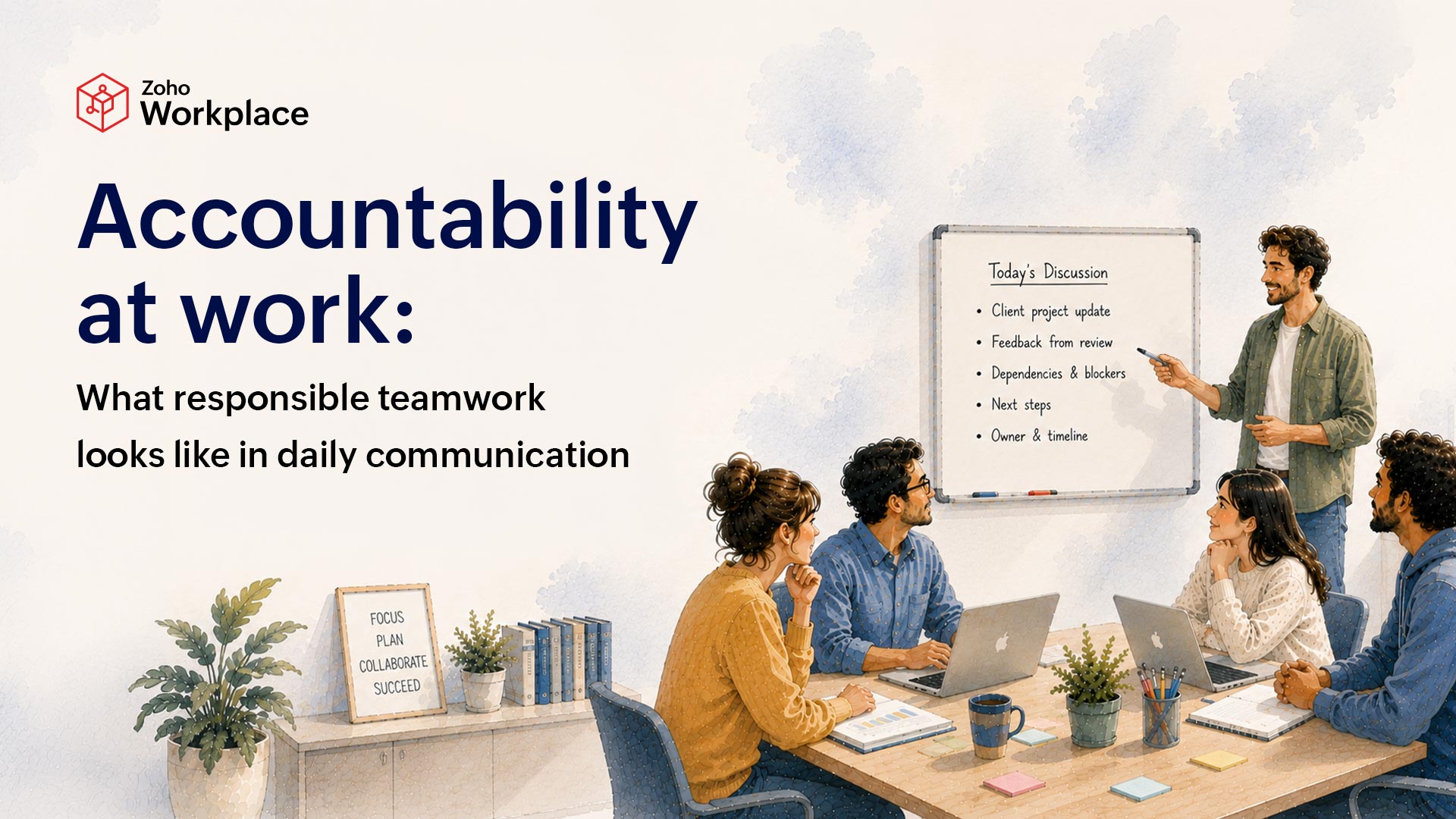
What is accountability at work?
Accountability means taking ownership of one’s mistakes and successes alike. When someone takes accountability for their mistakes, they confirm the mistake they made, do what’s needed to make things right, and avoid deflecting responsibility with excuses. Accountability also requires transparency, meaning people are open and honest about what they do and why they do it.
In the workplace, accountability is an essential part of effective teamwork. People need to know that they can rely on their coworkers to be open about wins and mistakes alike, so they can address both promptly.
Distributed teams can struggle more with accountability because the way they work naturally creates more gray areas where accountability can disappear. Leaders can’t have as much visibility into the work their teams do, collaborators are often scattered across time zones, and updates can get lost in project management tools and other platforms.
But building accountability in your teams is vital, even when they’re working across the globe.
7 examples of accountability in daily communication
Accountability needs to be built up in your teams over time. One of the best ways to do this is to recognize instances of it as you find them and encourage them. Here are some examples of what accountability looks like in your work and the daily communication that comes from it.
Flagging a delay before being asked about it
When accountable people run into a delay, they share it openly and proactively. The moment a deadline looks like it’s at risk, they share a status update in a way that’s visible to the project’s main stakeholders. They may even share a revised timeline so collaborators know exactly what to expect.
A lack of accountability may range from actively hiding a delay to only sharing it when a stakeholder asks about it. This gives stakeholders and collaborators less time to adapt to that delay or even prevents them from finding a solution.
Closing the loop on action items in writing
Accountability can look like actively updating action items regularly, in writing, in a place where relevant collaborators can see updates. A project manager responsible for a portfolio of projects, for example, may share monthly updates with stakeholders for each project right in their project management tool.
Someone less accountable may not even set that schedule of recurring updates. They’ll let projects and action items keep sliding toward their deadline, only sharing updates when asked to.
Owning a mistake without deflecting
People make mistakes. Even top performers make mistakes. Accountability means owning these mistakes when they happen, not just when someone notices them. Taking accountability for a mistake means naming it (e.g., “I wasn’t able to complete this task on time.”), sharing its impact (e.g., “This will be a blocker for project X.”), and suggesting a solution (e.g., “I’ll prioritize this task over all of my other work today.”).
A lack of accountability usually shows up as deflection and minimization. A person may shift the responsibility for a mistake onto their entire team rather than taking ownership themselves. They may bury the acknowledgment of a mistake within a flurry of status updates. Or they’ll come up with excuses for why mistakes weren’t really their fault.
Giving specific status instead of vague reassurance
Accountable people share detailed status updates. They share how confident they are in the timelines they set, they openly share potential blockers, and they share specific milestones. A quick but specific status update might look like: “Project is 60% complete, on track for completion by end of month. One blocker from design.”
Vague status updates create distance between what’s shared and what might happen. The gray area between them allows people to avoid accountability; there can’t be a missed deadline if the deadline was never shared. A status update that dodges accountability might look like: “Project going well. Should be on track.”
Escalating a blocker instead of quietly missing a deadline
Accountable people share blockers the moment they find them. They ensure that the blocker is shared with the right person—finding out who that person is if they don’t already know—and try to come up with ways to resolve it.
Someone lacking in accountability may wait to share a blocker until they’re sure it can’t be blamed on them. Or they may not share that blocker at all, with stakeholders only finding out about it when they ask.
Documenting decisions so others aren’t left guessing
Accountability means documenting decisions. That documentation may include a quick summary of the decision-making process as a whole, the points that were discussed during that process, and the objections stakeholders may have raised. That way, anyone who has questions about how a decision was made can consult that documentation.
A lack of accountability may show up as a complete absence of documentation. Or, if documentation is present, it’ll be light, with little detail about how a decision was made.
Following through on async commitments with visible updates
Asynchronous work has significant advantages, but it can also obscure accountability. Accountable people tend to over-communicate when working asynchronously, using chat channels or relevant comment threads in project management tools to share updates before being prompted. Even when there are no updates to share, they’ll say so.
A less accountable colleague may go completely silent between project milestones, leaving the rest of their team to guess at their progress.
How to build accountability across a distributed team
Accountability is a difficult virtue to build, and distributed work creates additional challenges. That’s why leaders need to proactively build a practice of accountability across their teams. Here’s how.
Name the norms
What does accountability mean for your organization? How should it be shown in day-to-day work? How should it be rewarded? Leaders need to clearly define what accountability means, what role it plays in projects, and who’s responsible for reinforcing it.
Lead by example
Leaders who want their teams to be more accountable need to lead by example. They need to own up to mistakes publicly, share credit with teams when relevant, and document their decisions the way they expect their teams to. This can be a challenging shift, but it’s absolutely essential.
Aim for visibility (not surveillance)
The goal of accountability at work is for teams to feel more empowered to take ownership over their work, so mistakes are identified and rectified quickly. But in some organizations, that push for accountability can go too far and bleed into surveillance. Teams shouldn’t feel surveilled by leadership; they need space to own their mistakes and support in fixing them.
Revisit norms and processes as teams change
Your understanding of accountability can, and should, shift as your organization evolves. With smaller teams, maintaining accountability may be as simple as having a few guidelines for face-to-face conversations. But when you scale to enterprise size, with distributed teams around the world, these guidelines will need to evolve.
FAQ
What are examples of accountability at work?
Examples of accountability at work include:
- Owning up to mistakes and communicating about them promptly.
- Flagging delays and blockers proactively, without being asked.
- Documenting decisions clearly.
- Following through on asynchronous commitments with visible updates.
- Giving specific status updates rather than vague reassurance.
How do you show accountability in daily communication?
Showing accountability in daily communication means showing a willingness to take ownership of your part in successes and failures. That includes everything from simple misunderstandings to failed projects. In practice, that looks like:
- Clear, detailed status updates.
- Owning mistakes without deflecting.
- Escalating blockers promptly.
- Documenting decisions.
- Following through on async commitments.
Why is accountability harder on remote or hybrid teams?
Remote and hybrid work naturally create obstacles for accountability. Leaders have less visibility into the work their teams do. Communication habits have to be more deliberate, leaving gray zones where status updates can get lost. Finally, silence can often be mistaken for progress or, at least, a signal that nothing is wrong.
How can managers encourage accountability without micromanaging?
Managers can encourage accountability by setting clear norms around communication and ownership, such as when blockers should be flagged or what status updates look like. They also need to model these behaviors themselves.
Stay accountable
Accountability is demonstrated through repeated, transparent behaviors, both in communication and in action. It’s not just a high-level value for a slide deck; it has a massive impact on work throughout your org chart. Leaders need to demonstrate their commitment to accountability in their own day-to-day actions, by owning mistakes, documenting decisions, and sharing updates transparently. Through that commitment—and clearly established norms—teams will start to live and breathe accountability.
 Genevieve Michaels
Genevieve Michaels is a freelance writer based in France. She specializes in long-form content and case studies for B2B tech companies. Her work focuses on collaboration, teamwork, and trends happening in the workplace. She has worked with major SaaS brands and her creative writing has been published in Elle Canada, Vice Canada, Canadian Art Magazine, and more.