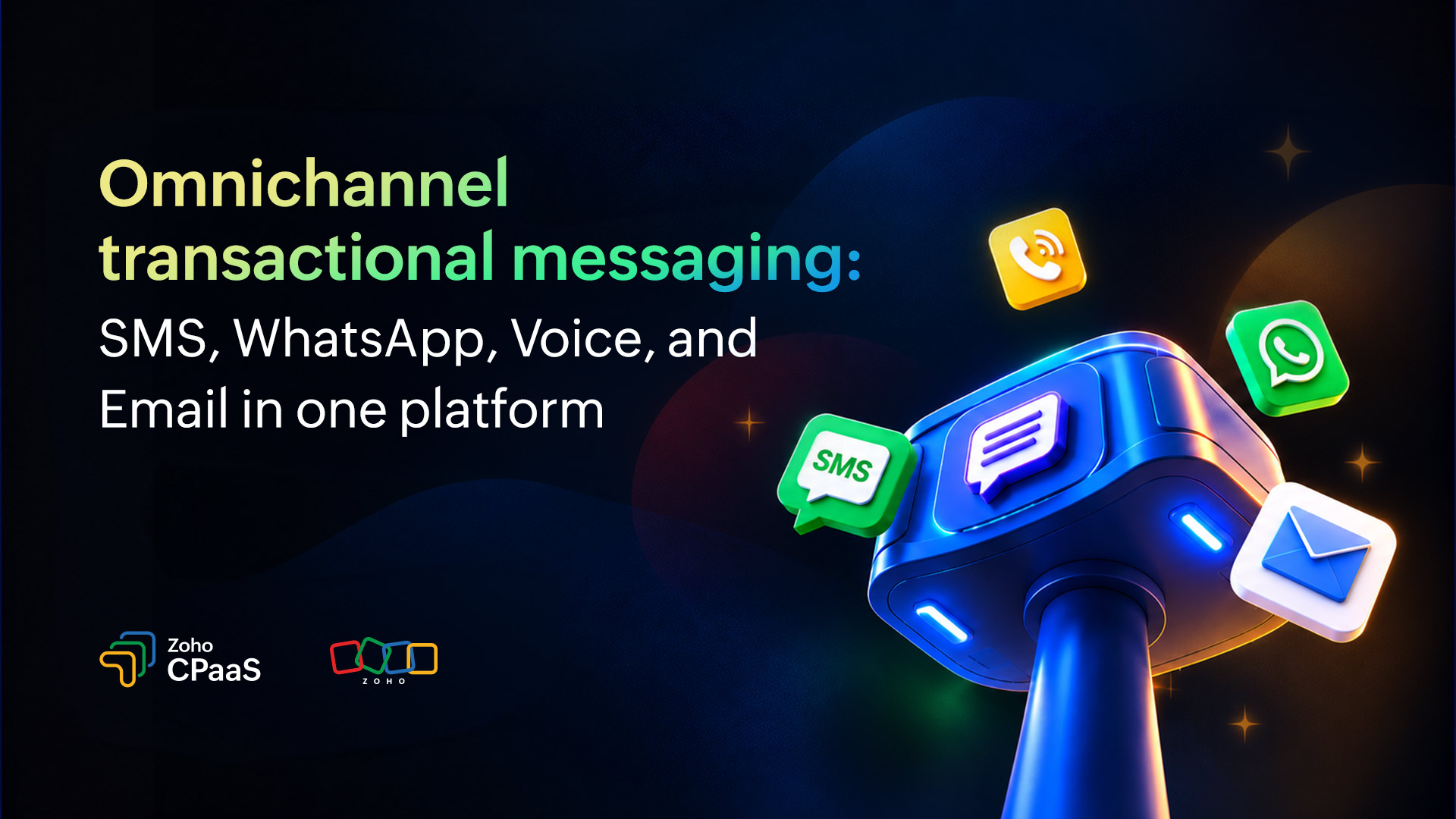
Omnichannel transactional messaging: SMS, WhatsApp, voice, and email in one platform
- Published : September 23, 2026
- Last Updated : October 7, 2026
- 117 Views
- 7 Min Read

Most businesses start with one channel. Email goes out first. It’s familiar, cost-effective, and easy to set up. Then a use case comes along that email can’t handle well: an OTP that needs to arrive in under five seconds, a delivery alert that needs to be read immediately, a reminder for a customer segment that barely opens email. So a second channel gets added. Then a third.
Before long, you’re managing separate vendors, separate APIs, and separate reporting dashboards for each one with no unified view of how your customers are actually receiving and responding to your messages.
Omnichannel transactional messaging is the alternative; using multiple communication channels deliberately, from a single platform, with each channel doing what it’s best at. This article explains how each channel works, how to use them together, and why the platform layer matters more than most teams realize.
Why channel choice matters
Not all communication channels are equal and not all messages are equal, either. The channel you use affects whether a message gets seen, how quickly, and in what context.
A few realities that drive channel strategy:
Average email open rates for transactional messages hover around 40% to 50%. For SMS, read rates are consistently cited above 90%, with most reads happening within three minutes of delivery.
WhatsApp has over three billion active users globally. In markets like India, Brazil, and much of Southeast Asia and the Middle East, it’s the primary messaging interface for many customers, more so than SMS.
Voice is the only channel that doesn’t require a smartphone, an internet connection, or literacy in a particular script. It’s also the most reliable fallback when every other channel fails.
Regulatory requirements vary by channel and geography, like DLT registration for SMS in India, GDPR for email in Europe, and WhatsApp Business API template approval globally.
The implication is that channel choice isn’t a preference but a decision that affects delivery, reach, compliance, and customer experience simultaneously.
What each channel is built for
Email is the correct channel for communication that benefits from detail, formatting, and permanence. Receipts, invoices, onboarding sequences, account summaries, and policy updates all belong in email. They need to be readable later, searchable, and potentially printed or forwarded.
What email isn’t good at is urgency. Notification fatigue and inbox volume mean that time-sensitive messages sent only via email frequently arrive too late or go unread. Email is also subject to spam filtering in ways that SMS and WhatsApp aren’t, which introduces delivery variability that’s hard to diagnose without robust monitoring.
For transactional messaging specifically, email infrastructure matters as much as content. Sending transactional email from shared IP pools, without proper authentication (SPF, DKIM, DMARC), or through platforms not purpose-built for transactional traffic introduces deliverability risk that compounds at scale.
SMS
SMS is the high-reach, low-friction channel. It requires no app, no internet connection, and no prior relationship with your brand beyond a phone number. That makes it reliable in a way no other channel matches. An SMS sent to a valid number will almost always be delivered.
SMS is best used for time-sensitive, short-form message like OTPs, delivery status updates, fraud alerts, appointment reminders, and payment confirmations. The 160-character constraint is a feature as much as a limitation. It forces the message to be actionable without requiring the recipient to do anything except read it.
The compliance layer for SMS is significant and often underestimated. In India, all commercial SMS traffic must be registered under the Distributed Ledger Technology (DLT) framework. Sender IDs, templates, and consent records all need to be in place before a single message can be sent. In the US, the TCPA governs opt-in requirements for marketing SMS. Different rules apply in different markets, and violations carry real penalties. A CPaaS platform with built-in compliance tools handles much of this operationally while doing it manually across carriers is a significant ongoing burden.
WhatsApp occupies a distinct position where it has the reach of SMS in many markets, but supports rich media, conversational flows, and a higher-trust brand presence through verified business profiles.
WhatsApp Business API messages fall into two categories: template messages (pre-approved structured notifications sent outside a 24-hour conversation window) and session messages (free-form replies within an active conversation). For transactional messaging, template messages are the primary format. Order updates, shipping notifications, appointment confirmations, and payment alerts all work well as WhatsApp templates.
The channel’s constraint is the approval process. Every template must be submitted to and approved by Meta before it can be sent, which introduces a lead time that doesn’t exist for email or SMS. This makes WhatsApp better suited for planned, recurring communication types than for ad-hoc or rapidly changing message formats.
Where WhatsApp earns its place in a channel mix is markets with high penetration and high email-ignore rates, use cases that benefit from rich media (product images, PDF attachments, location pins), and customer segments that are more responsive to messaging apps than to email or SMS.
Voice
Voice is the channel of last resort. In a well-designed multi-channel stack, voice plays a specific and important role of reaching customers when every other channel has failed or is unavailable.
Automated voice calls deliver OTPs, fraud alerts, and critical notifications to customers who didn’t receive an SMS, don’t have a smartphone, or are in a low-connectivity environment. Voice is also uniquely effective for audiences with lower digital literacy or for high-stakes alerts where confirmation of receipt matters.
Voice calls have higher delivery acknowledgment than any other channel—a phone rings until it’s answered or goes to voicemail, creating an interrupt that email, SMS, and WhatsApp cannot replicate. That makes it appropriate for time-critical, high-consequence notifications rather than routine transactional traffic.
How multi-channel orchestration works
Using multiple channels isn’t just about adding them to your stack. It’s also about coordinating them intelligently. That coordination is what separates multi-channel messaging from omnichannel messaging.
The logic layer involves three decisions for every communication event.
Channel selection: Which channel should this message go out on first, given the use case, the recipient’s market, and their communication preferences? An OTP in India goes to SMS by default. A shipping update in Brazil may go to WhatsApp first. A detailed invoice goes to email regardless of market.
Fallback sequencing: If the primary channel fails or goes unread within a defined window, what’s the next channel? This is where the orchestration earns its value. A CPaaS platform can automatically trigger a fallback send without your application needing to manage the logic manually.
Timing and frequency rules: When should the message send relative to the triggering event? How long to wait before a fallback? How many attempts before stopping? These rules prevent over-communication and ensure messages arrive at the right moment.
Fallback sequences in practice
Here’s how orchestration plays out across four common transactional scenarios.
OTP delivery
Primary: SMS.
If undelivered within 30 seconds: voice call with automated OTP readout.
This sequence handles the most common OTP failure mode of SMS delivery delay in high-traffic windows, without requiring the user to take any action.
Order confirmation
Primary: Email (full order summary, itemized receipt, returns policy).
Secondary: WhatsApp notification (brief confirmation with order number and tracking link, sent immediately after purchase).
The email serves as the permanent record and the WhatsApp message meets the customer’s immediate need for acknowledgment.
Appointment reminder
Primary: WhatsApp (sent 24 hours before, includes confirmation/reschedule CTA).
Fallback: SMS (sent 2 hours before if WhatsApp is undelivered or goes unopened).
The two-step sequence maximizes the chance of reaching the customer before a no-show becomes likely.
Fraud alert
Primary: SMS and voice simultaneously.
The parallel send without a wait time reflects the urgency. Waiting for SMS to fail before triggering voice costs time that matters in a fraud scenario. Both channels fire at once and the customer responds through whichever arrives first.
The benefits of a single platform
Operational ease
Running four channels across four vendors creates coordination overhead that compounds over time. Each vendor has its own API structure, authentication model, webhook format, and reporting dashboard. When a message fails to deliver, diagnosing whether the issue is in the channel, the carrier, the template, or the integration requires context that’s spread across multiple systems.
A single CPaaS platform eliminates that fragmentation: one API integration covering all channels, one event log for every delivery and engagement event, and one place to configure fallback logic and compliance rules. Troubleshooting that previously required cross-referencing four dashboards becomes a single query.
Unified analytics
When channel performance data lives in separate dashboards, cross-channel optimization is nearly impossible. You can see that email open rates are low, but you can’t easily see whether the customers who didn’t open the email were reached by WhatsApp or SMS instead and whether those channels drove the outcome you were measuring.
When channel data is unified, a different set of questions becomes answerable:
Which channel has the highest delivery rate for OTPs in your primary market?
What percentage of customers who don’t open the email are reached by the WhatsApp fallback?
Which channel drives the fastest response to appointment reminders?
Where are failure rates elevated? Is it a carrier issue, a template issue, or a volume issue?
These questions can’t be answered from single-channel reporting. They require a cross-channel view that only a unified platform provides. The insight compounds over time. The longer you run multi-channel communication through a single platform, the more precisely you can tune channel selection and fallback logic to your actual customer behavior.
Wrapping up
Each channel in a transactional messaging stack has its own infrastructure requirements, compliance obligations, and operational complexity. Building and maintaining all of that separately is viable but the cost is engineering overhead that doesn’t build product value. A CPaaS platform abstracts that layer. The infrastructure, compliance, and carrier relationships are the platform’s responsibility. Your team focuses on the communication experience.
Zoho CPaaS delivers email, SMS, WhatsApp, and Voice through APIs built for transactional messaging at scale. The email layer is built on ZeptoMail’s deliverability infrastructure that’s purpose-built for transactional traffic, with dedicated IP management, authentication tooling, and deliverability monitoring. The same compliance discipline extends to every other channel on the platform.
For businesses that need multi-channel transactional messaging without the overhead of managing it channel by channel, that’s the architecture that makes it workable.